

Remote Sensing and GIS for Land Use …
147
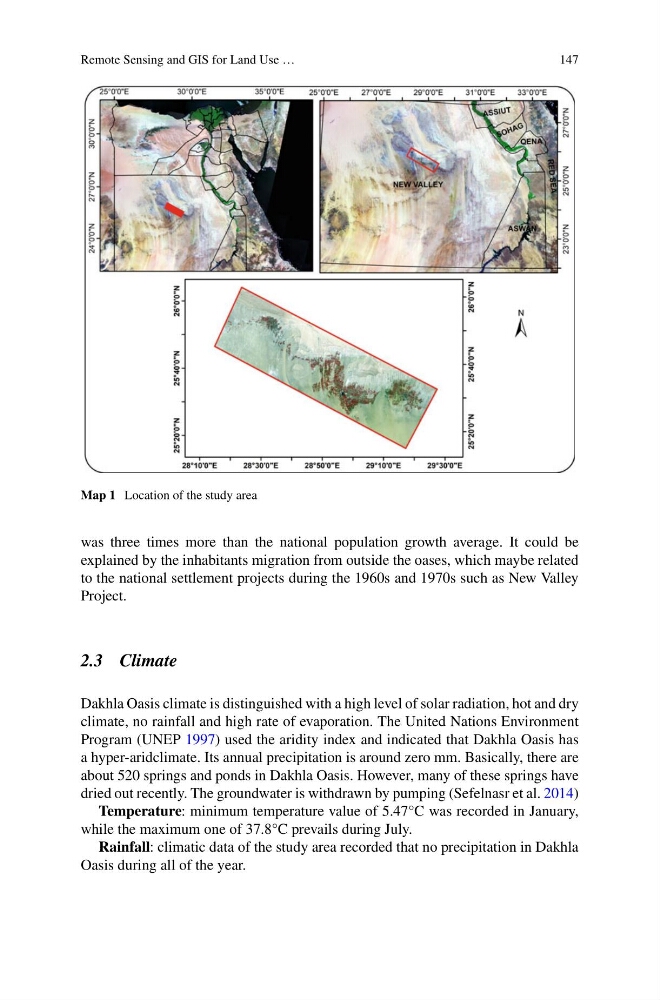
Map 1 Location of the study area
was three times more than the national population growth average. It could be
explained by the inhabitants migration from outside the oases, which maybe related
to the national settlement projects during the 1960s and 1970s such as New Valley
Project.
2.3 Climate
Dakhla Oasis climate is distinguished with a high level of solar radiation, hot and dry
climate, no rainfall and high rate of evaporation. The United Nations Environment
Program (UNEP 1997) used the aridity index and indicated that Dakhla Oasis has
a hyper-aridclimate. Its annual precipitation is around zero mm. Basically, there are
about 520 springs and ponds in Dakhla Oasis. However, many of these springs have
dried out recently. The groundwater is withdrawn by pumping (Sefelnasr et al. 2014)
Temperature: minimum temperature value of 5.47°C was recorded in January,
while the maximum one of 37.8°C prevails during July.
Rainfall: climatic data of the study area recorded that no precipitation in Dakhla
Oasis during all of the year.
147
Map 1 Location of the study area
was three times more than the national population growth average. It could be
explained by the inhabitants migration from outside the oases, which maybe related
to the national settlement projects during the 1960s and 1970s such as New Valley
Project.
2.3 Climate
Dakhla Oasis climate is distinguished with a high level of solar radiation, hot and dry
climate, no rainfall and high rate of evaporation. The United Nations Environment
Program (UNEP 1997) used the aridity index and indicated that Dakhla Oasis has
a hyper-aridclimate. Its annual precipitation is around zero mm. Basically, there are
about 520 springs and ponds in Dakhla Oasis. However, many of these springs have
dried out recently. The groundwater is withdrawn by pumping (Sefelnasr et al. 2014)
Temperature: minimum temperature value of 5.47°C was recorded in January,
while the maximum one of 37.8°C prevails during July.
Rainfall: climatic data of the study area recorded that no precipitation in Dakhla
Oasis during all of the year.