

Aeolian Sand Transport Potential and Its …
113
wind direction
wind direction
windward
face
slip face
Crescentic
Barchanoid
Linear dune
Linear
wind direction
horn
100 m
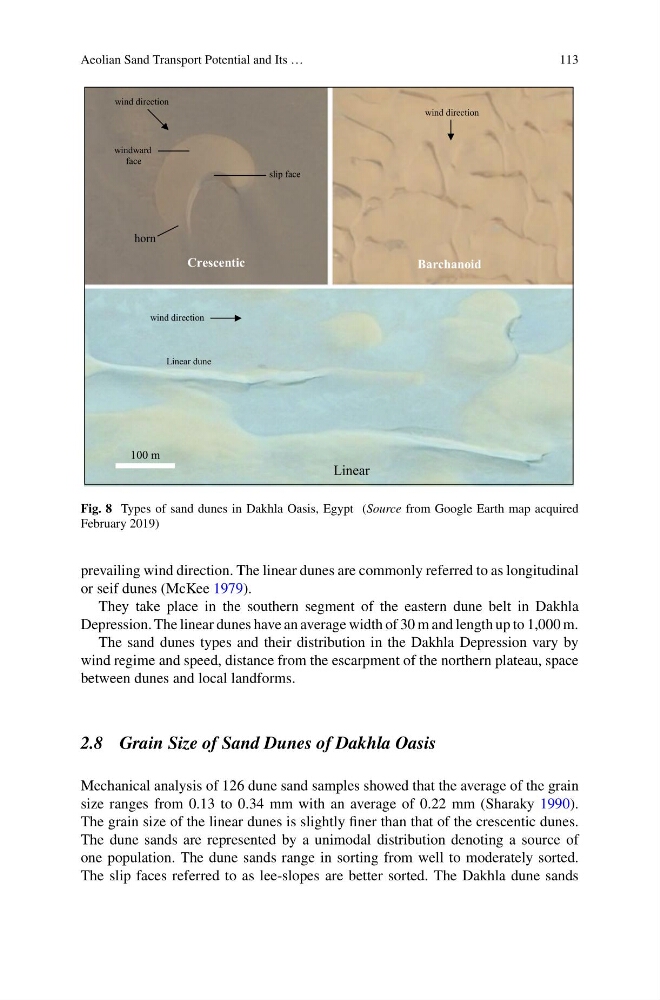
Fig. 8 Types of sand dunes in Dakhla Oasis, Egypt (Source from Google Earth map acquired
February 2019)
prevailing wind direction. The linear dunes are commonly referred to as longitudinal
or seif dunes (McKee 1979).
They take place in the southern segment of the eastern dune belt in Dakhla
Depression. The linear dunes have an average width of 30 m and length up to 1,000 m.
The sand dunes types and their distribution in the Dakhla Depression vary by
wind regime and speed, distance from the escarpment of the northern plateau, space
between dunes and local landforms.
2.8 Grain Size of Sand Dunes of Dakhla Oasis
Mechanical analysis of 126 dune sand samples showed that the average of the grain
size ranges from 0.13 to 0.34 mm with an average of 0.22 mm (Sharaky 1990).
The grain size of the linear dunes is slightly finer than that of the crescentic dunes.
The dune sands are represented by a unimodal distribution denoting a source of
one population. The dune sands range in sorting from well to moderately sorted.
The slip faces referred to as lee-slopes are better sorted. The Dakhla dune sands
113
wind direction
wind direction
windward
face
slip face
Crescentic
Barchanoid
Linear dune
Linear
wind direction
horn
100 m
Fig. 8 Types of sand dunes in Dakhla Oasis, Egypt (Source from Google Earth map acquired
February 2019)
prevailing wind direction. The linear dunes are commonly referred to as longitudinal
or seif dunes (McKee 1979).
They take place in the southern segment of the eastern dune belt in Dakhla
Depression. The linear dunes have an average width of 30 m and length up to 1,000 m.
The sand dunes types and their distribution in the Dakhla Depression vary by
wind regime and speed, distance from the escarpment of the northern plateau, space
between dunes and local landforms.
2.8 Grain Size of Sand Dunes of Dakhla Oasis
Mechanical analysis of 126 dune sand samples showed that the average of the grain
size ranges from 0.13 to 0.34 mm with an average of 0.22 mm (Sharaky 1990).
The grain size of the linear dunes is slightly finer than that of the crescentic dunes.
The dune sands are represented by a unimodal distribution denoting a source of
one population. The dune sands range in sorting from well to moderately sorted.
The slip faces referred to as lee-slopes are better sorted. The Dakhla dune sands