

96
R. Kimura
Threshold for dust outbreak (6.5 m/s)
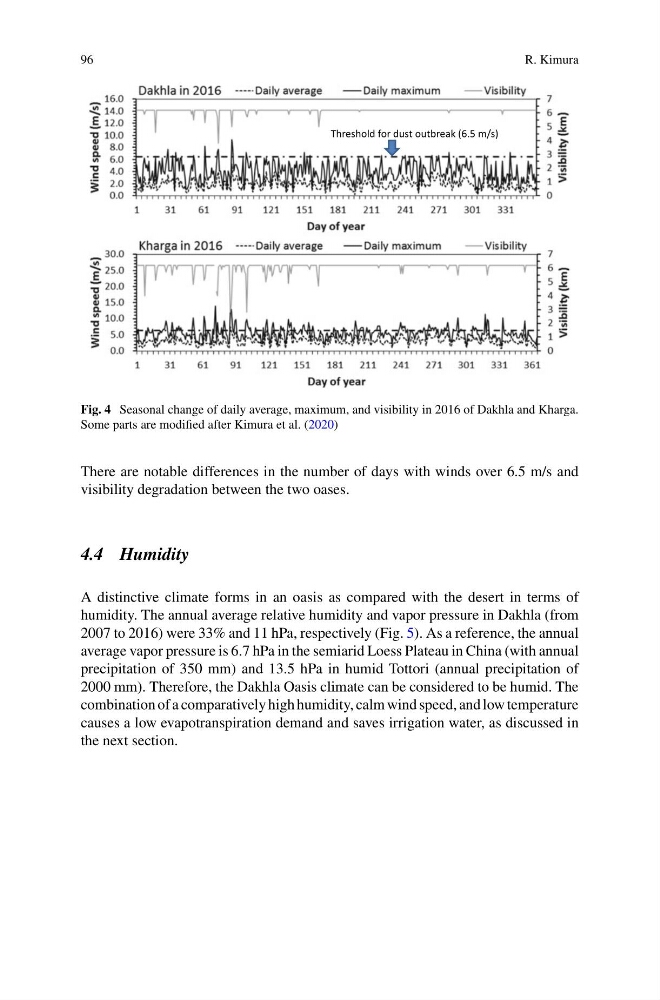
Fig. 4 Seasonal change of daily average, maximum, and visibility in 2016 of Dakhla and Kharga.
Some parts are modified after Kimura et al. (2020)
There are notable differences in the number of days with winds over 6.5 m/s and
visibility degradation between the two oases.
4.4 Humidity
A distinctive climate forms in an oasis as compared with the desert in terms of
humidity. The annual average relative humidity and vapor pressure in Dakhla (from
2007 to 2016) were 33% and 11 hPa, respectively (Fig. 5). As a reference, the annual
average vapor pressure is 6.7 hPa in the semiarid Loess Plateau in China (with annual
precipitation of 350 mm) and 13.5 hPa in humid Tottori (annual precipitation of
2000 mm). Therefore, the Dakhla Oasis climate can be considered to be humid. The
combination of a comparatively high humidity, calm wind speed, and low temperature
causes a low evapotranspiration demand and saves irrigation water, as discussed in
the next section.
R. Kimura
Threshold for dust outbreak (6.5 m/s)
Fig. 4 Seasonal change of daily average, maximum, and visibility in 2016 of Dakhla and Kharga.
Some parts are modified after Kimura et al. (2020)
There are notable differences in the number of days with winds over 6.5 m/s and
visibility degradation between the two oases.
4.4 Humidity
A distinctive climate forms in an oasis as compared with the desert in terms of
humidity. The annual average relative humidity and vapor pressure in Dakhla (from
2007 to 2016) were 33% and 11 hPa, respectively (Fig. 5). As a reference, the annual
average vapor pressure is 6.7 hPa in the semiarid Loess Plateau in China (with annual
precipitation of 350 mm) and 13.5 hPa in humid Tottori (annual precipitation of
2000 mm). Therefore, the Dakhla Oasis climate can be considered to be humid. The
combination of a comparatively high humidity, calm wind speed, and low temperature
causes a low evapotranspiration demand and saves irrigation water, as discussed in
the next section.