

76
S. Mohapatra et al.
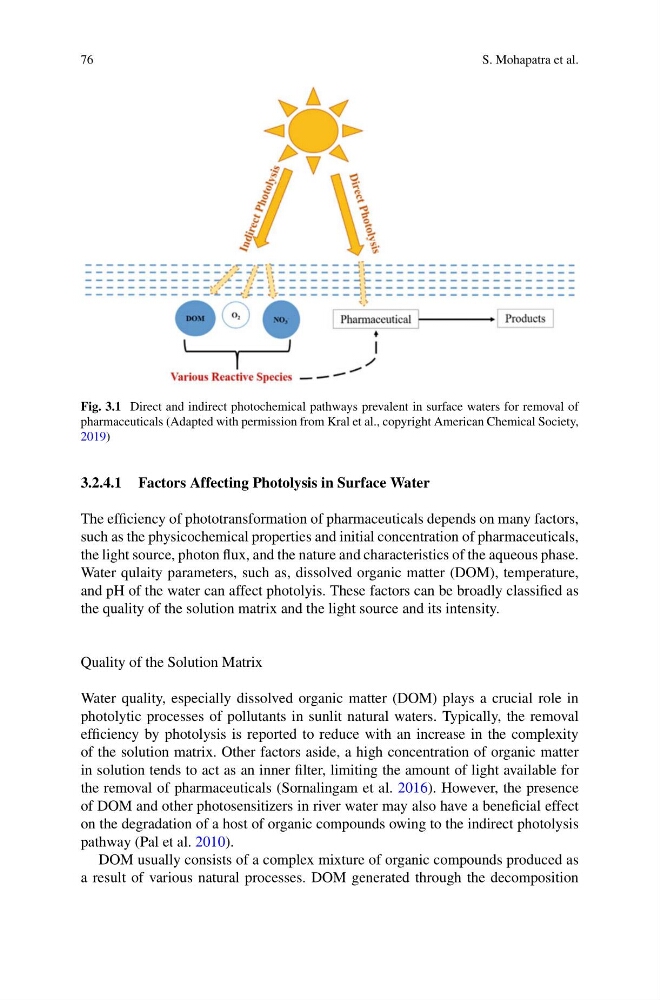
Fig. 3.1 Direct and indirect photochemical pathways prevalent in surface waters for removal of
pharmaceuticals (Adapted with permission from Kral et al., copyright American Chemical Society,
2019)
3.2.4.1 Factors Affecting Photolysis in Surface Water
The efficiency of phototransformation of pharmaceuticals depends on many factors,
such as the physicochemical properties and initial concentration of pharmaceuticals,
the light source, photon flux, and the nature and characteristics of the aqueous phase.
Water qulaity parameters, such as, dissolved organic matter (DOM), temperature,
and pH of the water can affect photolyis. These factors can be broadly classified as
the quality of the solution matrix and the light source and its intensity.
Quality of the Solution Matrix
Water quality, especially dissolved organic matter (DOM) plays a crucial role in
photolytic processes of pollutants in sunlit natural waters. Typically, the removal
efficiency by photolysis is reported to reduce with an increase in the complexity
of the solution matrix. Other factors aside, a high concentration of organic matter
in solution tends to act as an inner filter, limiting the amount of light available for
the removal of pharmaceuticals (Sornalingam et al. 2016). However, the presence
of DOM and other photosensitizers in river water may also have a beneficial effect
on the degradation of a host of organic compounds owing to the indirect photolysis
pathway (Pal et al. 2010).
DOM usually consists of a complex mixture of organic compounds produced as
a result of various natural processes. DOM generated through the decomposition
S. Mohapatra et al.
Fig. 3.1 Direct and indirect photochemical pathways prevalent in surface waters for removal of
pharmaceuticals (Adapted with permission from Kral et al., copyright American Chemical Society,
2019)
3.2.4.1 Factors Affecting Photolysis in Surface Water
The efficiency of phototransformation of pharmaceuticals depends on many factors,
such as the physicochemical properties and initial concentration of pharmaceuticals,
the light source, photon flux, and the nature and characteristics of the aqueous phase.
Water qulaity parameters, such as, dissolved organic matter (DOM), temperature,
and pH of the water can affect photolyis. These factors can be broadly classified as
the quality of the solution matrix and the light source and its intensity.
Quality of the Solution Matrix
Water quality, especially dissolved organic matter (DOM) plays a crucial role in
photolytic processes of pollutants in sunlit natural waters. Typically, the removal
efficiency by photolysis is reported to reduce with an increase in the complexity
of the solution matrix. Other factors aside, a high concentration of organic matter
in solution tends to act as an inner filter, limiting the amount of light available for
the removal of pharmaceuticals (Sornalingam et al. 2016). However, the presence
of DOM and other photosensitizers in river water may also have a beneficial effect
on the degradation of a host of organic compounds owing to the indirect photolysis
pathway (Pal et al. 2010).
DOM usually consists of a complex mixture of organic compounds produced as
a result of various natural processes. DOM generated through the decomposition