

2 Affinity-Based Methods for the Analysis of Emerging …
45
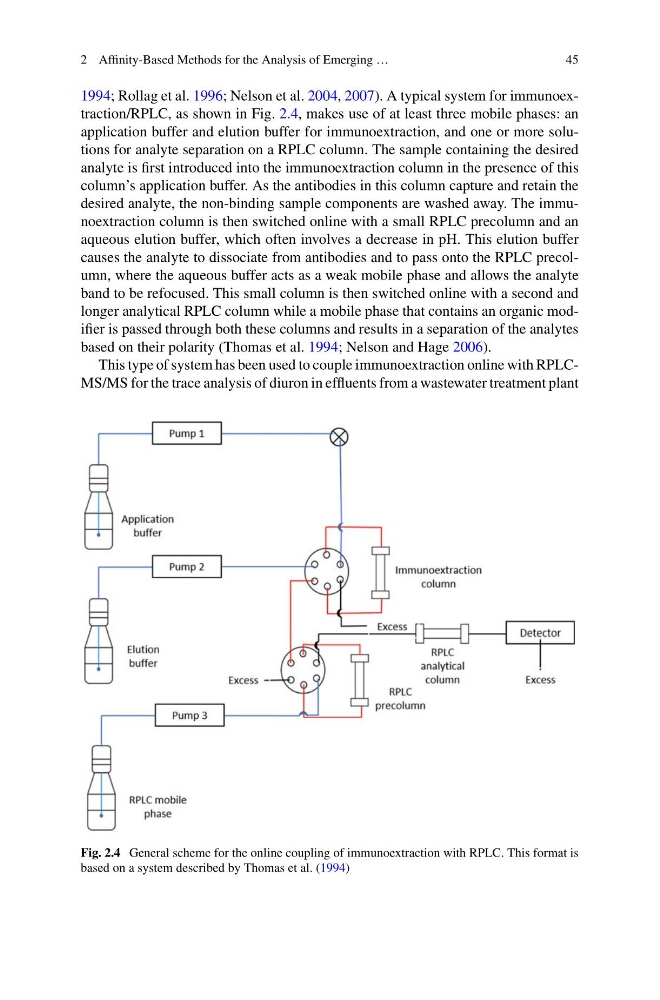
1994; Rollag et al. 1996; Nelson et al. 2004, 2007). A typical system for immunoextraction/RPLC, as shown in Fig. 2.4, makes use of at least three mobile phases: an
application buffer and elution buffer for immunoextraction, and one or more solutions for analyte separation on a RPLC column. The sample containing the desired
analyte is first introduced into the immunoextraction column in the presence of this
column’s application buffer. As the antibodies in this column capture and retain the
desired analyte, the non-binding sample components are washed away. The immunoextraction column is then switched online with a small RPLC precolumn and an
aqueous elution buffer, which often involves a decrease in pH. This elution buffer
causes the analyte to dissociate from antibodies and to pass onto the RPLC precolumn, where the aqueous buffer acts as a weak mobile phase and allows the analyte
band to be refocused. This small column is then switched online with a second and
longer analytical RPLC column while a mobile phase that contains an organic modifier is passed through both these columns and results in a separation of the analytes
based on their polarity (Thomas et al. 1994; Nelson and Hage 2006).
This type of system has been used to couple immunoextraction online with RPLCMS/MS for the trace analysis of diuron in effluents from a wastewater treatment plant
Fig. 2.4 General scheme for the online coupling of immunoextraction with RPLC. This format is
based on a system described by Thomas et al. (1994)
45
1994; Rollag et al. 1996; Nelson et al. 2004, 2007). A typical system for immunoextraction/RPLC, as shown in Fig. 2.4, makes use of at least three mobile phases: an
application buffer and elution buffer for immunoextraction, and one or more solutions for analyte separation on a RPLC column. The sample containing the desired
analyte is first introduced into the immunoextraction column in the presence of this
column’s application buffer. As the antibodies in this column capture and retain the
desired analyte, the non-binding sample components are washed away. The immunoextraction column is then switched online with a small RPLC precolumn and an
aqueous elution buffer, which often involves a decrease in pH. This elution buffer
causes the analyte to dissociate from antibodies and to pass onto the RPLC precolumn, where the aqueous buffer acts as a weak mobile phase and allows the analyte
band to be refocused. This small column is then switched online with a second and
longer analytical RPLC column while a mobile phase that contains an organic modifier is passed through both these columns and results in a separation of the analytes
based on their polarity (Thomas et al. 1994; Nelson and Hage 2006).
This type of system has been used to couple immunoextraction online with RPLCMS/MS for the trace analysis of diuron in effluents from a wastewater treatment plant
Fig. 2.4 General scheme for the online coupling of immunoextraction with RPLC. This format is
based on a system described by Thomas et al. (1994)