

1 Pharmaceuticals, Personal Care Products, and Artificial …
27
from WWTPs, landfills, and septic tanks. In comparison, non-point sources tend to
stretch over a broad geological region, making it difficult even to define, let alone
identify, hotspots, but instead demanding a focus on areas. Examples include agricultural activities involving fertilizer use, manure, sludge, leakage from sewerage
systems, and stormwater runoff. Groundwater recharge sources, such as irrigation
or artificial groundwater recharge practices, can also be sources of contaminants. In
areas without sewage collection or treatment systems, discharge of domestic wastewater to nearby waterways (rivers, streams, canals, ponds, and lakes) is often a major
pathway of wastewater-derived contaminants into groundwater.
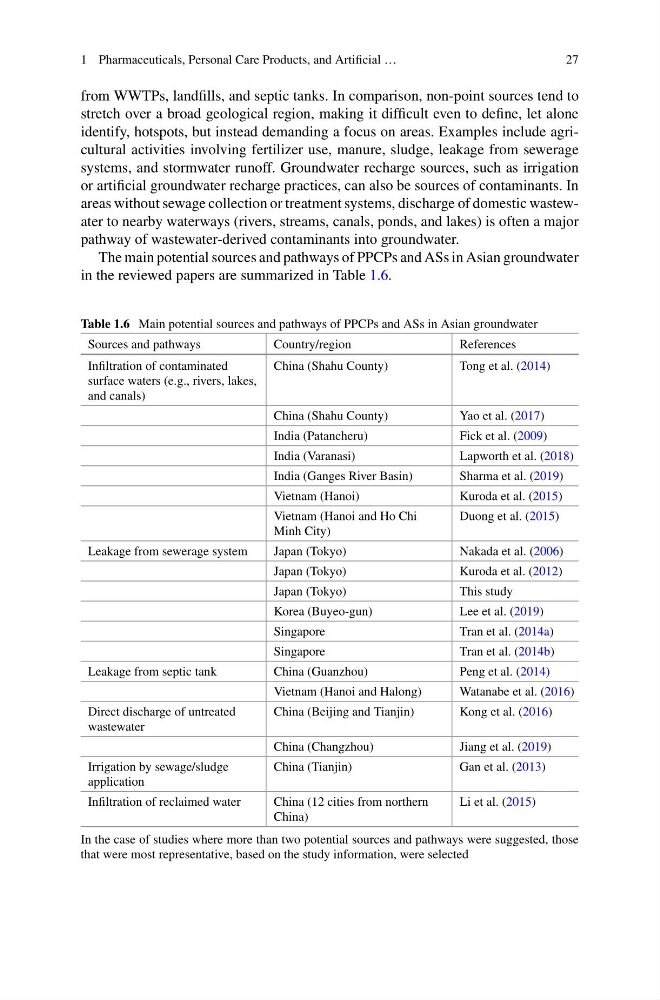
The main potential sources and pathways of PPCPs and ASs in Asian groundwater
in the reviewed papers are summarized in Table 1.6.
Table 1.6 Main potential sources and pathways of PPCPs and ASs in Asian groundwater
Sources and pathways
Country/region
References
Infiltration of contaminated
surface waters (e.g., rivers, lakes,
and canals)
China (Shahu County)
Tong et al. (2014)
China (Shahu County)
Yao et al. (2017)
India (Patancheru)
Fick et al. (2009)
India (Varanasi)
Lapworth et al. (2018)
India (Ganges River Basin)
Sharma et al. (2019)
Vietnam (Hanoi)
Kuroda et al. (2015)
Vietnam (Hanoi and Ho Chi
Minh City)
Duong et al. (2015)
Leakage from sewerage system
Japan (Tokyo)
Nakada et al. (2006)
Japan (Tokyo)
Kuroda et al. (2012)
Japan (Tokyo)
This study
Korea (Buyeo-gun)
Lee et al. (2019)
Singapore
Tran et al. (2014a)
Singapore
Tran et al. (2014b)
Leakage from septic tank
China (Guanzhou)
Peng et al. (2014)
Vietnam (Hanoi and Halong)
Watanabe et al. (2016)
Direct discharge of untreated
wastewater
China (Beijing and Tianjin)
Kong et al. (2016)
China (Changzhou)
Jiang et al. (2019)
Irrigation by sewage/sludge
application
China (Tianjin)
Gan et al. (2013)
Infiltration of reclaimed water
China (12 cities from northern
China)
Li et al. (2015)
In the case of studies where more than two potential sources and pathways were suggested, those
that were most representative, based on the study information, were selected
27
from WWTPs, landfills, and septic tanks. In comparison, non-point sources tend to
stretch over a broad geological region, making it difficult even to define, let alone
identify, hotspots, but instead demanding a focus on areas. Examples include agricultural activities involving fertilizer use, manure, sludge, leakage from sewerage
systems, and stormwater runoff. Groundwater recharge sources, such as irrigation
or artificial groundwater recharge practices, can also be sources of contaminants. In
areas without sewage collection or treatment systems, discharge of domestic wastewater to nearby waterways (rivers, streams, canals, ponds, and lakes) is often a major
pathway of wastewater-derived contaminants into groundwater.
The main potential sources and pathways of PPCPs and ASs in Asian groundwater
in the reviewed papers are summarized in Table 1.6.
Table 1.6 Main potential sources and pathways of PPCPs and ASs in Asian groundwater
Sources and pathways
Country/region
References
Infiltration of contaminated
surface waters (e.g., rivers, lakes,
and canals)
China (Shahu County)
Tong et al. (2014)
China (Shahu County)
Yao et al. (2017)
India (Patancheru)
Fick et al. (2009)
India (Varanasi)
Lapworth et al. (2018)
India (Ganges River Basin)
Sharma et al. (2019)
Vietnam (Hanoi)
Kuroda et al. (2015)
Vietnam (Hanoi and Ho Chi
Minh City)
Duong et al. (2015)
Leakage from sewerage system
Japan (Tokyo)
Nakada et al. (2006)
Japan (Tokyo)
Kuroda et al. (2012)
Japan (Tokyo)
This study
Korea (Buyeo-gun)
Lee et al. (2019)
Singapore
Tran et al. (2014a)
Singapore
Tran et al. (2014b)
Leakage from septic tank
China (Guanzhou)
Peng et al. (2014)
Vietnam (Hanoi and Halong)
Watanabe et al. (2016)
Direct discharge of untreated
wastewater
China (Beijing and Tianjin)
Kong et al. (2016)
China (Changzhou)
Jiang et al. (2019)
Irrigation by sewage/sludge
application
China (Tianjin)
Gan et al. (2013)
Infiltration of reclaimed water
China (12 cities from northern
China)
Li et al. (2015)
In the case of studies where more than two potential sources and pathways were suggested, those
that were most representative, based on the study information, were selected