

406
K. Dhangar and M. Kumar
level. The concern regarding PFOS started to rise in the 2000s, when the renowned
PFC manufacturer, 3M Company, USA, decided to phase out the production of PFOS
related products. Since then, several research works and review papers started to be
documented regarding the occurrence of PFOS in different environmental media such
as surface water, wastewater, sludge/biosolids, groundwater, human and other biota.
Some review papers summarized the fate and transport of PFOS in WWTPs, surface
water and groundwater (Xiao et al. 2015; Arvaniti and Stasinakis 2015; Prevedouros
et al. 2006). Limited studies are available reviewing occurrence and effect of PFOS
on biota (Giesy and Kannan 2001). However, most of the review literature have been
associated with particular media of occurrence or the domain of PFOS.
Based on the above, the main objective of this study is to review and summarize the
currently available literature regarding the worldwide occurrence, fate and transport
of PFOS in different environmental media. This study also discusses the removal
technologies available for remediation of PFOS. The literature gaps are identified,
and future directions are suggested accordingly.
18.2 PFOS and Its Characteristics
PFOS is one of the perfluorinated surfactant anions. Its chemical formula is
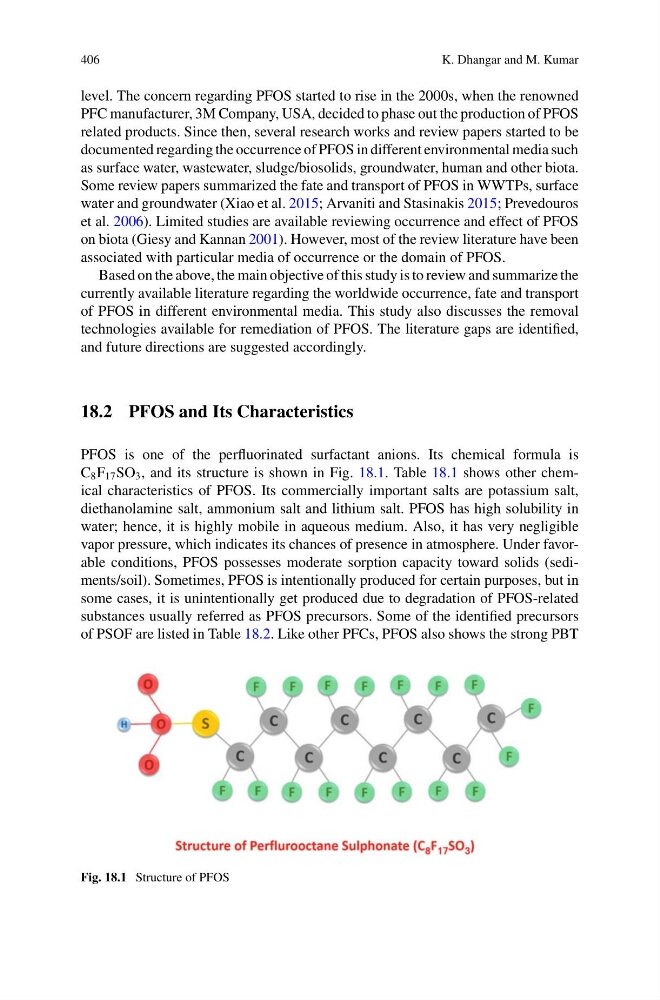
C 8 F 17 SO 3 , and its structure is shown in Fig. 18.1. Table 18.1 shows other chemical characteristics of PFOS. Its commercially important salts are potassium salt,
diethanolamine salt, ammonium salt and lithium salt. PFOS has high solubility in
water; hence, it is highly mobile in aqueous medium. Also, it has very negligible
vapor pressure, which indicates its chances of presence in atmosphere. Under favorable conditions, PFOS possesses moderate sorption capacity toward solids (sediments/soil). Sometimes, PFOS is intentionally produced for certain purposes, but in
some cases, it is unintentionally get produced due to degradation of PFOS-related
substances usually referred as PFOS precursors. Some of the identified precursors
of PSOF are listed in Table 18.2. Like other PFCs, PFOS also shows the strong PBT
Fig. 18.1 Structure of PFOS
K. Dhangar and M. Kumar
level. The concern regarding PFOS started to rise in the 2000s, when the renowned
PFC manufacturer, 3M Company, USA, decided to phase out the production of PFOS
related products. Since then, several research works and review papers started to be
documented regarding the occurrence of PFOS in different environmental media such
as surface water, wastewater, sludge/biosolids, groundwater, human and other biota.
Some review papers summarized the fate and transport of PFOS in WWTPs, surface
water and groundwater (Xiao et al. 2015; Arvaniti and Stasinakis 2015; Prevedouros
et al. 2006). Limited studies are available reviewing occurrence and effect of PFOS
on biota (Giesy and Kannan 2001). However, most of the review literature have been
associated with particular media of occurrence or the domain of PFOS.
Based on the above, the main objective of this study is to review and summarize the
currently available literature regarding the worldwide occurrence, fate and transport
of PFOS in different environmental media. This study also discusses the removal
technologies available for remediation of PFOS. The literature gaps are identified,
and future directions are suggested accordingly.
18.2 PFOS and Its Characteristics
PFOS is one of the perfluorinated surfactant anions. Its chemical formula is
C 8 F 17 SO 3 , and its structure is shown in Fig. 18.1. Table 18.1 shows other chemical characteristics of PFOS. Its commercially important salts are potassium salt,
diethanolamine salt, ammonium salt and lithium salt. PFOS has high solubility in
water; hence, it is highly mobile in aqueous medium. Also, it has very negligible
vapor pressure, which indicates its chances of presence in atmosphere. Under favorable conditions, PFOS possesses moderate sorption capacity toward solids (sediments/soil). Sometimes, PFOS is intentionally produced for certain purposes, but in
some cases, it is unintentionally get produced due to degradation of PFOS-related
substances usually referred as PFOS precursors. Some of the identified precursors
of PSOF are listed in Table 18.2. Like other PFCs, PFOS also shows the strong PBT
Fig. 18.1 Structure of PFOS