

394
A. Srivastava
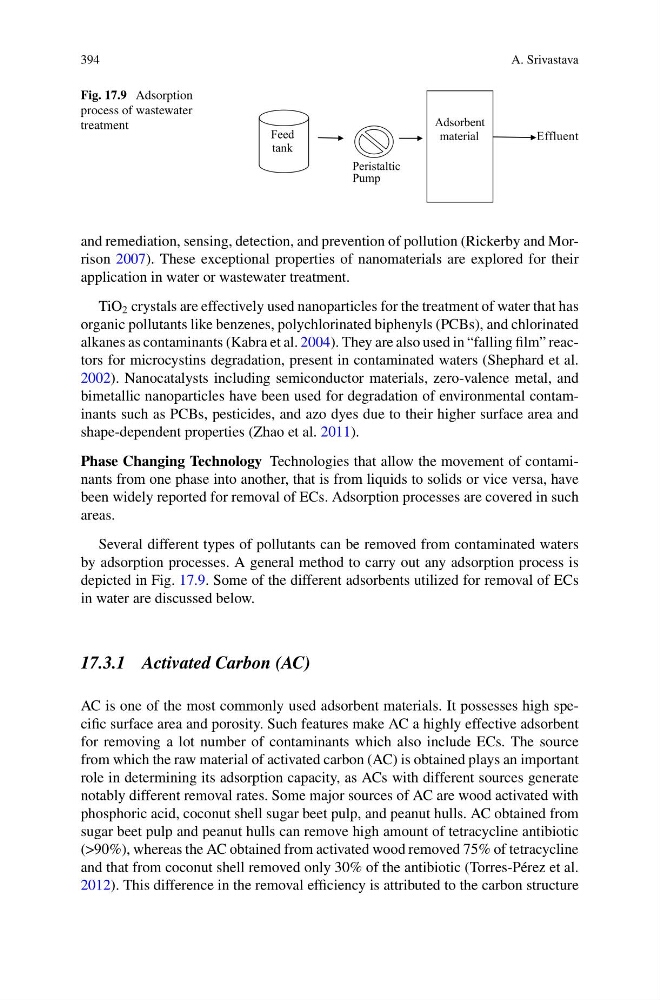
Fig. 17.9 Adsorption
process of wastewater
treatment
Effluent
Peristaltic
Pump
Feed
tank
Adsorbent
material
and remediation, sensing, detection, and prevention of pollution (Rickerby and Morrison 2007). These exceptional properties of nanomaterials are explored for their
application in water or wastewater treatment.
TiO 2 crystals are effectively used nanoparticles for the treatment of water that has
organic pollutants like benzenes, polychlorinated biphenyls (PCBs), and chlorinated
alkanes as contaminants (Kabra et al. 2004). They are also used in “falling film” reactors for microcystins degradation, present in contaminated waters (Shephard et al.
2002). Nanocatalysts including semiconductor materials, zero-valence metal, and
bimetallic nanoparticles have been used for degradation of environmental contaminants such as PCBs, pesticides, and azo dyes due to their higher surface area and
shape-dependent properties (Zhao et al. 2011).
Phase Changing Technology Technologies that allow the movement of contaminants from one phase into another, that is from liquids to solids or vice versa, have
been widely reported for removal of ECs. Adsorption processes are covered in such
areas.
Several different types of pollutants can be removed from contaminated waters
by adsorption processes. A general method to carry out any adsorption process is
depicted in Fig. 17.9. Some of the different adsorbents utilized for removal of ECs
in water are discussed below.
17.3.1 Activated Carbon (AC)
AC is one of the most commonly used adsorbent materials. It possesses high specific surface area and porosity. Such features make AC a highly effective adsorbent
for removing a lot number of contaminants which also include ECs. The source
from which the raw material of activated carbon (AC) is obtained plays an important
role in determining its adsorption capacity, as ACs with different sources generate
notably different removal rates. Some major sources of AC are wood activated with
phosphoric acid, coconut shell sugar beet pulp, and peanut hulls. AC obtained from
sugar beet pulp and peanut hulls can remove high amount of tetracycline antibiotic
(>90%), whereas the AC obtained from activated wood removed 75% of tetracycline
and that from coconut shell removed only 30% of the antibiotic (Torres-Pérez et al.
2012). This difference in the removal efficiency is attributed to the carbon structure
A. Srivastava
Fig. 17.9 Adsorption
process of wastewater
treatment
Effluent
Peristaltic
Pump
Feed
tank
Adsorbent
material
and remediation, sensing, detection, and prevention of pollution (Rickerby and Morrison 2007). These exceptional properties of nanomaterials are explored for their
application in water or wastewater treatment.
TiO 2 crystals are effectively used nanoparticles for the treatment of water that has
organic pollutants like benzenes, polychlorinated biphenyls (PCBs), and chlorinated
alkanes as contaminants (Kabra et al. 2004). They are also used in “falling film” reactors for microcystins degradation, present in contaminated waters (Shephard et al.
2002). Nanocatalysts including semiconductor materials, zero-valence metal, and
bimetallic nanoparticles have been used for degradation of environmental contaminants such as PCBs, pesticides, and azo dyes due to their higher surface area and
shape-dependent properties (Zhao et al. 2011).
Phase Changing Technology Technologies that allow the movement of contaminants from one phase into another, that is from liquids to solids or vice versa, have
been widely reported for removal of ECs. Adsorption processes are covered in such
areas.
Several different types of pollutants can be removed from contaminated waters
by adsorption processes. A general method to carry out any adsorption process is
depicted in Fig. 17.9. Some of the different adsorbents utilized for removal of ECs
in water are discussed below.
17.3.1 Activated Carbon (AC)
AC is one of the most commonly used adsorbent materials. It possesses high specific surface area and porosity. Such features make AC a highly effective adsorbent
for removing a lot number of contaminants which also include ECs. The source
from which the raw material of activated carbon (AC) is obtained plays an important
role in determining its adsorption capacity, as ACs with different sources generate
notably different removal rates. Some major sources of AC are wood activated with
phosphoric acid, coconut shell sugar beet pulp, and peanut hulls. AC obtained from
sugar beet pulp and peanut hulls can remove high amount of tetracycline antibiotic
(>90%), whereas the AC obtained from activated wood removed 75% of tetracycline
and that from coconut shell removed only 30% of the antibiotic (Torres-Pérez et al.
2012). This difference in the removal efficiency is attributed to the carbon structure