

350
N. Pradhan et al.
Pesticides and Fertilizers
Manure
Well
Water Table
Septic
System
Groundwater Flow
Municipal
Water Supply
Sand and Gravel Aquifer
Airborn Sulphur and Nitrogen
Compounds
Acid Rain
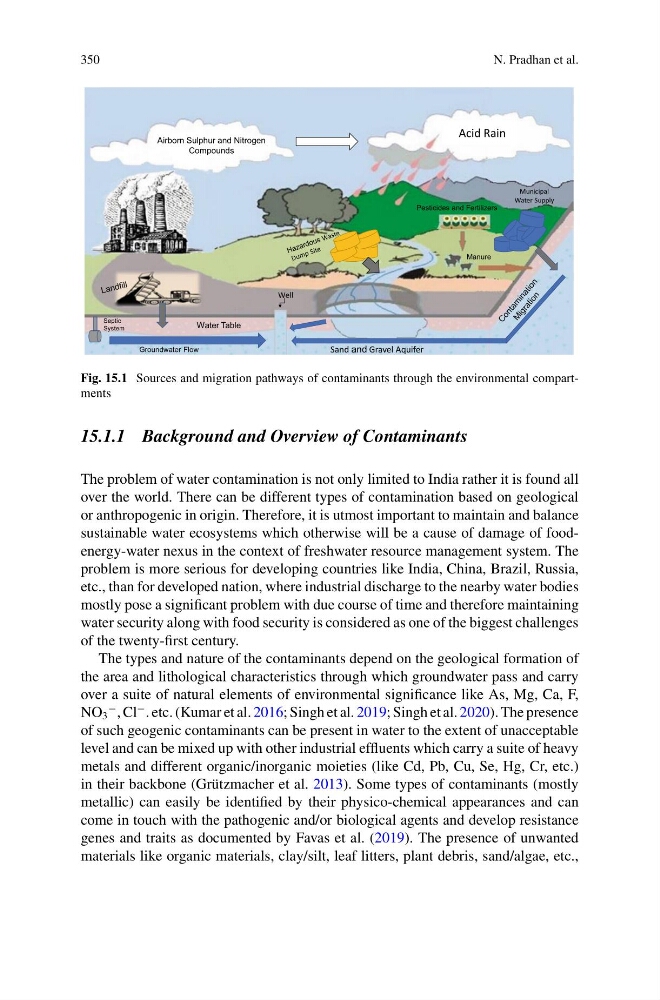
Fig. 15.1 Sources and migration pathways of contaminants through the environmental compartments
15.1.1 Background and Overview of Contaminants
The problem of water contamination is not only limited to India rather it is found all
over the world. There can be different types of contamination based on geological
or anthropogenic in origin. Therefore, it is utmost important to maintain and balance
sustainable water ecosystems which otherwise will be a cause of damage of foodenergy-water nexus in the context of freshwater resource management system. The
problem is more serious for developing countries like India, China, Brazil, Russia,
etc., than for developed nation, where industrial discharge to the nearby water bodies
mostly pose a significant problem with due course of time and therefore maintaining
water security along with food security is considered as one of the biggest challenges
of the twenty-first century.
The types and nature of the contaminants depend on the geological formation of
the area and lithological characteristics through which groundwater pass and carry
over a suite of natural elements of environmental significance like As, Mg, Ca, F,
NO 3
− , Cl
− . etc. (Kumar et al. 2016; Singh et al. 2019; Singh et al. 2020). The presence
of such geogenic contaminants can be present in water to the extent of unacceptable
level and can be mixed up with other industrial effluents which carry a suite of heavy
metals and different organic/inorganic moieties (like Cd, Pb, Cu, Se, Hg, Cr, etc.)
in their backbone (Grützmacher et al. 2013). Some types of contaminants (mostly
metallic) can easily be identified by their physico-chemical appearances and can
come in touch with the pathogenic and/or biological agents and develop resistance
genes and traits as documented by Favas et al. (2019). The presence of unwanted
materials like organic materials, clay/silt, leaf litters, plant debris, sand/algae, etc.,
N. Pradhan et al.
Pesticides and Fertilizers
Manure
Well
Water Table
Septic
System
Groundwater Flow
Municipal
Water Supply
Sand and Gravel Aquifer
Airborn Sulphur and Nitrogen
Compounds
Acid Rain
Fig. 15.1 Sources and migration pathways of contaminants through the environmental compartments
15.1.1 Background and Overview of Contaminants
The problem of water contamination is not only limited to India rather it is found all
over the world. There can be different types of contamination based on geological
or anthropogenic in origin. Therefore, it is utmost important to maintain and balance
sustainable water ecosystems which otherwise will be a cause of damage of foodenergy-water nexus in the context of freshwater resource management system. The
problem is more serious for developing countries like India, China, Brazil, Russia,
etc., than for developed nation, where industrial discharge to the nearby water bodies
mostly pose a significant problem with due course of time and therefore maintaining
water security along with food security is considered as one of the biggest challenges
of the twenty-first century.
The types and nature of the contaminants depend on the geological formation of
the area and lithological characteristics through which groundwater pass and carry
over a suite of natural elements of environmental significance like As, Mg, Ca, F,
NO 3
− , Cl
− . etc. (Kumar et al. 2016; Singh et al. 2019; Singh et al. 2020). The presence
of such geogenic contaminants can be present in water to the extent of unacceptable
level and can be mixed up with other industrial effluents which carry a suite of heavy
metals and different organic/inorganic moieties (like Cd, Pb, Cu, Se, Hg, Cr, etc.)
in their backbone (Grützmacher et al. 2013). Some types of contaminants (mostly
metallic) can easily be identified by their physico-chemical appearances and can
come in touch with the pathogenic and/or biological agents and develop resistance
genes and traits as documented by Favas et al. (2019). The presence of unwanted
materials like organic materials, clay/silt, leaf litters, plant debris, sand/algae, etc.,