

316
C. Bhagat et al.
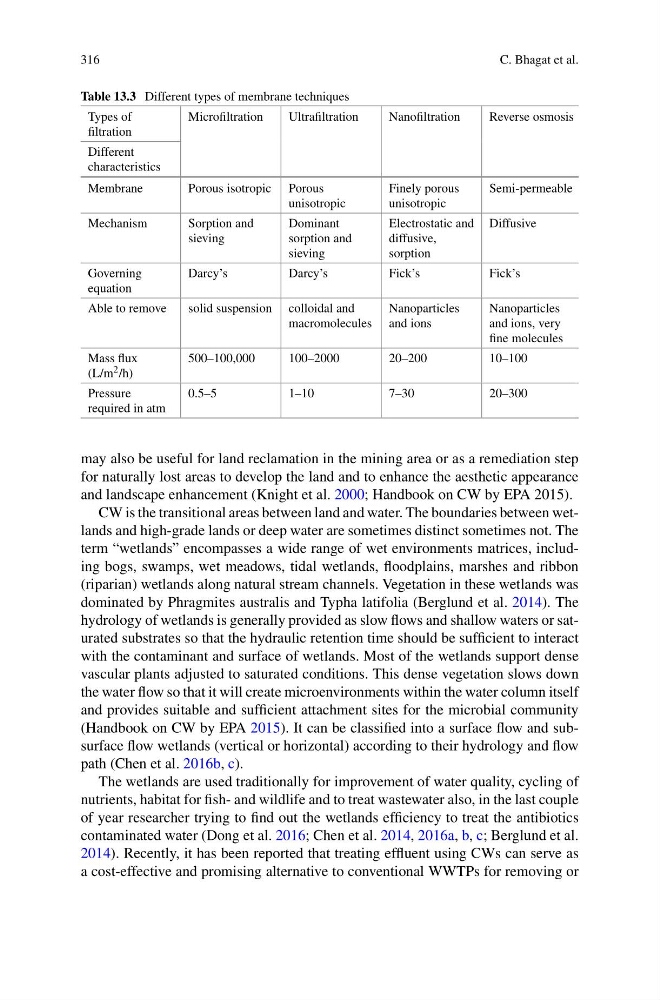
Table 13.3 Different types of membrane techniques
Types of
filtration
Microfiltration
Ultrafiltration
Nanofiltration
Reverse osmosis
Different
characteristics
Membrane
Porous isotropic Porous
unisotropic
Finely porous
unisotropic
Semi-permeable
Mechanism
Sorption and
sieving
Dominant
sorption and
sieving
Electrostatic and
diffusive,
sorption
Diffusive
Governing
equation
Darcy’s
Darcy’s
Fick’s
Fick’s
Able to remove
solid suspension colloidal and
macromolecules
Nanoparticles
and ions
Nanoparticles
and ions, very
fine molecules
Mass flux
(L/m 2 /h)
500–100,000
100–2000
20–200
10–100
Pressure
required in atm
0.5–5
1–10
7–30
20–300
may also be useful for land reclamation in the mining area or as a remediation step
for naturally lost areas to develop the land and to enhance the aesthetic appearance
and landscape enhancement (Knight et al. 2000; Handbook on CW by EPA 2015).
CW is the transitional areas between land and water. The boundaries between wetlands and high-grade lands or deep water are sometimes distinct sometimes not. The
term “wetlands” encompasses a wide range of wet environments matrices, including bogs, swamps, wet meadows, tidal wetlands, floodplains, marshes and ribbon
(riparian) wetlands along natural stream channels. Vegetation in these wetlands was
dominated by Phragmites australis and Typha latifolia (Berglund et al. 2014). The
hydrology of wetlands is generally provided as slow flows and shallow waters or saturated substrates so that the hydraulic retention time should be sufficient to interact
with the contaminant and surface of wetlands. Most of the wetlands support dense
vascular plants adjusted to saturated conditions. This dense vegetation slows down
the water flow so that it will create microenvironments within the water column itself
and provides suitable and sufficient attachment sites for the microbial community
(Handbook on CW by EPA 2015). It can be classified into a surface flow and subsurface flow wetlands (vertical or horizontal) according to their hydrology and flow
path (Chen et al. 2016b, c).
The wetlands are used traditionally for improvement of water quality, cycling of
nutrients, habitat for fish- and wildlife and to treat wastewater also, in the last couple
of year researcher trying to find out the wetlands efficiency to treat the antibiotics
contaminated water (Dong et al. 2016; Chen et al. 2014, 2016a, b, c; Berglund et al.
2014). Recently, it has been reported that treating effluent using CWs can serve as
a cost-effective and promising alternative to conventional WWTPs for removing or
C. Bhagat et al.
Table 13.3 Different types of membrane techniques
Types of
filtration
Microfiltration
Ultrafiltration
Nanofiltration
Reverse osmosis
Different
characteristics
Membrane
Porous isotropic Porous
unisotropic
Finely porous
unisotropic
Semi-permeable
Mechanism
Sorption and
sieving
Dominant
sorption and
sieving
Electrostatic and
diffusive,
sorption
Diffusive
Governing
equation
Darcy’s
Darcy’s
Fick’s
Fick’s
Able to remove
solid suspension colloidal and
macromolecules
Nanoparticles
and ions
Nanoparticles
and ions, very
fine molecules
Mass flux
(L/m 2 /h)
500–100,000
100–2000
20–200
10–100
Pressure
required in atm
0.5–5
1–10
7–30
20–300
may also be useful for land reclamation in the mining area or as a remediation step
for naturally lost areas to develop the land and to enhance the aesthetic appearance
and landscape enhancement (Knight et al. 2000; Handbook on CW by EPA 2015).
CW is the transitional areas between land and water. The boundaries between wetlands and high-grade lands or deep water are sometimes distinct sometimes not. The
term “wetlands” encompasses a wide range of wet environments matrices, including bogs, swamps, wet meadows, tidal wetlands, floodplains, marshes and ribbon
(riparian) wetlands along natural stream channels. Vegetation in these wetlands was
dominated by Phragmites australis and Typha latifolia (Berglund et al. 2014). The
hydrology of wetlands is generally provided as slow flows and shallow waters or saturated substrates so that the hydraulic retention time should be sufficient to interact
with the contaminant and surface of wetlands. Most of the wetlands support dense
vascular plants adjusted to saturated conditions. This dense vegetation slows down
the water flow so that it will create microenvironments within the water column itself
and provides suitable and sufficient attachment sites for the microbial community
(Handbook on CW by EPA 2015). It can be classified into a surface flow and subsurface flow wetlands (vertical or horizontal) according to their hydrology and flow
path (Chen et al. 2016b, c).
The wetlands are used traditionally for improvement of water quality, cycling of
nutrients, habitat for fish- and wildlife and to treat wastewater also, in the last couple
of year researcher trying to find out the wetlands efficiency to treat the antibiotics
contaminated water (Dong et al. 2016; Chen et al. 2014, 2016a, b, c; Berglund et al.
2014). Recently, it has been reported that treating effluent using CWs can serve as
a cost-effective and promising alternative to conventional WWTPs for removing or