

290
B. Gunawardana et al.
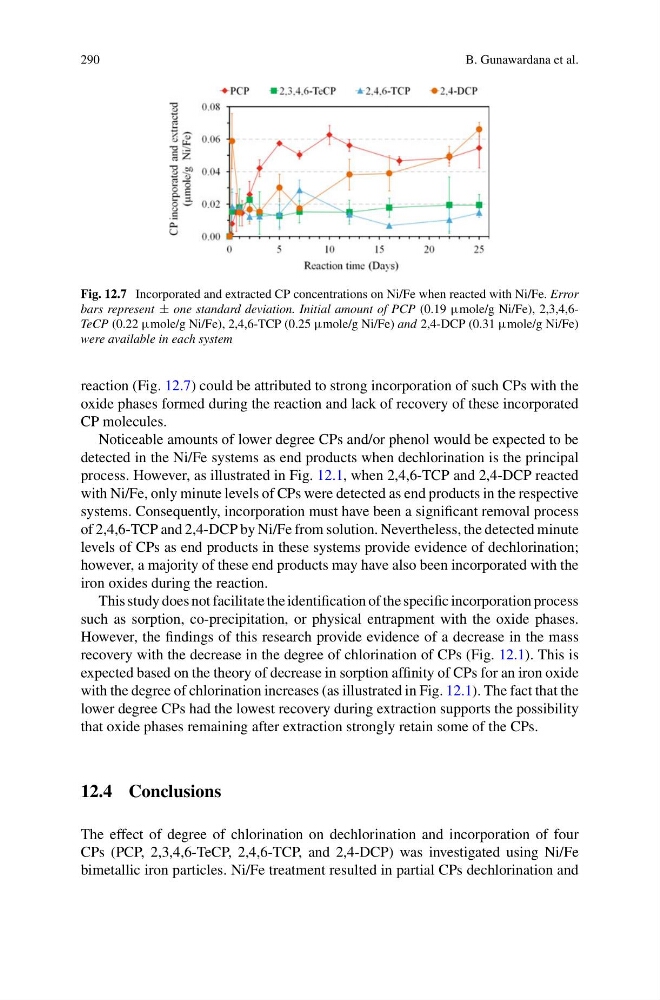
Fig. 12.7 Incorporated and extracted CP concentrations on Ni/Fe when reacted with Ni/Fe. Error
bars represent ± one standard deviation. Initial amount of PCP (0.19 µmole/g Ni/Fe), 2,3,4,6TeCP (0.22 µmole/g Ni/Fe), 2,4,6-TCP (0.25 µmole/g Ni/Fe) and 2,4-DCP (0.31 µmole/g Ni/Fe)
were available in each system
reaction (Fig. 12.7) could be attributed to strong incorporation of such CPs with the
oxide phases formed during the reaction and lack of recovery of these incorporated
CP molecules.
Noticeable amounts of lower degree CPs and/or phenol would be expected to be
detected in the Ni/Fe systems as end products when dechlorination is the principal
process. However, as illustrated in Fig. 12.1, when 2,4,6-TCP and 2,4-DCP reacted
with Ni/Fe, only minute levels of CPs were detected as end products in the respective
systems. Consequently, incorporation must have been a significant removal process
of 2,4,6-TCP and 2,4-DCP by Ni/Fe from solution. Nevertheless, the detected minute
levels of CPs as end products in these systems provide evidence of dechlorination;
however, a majority of these end products may have also been incorporated with the
iron oxides during the reaction.
This study does not facilitate the identification of the specific incorporation process
such as sorption, co-precipitation, or physical entrapment with the oxide phases.
However, the findings of this research provide evidence of a decrease in the mass
recovery with the decrease in the degree of chlorination of CPs (Fig. 12.1). This is
expected based on the theory of decrease in sorption affinity of CPs for an iron oxide
with the degree of chlorination increases (as illustrated in Fig. 12.1). The fact that the
lower degree CPs had the lowest recovery during extraction supports the possibility
that oxide phases remaining after extraction strongly retain some of the CPs.
12.4 Conclusions
The effect of degree of chlorination on dechlorination and incorporation of four
CPs (PCP, 2,3,4,6-TeCP, 2,4,6-TCP, and 2,4-DCP) was investigated using Ni/Fe
bimetallic iron particles. Ni/Fe treatment resulted in partial CPs dechlorination and
B. Gunawardana et al.
Fig. 12.7 Incorporated and extracted CP concentrations on Ni/Fe when reacted with Ni/Fe. Error
bars represent ± one standard deviation. Initial amount of PCP (0.19 µmole/g Ni/Fe), 2,3,4,6TeCP (0.22 µmole/g Ni/Fe), 2,4,6-TCP (0.25 µmole/g Ni/Fe) and 2,4-DCP (0.31 µmole/g Ni/Fe)
were available in each system
reaction (Fig. 12.7) could be attributed to strong incorporation of such CPs with the
oxide phases formed during the reaction and lack of recovery of these incorporated
CP molecules.
Noticeable amounts of lower degree CPs and/or phenol would be expected to be
detected in the Ni/Fe systems as end products when dechlorination is the principal
process. However, as illustrated in Fig. 12.1, when 2,4,6-TCP and 2,4-DCP reacted
with Ni/Fe, only minute levels of CPs were detected as end products in the respective
systems. Consequently, incorporation must have been a significant removal process
of 2,4,6-TCP and 2,4-DCP by Ni/Fe from solution. Nevertheless, the detected minute
levels of CPs as end products in these systems provide evidence of dechlorination;
however, a majority of these end products may have also been incorporated with the
iron oxides during the reaction.
This study does not facilitate the identification of the specific incorporation process
such as sorption, co-precipitation, or physical entrapment with the oxide phases.
However, the findings of this research provide evidence of a decrease in the mass
recovery with the decrease in the degree of chlorination of CPs (Fig. 12.1). This is
expected based on the theory of decrease in sorption affinity of CPs for an iron oxide
with the degree of chlorination increases (as illustrated in Fig. 12.1). The fact that the
lower degree CPs had the lowest recovery during extraction supports the possibility
that oxide phases remaining after extraction strongly retain some of the CPs.
12.4 Conclusions
The effect of degree of chlorination on dechlorination and incorporation of four
CPs (PCP, 2,3,4,6-TeCP, 2,4,6-TCP, and 2,4-DCP) was investigated using Ni/Fe
bimetallic iron particles. Ni/Fe treatment resulted in partial CPs dechlorination and