

9 An Insight into Microbial Remediation of Hexavalent Chromium …
215
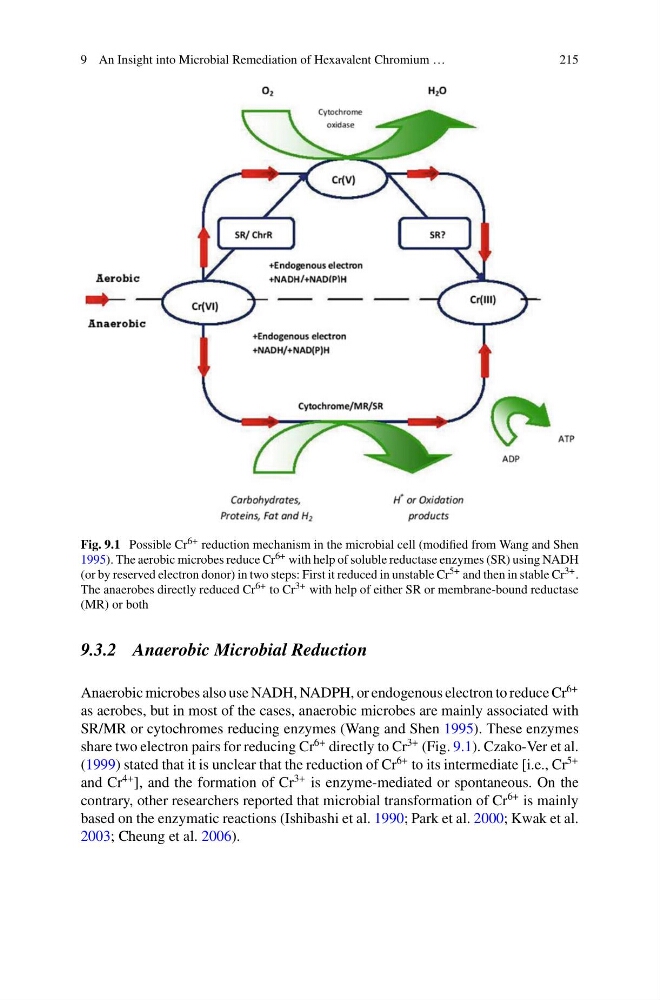
Fig. 9.1 Possible Cr 6+ reduction mechanism in the microbial cell (modified from Wang and Shen
1995). The aerobic microbes reduce Cr 6+ with help of soluble reductase enzymes (SR) using NADH
(or by reserved electron donor) in two steps: First it reduced in unstable Cr 5+ and then in stable Cr 3+ .
The anaerobes directly reduced Cr 6+ to Cr 3+ with help of either SR or membrane-bound reductase
(MR) or both
9.3.2 Anaerobic Microbial Reduction
Anaerobic microbes also use NADH, NADPH, or endogenous electron to reduce Cr
6+
as aerobes, but in most of the cases, anaerobic microbes are mainly associated with
SR/MR or cytochromes reducing enzymes (Wang and Shen 1995). These enzymes
share two electron pairs for reducing Cr
6+ directly to Cr
3+ (Fig. 9.1). Czako-Ver et al.
(1999) stated that it is unclear that the reduction of Cr
6+ to its intermediate [i.e., Cr
5+
and Cr
4+ ], and the formation of Cr
3+ is enzyme-mediated or spontaneous. On the
contrary, other researchers reported that microbial transformation of Cr
6+ is mainly
based on the enzymatic reactions (Ishibashi et al. 1990; Park et al. 2000; Kwak et al.
2003; Cheung et al. 2006).
215
Fig. 9.1 Possible Cr 6+ reduction mechanism in the microbial cell (modified from Wang and Shen
1995). The aerobic microbes reduce Cr 6+ with help of soluble reductase enzymes (SR) using NADH
(or by reserved electron donor) in two steps: First it reduced in unstable Cr 5+ and then in stable Cr 3+ .
The anaerobes directly reduced Cr 6+ to Cr 3+ with help of either SR or membrane-bound reductase
(MR) or both
9.3.2 Anaerobic Microbial Reduction
Anaerobic microbes also use NADH, NADPH, or endogenous electron to reduce Cr
6+
as aerobes, but in most of the cases, anaerobic microbes are mainly associated with
SR/MR or cytochromes reducing enzymes (Wang and Shen 1995). These enzymes
share two electron pairs for reducing Cr
6+ directly to Cr
3+ (Fig. 9.1). Czako-Ver et al.
(1999) stated that it is unclear that the reduction of Cr
6+ to its intermediate [i.e., Cr
5+
and Cr
4+ ], and the formation of Cr
3+ is enzyme-mediated or spontaneous. On the
contrary, other researchers reported that microbial transformation of Cr
6+ is mainly
based on the enzymatic reactions (Ishibashi et al. 1990; Park et al. 2000; Kwak et al.
2003; Cheung et al. 2006).