

182
A. K. Thakur and M. Kumar
0
5
10
15
20
25
30
35
40
No. of Districts affected
Different States of India
Fluoride (>1.5 ppm) Arsenic(>0.01 ppm) Chloride(>1000 mg/L) Iron(>1 mg/L) Nitrate(>45 mg/L) EC> 3000 μS/cm
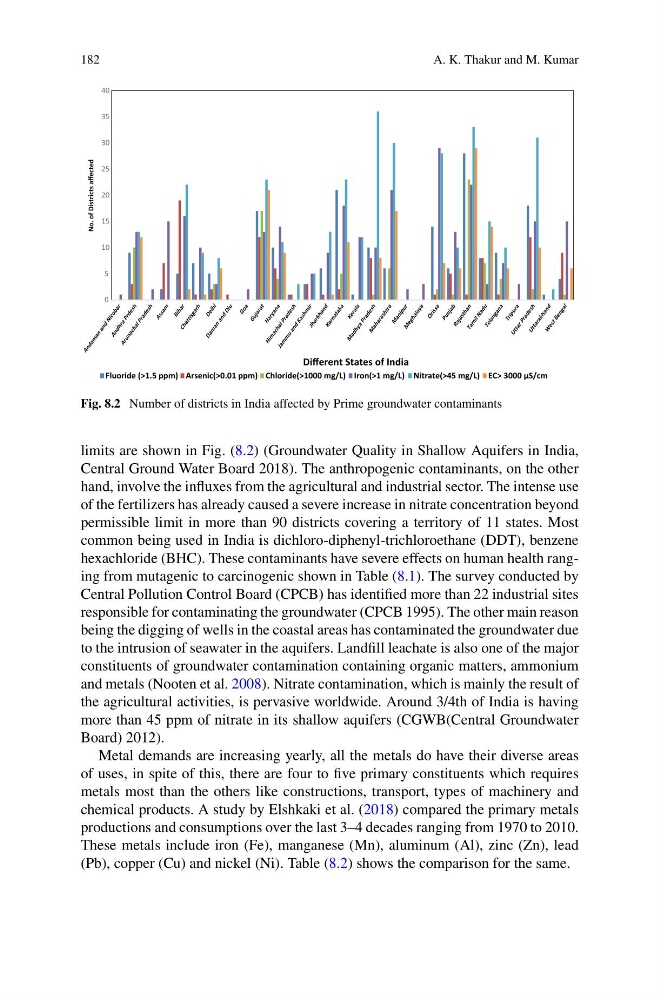
Fig. 8.2 Number of districts in India affected by Prime groundwater contaminants
limits are shown in Fig. (8.2) (Groundwater Quality in Shallow Aquifers in India,
Central Ground Water Board 2018). The anthropogenic contaminants, on the other
hand, involve the influxes from the agricultural and industrial sector. The intense use
of the fertilizers has already caused a severe increase in nitrate concentration beyond
permissible limit in more than 90 districts covering a territory of 11 states. Most
common being used in India is dichloro-diphenyl-trichloroethane (DDT), benzene
hexachloride (BHC). These contaminants have severe effects on human health ranging from mutagenic to carcinogenic shown in Table (8.1). The survey conducted by
Central Pollution Control Board (CPCB) has identified more than 22 industrial sites
responsible for contaminating the groundwater (CPCB 1995). The other main reason
being the digging of wells in the coastal areas has contaminated the groundwater due
to the intrusion of seawater in the aquifers. Landfill leachate is also one of the major
constituents of groundwater contamination containing organic matters, ammonium
and metals (Nooten et al. 2008). Nitrate contamination, which is mainly the result of
the agricultural activities, is pervasive worldwide. Around 3/4th of India is having
more than 45 ppm of nitrate in its shallow aquifers (CGWB(Central Groundwater
Board) 2012).
Metal demands are increasing yearly, all the metals do have their diverse areas
of uses, in spite of this, there are four to five primary constituents which requires
metals most than the others like constructions, transport, types of machinery and
chemical products. A study by Elshkaki et al. (2018) compared the primary metals
productions and consumptions over the last 3–4 decades ranging from 1970 to 2010.
These metals include iron (Fe), manganese (Mn), aluminum (Al), zinc (Zn), lead
(Pb), copper (Cu) and nickel (Ni). Table (8.2) shows the comparison for the same.
A. K. Thakur and M. Kumar
0
5
10
15
20
25
30
35
40
No. of Districts affected
Different States of India
Fluoride (>1.5 ppm) Arsenic(>0.01 ppm) Chloride(>1000 mg/L) Iron(>1 mg/L) Nitrate(>45 mg/L) EC> 3000 μS/cm
Fig. 8.2 Number of districts in India affected by Prime groundwater contaminants
limits are shown in Fig. (8.2) (Groundwater Quality in Shallow Aquifers in India,
Central Ground Water Board 2018). The anthropogenic contaminants, on the other
hand, involve the influxes from the agricultural and industrial sector. The intense use
of the fertilizers has already caused a severe increase in nitrate concentration beyond
permissible limit in more than 90 districts covering a territory of 11 states. Most
common being used in India is dichloro-diphenyl-trichloroethane (DDT), benzene
hexachloride (BHC). These contaminants have severe effects on human health ranging from mutagenic to carcinogenic shown in Table (8.1). The survey conducted by
Central Pollution Control Board (CPCB) has identified more than 22 industrial sites
responsible for contaminating the groundwater (CPCB 1995). The other main reason
being the digging of wells in the coastal areas has contaminated the groundwater due
to the intrusion of seawater in the aquifers. Landfill leachate is also one of the major
constituents of groundwater contamination containing organic matters, ammonium
and metals (Nooten et al. 2008). Nitrate contamination, which is mainly the result of
the agricultural activities, is pervasive worldwide. Around 3/4th of India is having
more than 45 ppm of nitrate in its shallow aquifers (CGWB(Central Groundwater
Board) 2012).
Metal demands are increasing yearly, all the metals do have their diverse areas
of uses, in spite of this, there are four to five primary constituents which requires
metals most than the others like constructions, transport, types of machinery and
chemical products. A study by Elshkaki et al. (2018) compared the primary metals
productions and consumptions over the last 3–4 decades ranging from 1970 to 2010.
These metals include iron (Fe), manganese (Mn), aluminum (Al), zinc (Zn), lead
(Pb), copper (Cu) and nickel (Ni). Table (8.2) shows the comparison for the same.