

5 Urbanisation and Land Use Change
89
• Management; reflecting the “persuasive” approach that tries to change the
behaviour of land-using actors, either by providing them with information on
the consequences of their behaviour, or by involving them in a communicative
process together with actors that wish to restrict land consumption.
These planning principles are of course ideal types. In reality, policy responses and
planning instruments that address the problem of land consumption are frequently
combinations of several instruments that entail the adoption of various principles.
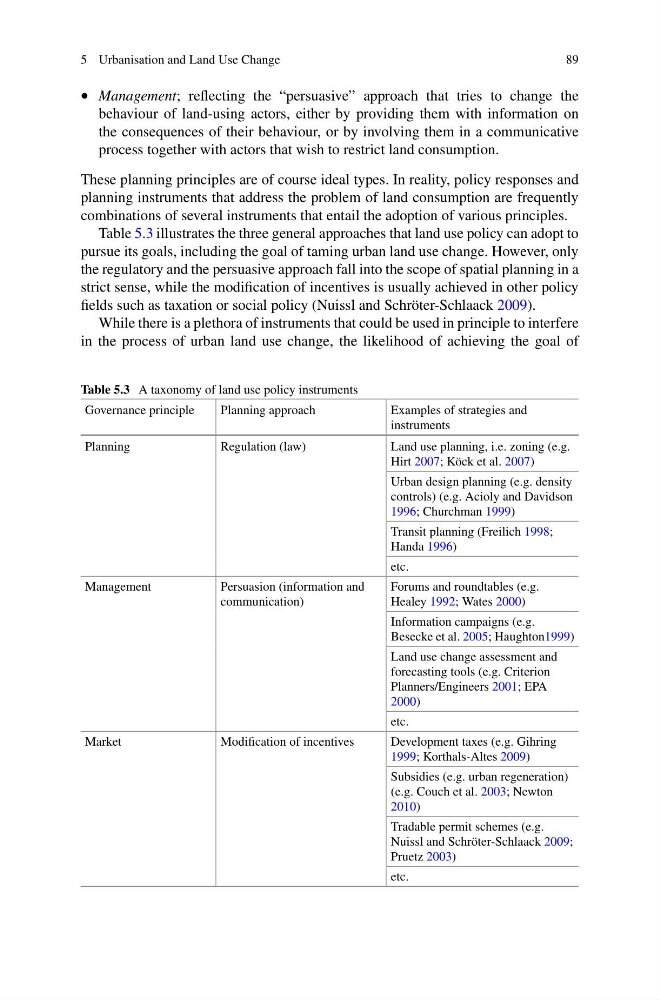
Table 5.3 illustrates the three general approaches that land use policy can adopt to
pursue its goals, including the goal of taming urban land use change. However, only
the regulatory and the persuasive approach fall into the scope of spatial planning in a
strict sense, while the modification of incentives is usually achieved in other policy
fields such as taxation or social policy (Nuissl and Schröter-Schlaack 2009).
While there is a plethora of instruments that could be used in principle to interfere
in the process of urban land use change, the likelihood of achieving the goal of
Table 5.3 A taxonomy of land use policy instruments
Governance principle
Planning approach
Examples of strategies and
instruments
Planning
Regulation (law)
Land use planning, i.e. zoning (e.g.
Hirt 2007; Köck et al. 2007)
Urban design planning (e.g. density
controls) (e.g. Acioly and Davidson
1996; Churchman 1999)
Transit planning (Freilich 1998;
Handa 1996)
etc.
Management
Persuasion (information and
communication)
Forums and roundtables (e.g.
Healey 1992; Wates 2000)
Information campaigns (e.g.
Besecke et al. 2005; Haughton1999)
Land use change assessment and
forecasting tools (e.g. Criterion
Planners/Engineers 2001; EPA
2000)
etc.
Market
Modification of incentives
Development taxes (e.g. Gihring
1999; Korthals-Altes 2009)
Subsidies (e.g. urban regeneration)
(e.g. Couch et al. 2003; Newton
2010)
Tradable permit schemes (e.g.
Nuissl and Schröter-Schlaack 2009;
Pruetz 2003)
etc.
89
• Management; reflecting the “persuasive” approach that tries to change the
behaviour of land-using actors, either by providing them with information on
the consequences of their behaviour, or by involving them in a communicative
process together with actors that wish to restrict land consumption.
These planning principles are of course ideal types. In reality, policy responses and
planning instruments that address the problem of land consumption are frequently
combinations of several instruments that entail the adoption of various principles.
Table 5.3 illustrates the three general approaches that land use policy can adopt to
pursue its goals, including the goal of taming urban land use change. However, only
the regulatory and the persuasive approach fall into the scope of spatial planning in a
strict sense, while the modification of incentives is usually achieved in other policy
fields such as taxation or social policy (Nuissl and Schröter-Schlaack 2009).
While there is a plethora of instruments that could be used in principle to interfere
in the process of urban land use change, the likelihood of achieving the goal of
Table 5.3 A taxonomy of land use policy instruments
Governance principle
Planning approach
Examples of strategies and
instruments
Planning
Regulation (law)
Land use planning, i.e. zoning (e.g.
Hirt 2007; Köck et al. 2007)
Urban design planning (e.g. density
controls) (e.g. Acioly and Davidson
1996; Churchman 1999)
Transit planning (Freilich 1998;
Handa 1996)
etc.
Management
Persuasion (information and
communication)
Forums and roundtables (e.g.
Healey 1992; Wates 2000)
Information campaigns (e.g.
Besecke et al. 2005; Haughton1999)
Land use change assessment and
forecasting tools (e.g. Criterion
Planners/Engineers 2001; EPA
2000)
etc.
Market
Modification of incentives
Development taxes (e.g. Gihring
1999; Korthals-Altes 2009)
Subsidies (e.g. urban regeneration)
(e.g. Couch et al. 2003; Newton
2010)
Tradable permit schemes (e.g.
Nuissl and Schröter-Schlaack 2009;
Pruetz 2003)
etc.