

86
H. Nuissl and S. Siedentop
that urban sprawl could have a severe impact on public health, leading to obesity and
a generally insufficient level of physical activity among many people (e.g. McCann
and Ewing 2003; Kelly-Schwartz et al. 2004; Committee on Physical Activity 2005).
Box: Systematisation of Systematic Accounts of Land Use Change
Impacts
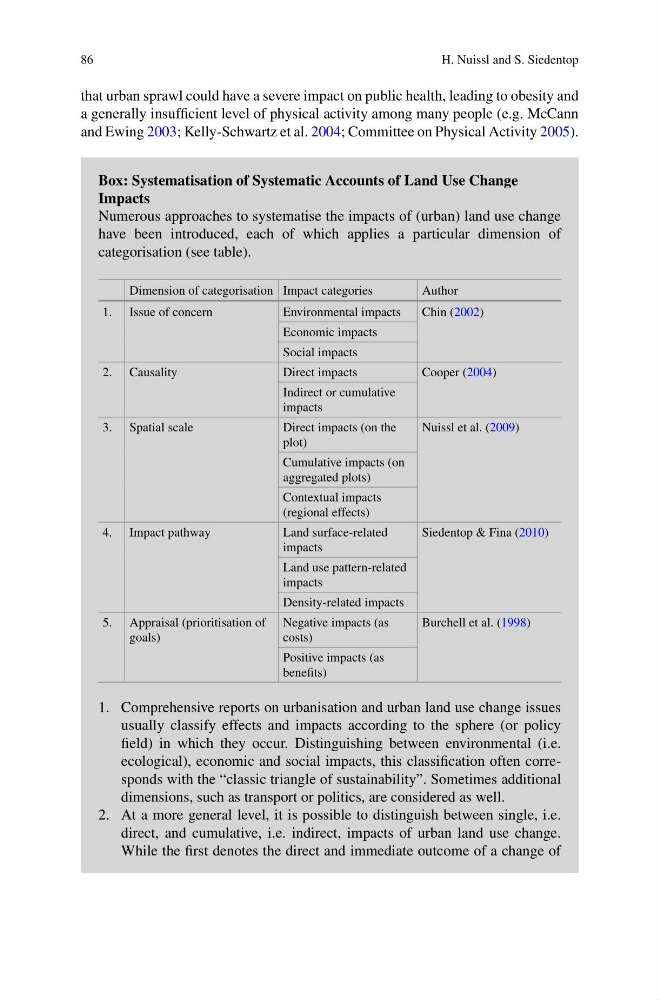
Numerous approaches to systematise the impacts of (urban) land use change
have been introduced, each of which applies a particular dimension of
categorisation (see table).
Dimension of categorisation Impact categories
Author
1. Issue of concern
Environmental impacts
Chin (2002)
Economic impacts
Social impacts
2. Causality
Direct impacts
Cooper (2004)
Indirect or cumulative
impacts
3. Spatial scale
Direct impacts (on the
plot)
Nuissl et al. (2009)
Cumulative impacts (on
aggregated plots)
Contextual impacts
(regional effects)
4. Impact pathway
Land surface-related
impacts
Siedentop & Fina (2010)
Land use pattern-related
impacts
Density-related impacts
5. Appraisal (prioritisation of
goals)
Negative impacts (as
costs)
Burchell et al. (1998)
Positive impacts (as
benefits)
1. Comprehensive reports on urbanisation and urban land use change issues
usually classify effects and impacts according to the sphere (or policy
field) in which they occur. Distinguishing between environmental (i.e.
ecological), economic and social impacts, this classification often corresponds with the “classic triangle of sustainability”. Sometimes additional
dimensions, such as transport or politics, are considered as well.
2. At a more general level, it is possible to distinguish between single, i.e.
direct, and cumulative, i.e. indirect, impacts of urban land use change.
While the first denotes the direct and immediate outcome of a change of
H. Nuissl and S. Siedentop
that urban sprawl could have a severe impact on public health, leading to obesity and
a generally insufficient level of physical activity among many people (e.g. McCann
and Ewing 2003; Kelly-Schwartz et al. 2004; Committee on Physical Activity 2005).
Box: Systematisation of Systematic Accounts of Land Use Change
Impacts
Numerous approaches to systematise the impacts of (urban) land use change
have been introduced, each of which applies a particular dimension of
categorisation (see table).
Dimension of categorisation Impact categories
Author
1. Issue of concern
Environmental impacts
Chin (2002)
Economic impacts
Social impacts
2. Causality
Direct impacts
Cooper (2004)
Indirect or cumulative
impacts
3. Spatial scale
Direct impacts (on the
plot)
Nuissl et al. (2009)
Cumulative impacts (on
aggregated plots)
Contextual impacts
(regional effects)
4. Impact pathway
Land surface-related
impacts
Siedentop & Fina (2010)
Land use pattern-related
impacts
Density-related impacts
5. Appraisal (prioritisation of
goals)
Negative impacts (as
costs)
Burchell et al. (1998)
Positive impacts (as
benefits)
1. Comprehensive reports on urbanisation and urban land use change issues
usually classify effects and impacts according to the sphere (or policy
field) in which they occur. Distinguishing between environmental (i.e.
ecological), economic and social impacts, this classification often corresponds with the “classic triangle of sustainability”. Sometimes additional
dimensions, such as transport or politics, are considered as well.
2. At a more general level, it is possible to distinguish between single, i.e.
direct, and cumulative, i.e. indirect, impacts of urban land use change.
While the first denotes the direct and immediate outcome of a change of