

82
H. Nuissl and S. Siedentop
prime farmland) or “positive planning” inasmuch as they define the suitability of
a piece of land for a specific use (i.e. where they explicitly designate sites for
urban development).
While some of these determinants of urban land use change illuminate the total
pressure on the land within a region or even a nation-state, others—such as moderate
land prices or above-average accessibility—are suited to identifying the local hot
spots of development, but are largely unable to explain the aggregate regional growth
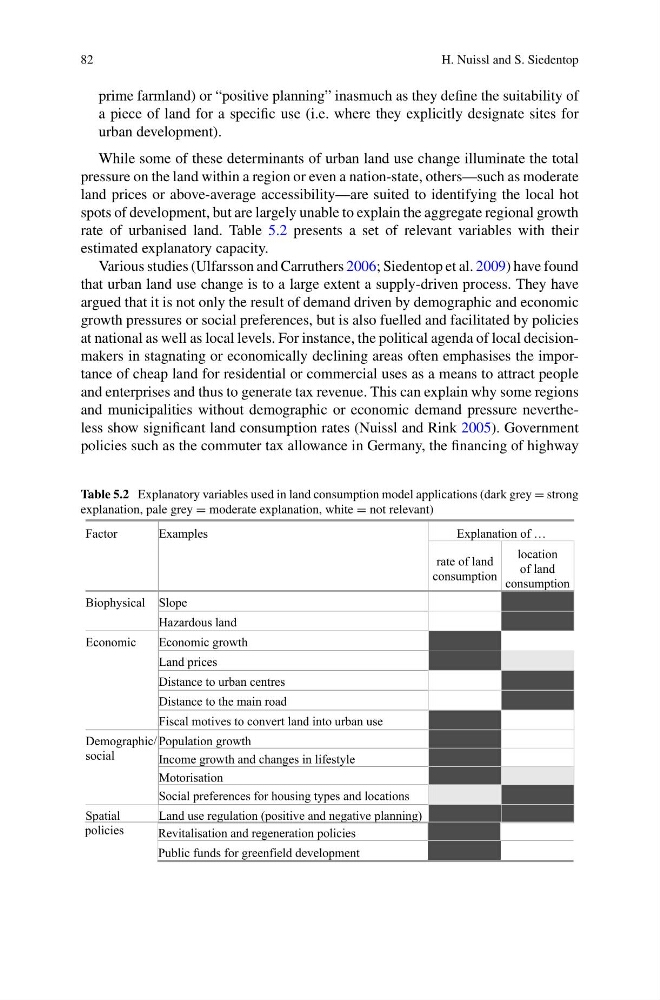
rate of urbanised land. Table 5.2 presents a set of relevant variables with their
estimated explanatory capacity.
Various studies (Ulfarsson and Carruthers 2006; Siedentop et al. 2009) have found
that urban land use change is to a large extent a supply-driven process. They have
argued that it is not only the result of demand driven by demographic and economic
growth pressures or social preferences, but is also fuelled and facilitated by policies
at national as well as local levels. For instance, the political agenda of local decisionmakers in stagnating or economically declining areas often emphasises the importance of cheap land for residential or commercial uses as a means to attract people
and enterprises and thus to generate tax revenue. This can explain why some regions
and municipalities without demographic or economic demand pressure nevertheless show significant land consumption rates (Nuissl and Rink 2005). Government
policies such as the commuter tax allowance in Germany, the financing of highway
Table 5.2 Explanatory variables used in land consumption model applications (dark grey = strong
explanation, pale grey = moderate explanation, white = not relevant)
Factor
Examples
Explanation of …
rate of land
consumption
location
of land
consumption
Biophysical Slope
Hazardous land
Economic
Economic growth
Land prices
Distance to urban centres
Distance to the main road
Fiscal motives to convert land into urban use
Demographic/
social
Population growth
Income growth and changes in lifestyle
Motorisation
Social preferences for housing types and locations
Spatial
Land use regulation (positive and negative planning)
policies
Revitalisation and regeneration policies
Public funds for greenfield development
H. Nuissl and S. Siedentop
prime farmland) or “positive planning” inasmuch as they define the suitability of
a piece of land for a specific use (i.e. where they explicitly designate sites for
urban development).
While some of these determinants of urban land use change illuminate the total
pressure on the land within a region or even a nation-state, others—such as moderate
land prices or above-average accessibility—are suited to identifying the local hot
spots of development, but are largely unable to explain the aggregate regional growth
rate of urbanised land. Table 5.2 presents a set of relevant variables with their
estimated explanatory capacity.
Various studies (Ulfarsson and Carruthers 2006; Siedentop et al. 2009) have found
that urban land use change is to a large extent a supply-driven process. They have
argued that it is not only the result of demand driven by demographic and economic
growth pressures or social preferences, but is also fuelled and facilitated by policies
at national as well as local levels. For instance, the political agenda of local decisionmakers in stagnating or economically declining areas often emphasises the importance of cheap land for residential or commercial uses as a means to attract people
and enterprises and thus to generate tax revenue. This can explain why some regions
and municipalities without demographic or economic demand pressure nevertheless show significant land consumption rates (Nuissl and Rink 2005). Government
policies such as the commuter tax allowance in Germany, the financing of highway
Table 5.2 Explanatory variables used in land consumption model applications (dark grey = strong
explanation, pale grey = moderate explanation, white = not relevant)
Factor
Examples
Explanation of …
rate of land
consumption
location
of land
consumption
Biophysical Slope
Hazardous land
Economic
Economic growth
Land prices
Distance to urban centres
Distance to the main road
Fiscal motives to convert land into urban use
Demographic/
social
Population growth
Income growth and changes in lifestyle
Motorisation
Social preferences for housing types and locations
Spatial
Land use regulation (positive and negative planning)
policies
Revitalisation and regeneration policies
Public funds for greenfield development