

28
M. García-Martín et al.
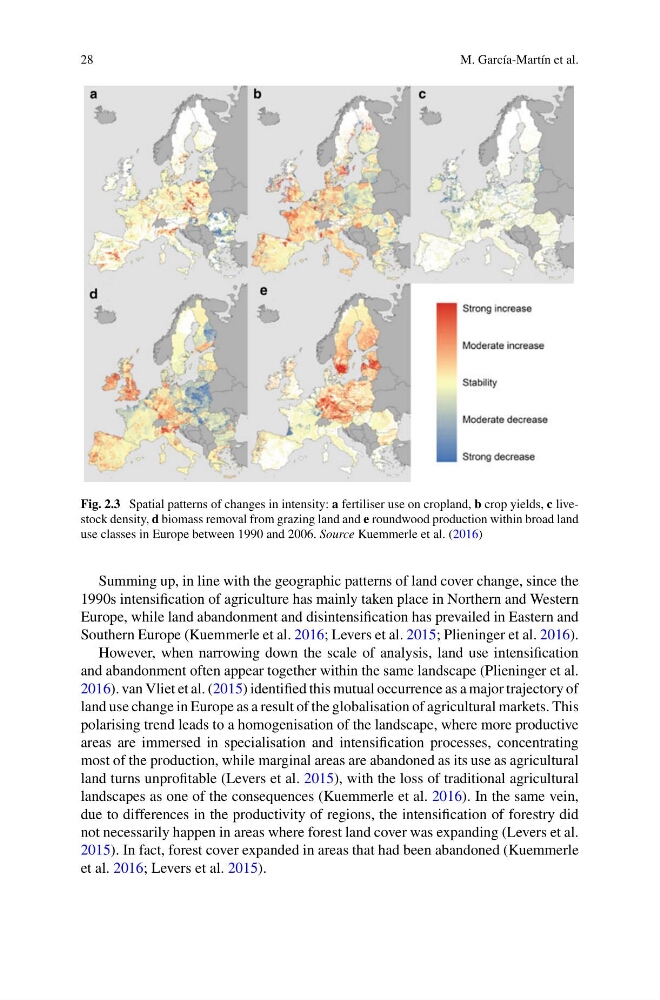
Fig. 2.3 Spatial patterns of changes in intensity: a fertiliser use on cropland, b crop yields, c livestock density, d biomass removal from grazing land and e roundwood production within broad land
use classes in Europe between 1990 and 2006. Source Kuemmerle et al. (2016)
Summing up, in line with the geographic patterns of land cover change, since the
1990s intensification of agriculture has mainly taken place in Northern and Western
Europe, while land abandonment and disintensification has prevailed in Eastern and
Southern Europe (Kuemmerle et al. 2016; Levers et al. 2015; Plieninger et al. 2016).
However, when narrowing down the scale of analysis, land use intensification
and abandonment often appear together within the same landscape (Plieninger et al.
2016). van Vliet et al. (2015) identified this mutual occurrence as a major trajectory of
land use change in Europe as a result of the globalisation of agricultural markets. This
polarising trend leads to a homogenisation of the landscape, where more productive
areas are immersed in specialisation and intensification processes, concentrating
most of the production, while marginal areas are abandoned as its use as agricultural
land turns unprofitable (Levers et al. 2015), with the loss of traditional agricultural
landscapes as one of the consequences (Kuemmerle et al. 2016). In the same vein,
due to differences in the productivity of regions, the intensification of forestry did
not necessarily happen in areas where forest land cover was expanding (Levers et al.
2015). In fact, forest cover expanded in areas that had been abandoned (Kuemmerle
et al. 2016; Levers et al. 2015).
M. García-Martín et al.
Fig. 2.3 Spatial patterns of changes in intensity: a fertiliser use on cropland, b crop yields, c livestock density, d biomass removal from grazing land and e roundwood production within broad land
use classes in Europe between 1990 and 2006. Source Kuemmerle et al. (2016)
Summing up, in line with the geographic patterns of land cover change, since the
1990s intensification of agriculture has mainly taken place in Northern and Western
Europe, while land abandonment and disintensification has prevailed in Eastern and
Southern Europe (Kuemmerle et al. 2016; Levers et al. 2015; Plieninger et al. 2016).
However, when narrowing down the scale of analysis, land use intensification
and abandonment often appear together within the same landscape (Plieninger et al.
2016). van Vliet et al. (2015) identified this mutual occurrence as a major trajectory of
land use change in Europe as a result of the globalisation of agricultural markets. This
polarising trend leads to a homogenisation of the landscape, where more productive
areas are immersed in specialisation and intensification processes, concentrating
most of the production, while marginal areas are abandoned as its use as agricultural
land turns unprofitable (Levers et al. 2015), with the loss of traditional agricultural
landscapes as one of the consequences (Kuemmerle et al. 2016). In the same vein,
due to differences in the productivity of regions, the intensification of forestry did
not necessarily happen in areas where forest land cover was expanding (Levers et al.
2015). In fact, forest cover expanded in areas that had been abandoned (Kuemmerle
et al. 2016; Levers et al. 2015).