

17 Upcoming Challenges in Land Use Science—An International Perspective
325
or forestry. Concentration in urban areas might be sustainable from the perspective
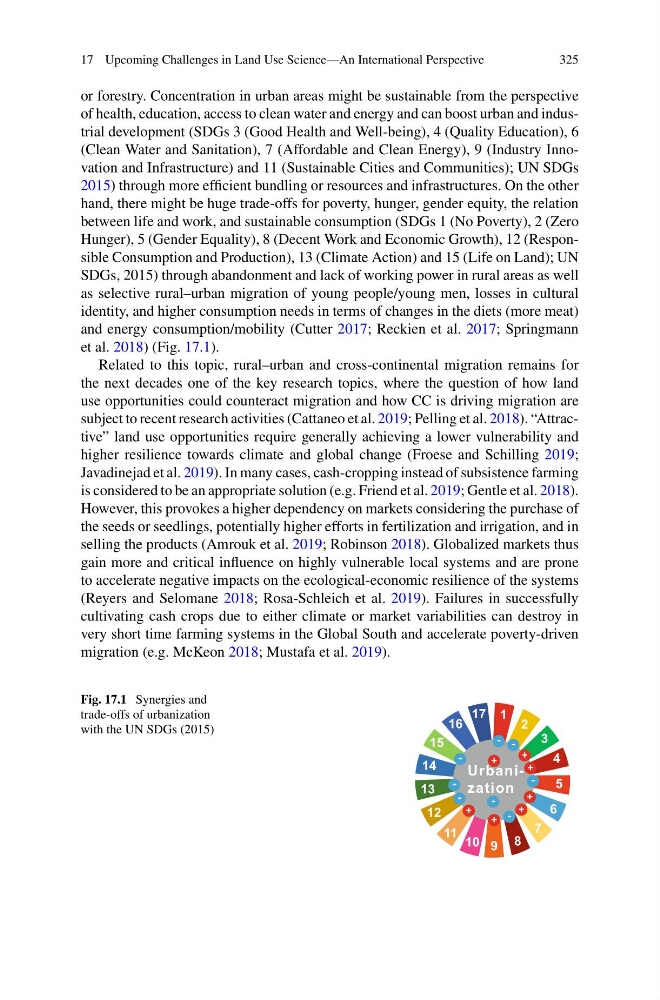
of health, education, access to clean water and energy and can boost urban and industrial development (SDGs 3 (Good Health and Well-being), 4 (Quality Education), 6
(Clean Water and Sanitation), 7 (Affordable and Clean Energy), 9 (Industry Innovation and Infrastructure) and 11 (Sustainable Cities and Communities); UN SDGs
2015) through more efficient bundling or resources and infrastructures. On the other
hand, there might be huge trade-offs for poverty, hunger, gender equity, the relation
between life and work, and sustainable consumption (SDGs 1 (No Poverty), 2 (Zero
Hunger), 5 (Gender Equality), 8 (Decent Work and Economic Growth), 12 (Responsible Consumption and Production), 13 (Climate Action) and 15 (Life on Land); UN
SDGs, 2015) through abandonment and lack of working power in rural areas as well
as selective rural–urban migration of young people/young men, losses in cultural
identity, and higher consumption needs in terms of changes in the diets (more meat)
and energy consumption/mobility (Cutter 2017; Reckien et al. 2017; Springmann
et al. 2018) (Fig. 17.1).
Related to this topic, rural–urban and cross-continental migration remains for
the next decades one of the key research topics, where the question of how land
use opportunities could counteract migration and how CC is driving migration are
subject to recent research activities (Cattaneo et al. 2019; Pelling et al. 2018). “Attractive” land use opportunities require generally achieving a lower vulnerability and
higher resilience towards climate and global change (Froese and Schilling 2019;
Javadinejad et al. 2019). In many cases, cash-cropping instead of subsistence farming
is considered to be an appropriate solution (e.g. Friend et al. 2019; Gentle et al. 2018).
However, this provokes a higher dependency on markets considering the purchase of
the seeds or seedlings, potentially higher efforts in fertilization and irrigation, and in
selling the products (Amrouk et al. 2019; Robinson 2018). Globalized markets thus
gain more and critical influence on highly vulnerable local systems and are prone
to accelerate negative impacts on the ecological-economic resilience of the systems
(Reyers and Selomane 2018; Rosa-Schleich et al. 2019). Failures in successfully
cultivating cash crops due to either climate or market variabilities can destroy in
very short time farming systems in the Global South and accelerate poverty-driven
migration (e.g. McKeon 2018; Mustafa et al. 2019).
Fig. 17.1 Synergies and
trade-offs of urbanization
with the UN SDGs (2015)
Urbanization
1
2
3
4
5
6
7
8
9
10
11
12
13
14
15
16
17
- -
-
-
-
-
-
-
+
+
+
+
+
+
+
325
or forestry. Concentration in urban areas might be sustainable from the perspective
of health, education, access to clean water and energy and can boost urban and industrial development (SDGs 3 (Good Health and Well-being), 4 (Quality Education), 6
(Clean Water and Sanitation), 7 (Affordable and Clean Energy), 9 (Industry Innovation and Infrastructure) and 11 (Sustainable Cities and Communities); UN SDGs
2015) through more efficient bundling or resources and infrastructures. On the other
hand, there might be huge trade-offs for poverty, hunger, gender equity, the relation
between life and work, and sustainable consumption (SDGs 1 (No Poverty), 2 (Zero
Hunger), 5 (Gender Equality), 8 (Decent Work and Economic Growth), 12 (Responsible Consumption and Production), 13 (Climate Action) and 15 (Life on Land); UN
SDGs, 2015) through abandonment and lack of working power in rural areas as well
as selective rural–urban migration of young people/young men, losses in cultural
identity, and higher consumption needs in terms of changes in the diets (more meat)
and energy consumption/mobility (Cutter 2017; Reckien et al. 2017; Springmann
et al. 2018) (Fig. 17.1).
Related to this topic, rural–urban and cross-continental migration remains for
the next decades one of the key research topics, where the question of how land
use opportunities could counteract migration and how CC is driving migration are
subject to recent research activities (Cattaneo et al. 2019; Pelling et al. 2018). “Attractive” land use opportunities require generally achieving a lower vulnerability and
higher resilience towards climate and global change (Froese and Schilling 2019;
Javadinejad et al. 2019). In many cases, cash-cropping instead of subsistence farming
is considered to be an appropriate solution (e.g. Friend et al. 2019; Gentle et al. 2018).
However, this provokes a higher dependency on markets considering the purchase of
the seeds or seedlings, potentially higher efforts in fertilization and irrigation, and in
selling the products (Amrouk et al. 2019; Robinson 2018). Globalized markets thus
gain more and critical influence on highly vulnerable local systems and are prone
to accelerate negative impacts on the ecological-economic resilience of the systems
(Reyers and Selomane 2018; Rosa-Schleich et al. 2019). Failures in successfully
cultivating cash crops due to either climate or market variabilities can destroy in
very short time farming systems in the Global South and accelerate poverty-driven
migration (e.g. McKeon 2018; Mustafa et al. 2019).
Fig. 17.1 Synergies and
trade-offs of urbanization
with the UN SDGs (2015)
Urbanization
1
2
3
4
5
6
7
8
9
10
11
12
13
14
15
16
17
- -
-
-
-
-
-
-
+
+
+
+
+
+
+