

322
C. Fürst
Table 17.1 Comparison of the concepts sustainability, ecosystem services, landscape services,
land use functions and multifunctionality
Concept
Scale
Holistic?
Comprehensive? Indicator
availability?
Sustainability
Social-ecological
systems
Yes
Partially
High
Ecosystem services Ecosystems
Partially
Yes
Still in work
Landscape services Landscapes
Partially
Partially
Not yet fully
Land use functions Ecosystems/land use
types
Reductionist Yes
High
Multifunctionality
Landscapes
(Ecosystems)
Partially
Yes
High
factors for services generation. Other attempts, such as the concept of land use functions (Pérez-Soba et al. 2008) suggest a more reductionist approach, focusing on
those functions (or services) that are decisive in a regional context.
In contrast, multifunctionality was conceived as a concept to assess land use
systems and landscapes in terms of their performance from an integrative transdisciplinary perspective (Antrop 2005; Fry 2001). Their relevance consists particularly
in supporting a holistic (cultural) landscape (von Haaren 2002) and land use system
planning (Selman 2009) and development including sectorial applications in agricultural (Renting et al. 2009) and forest management planning (Schmithüsen 2007)
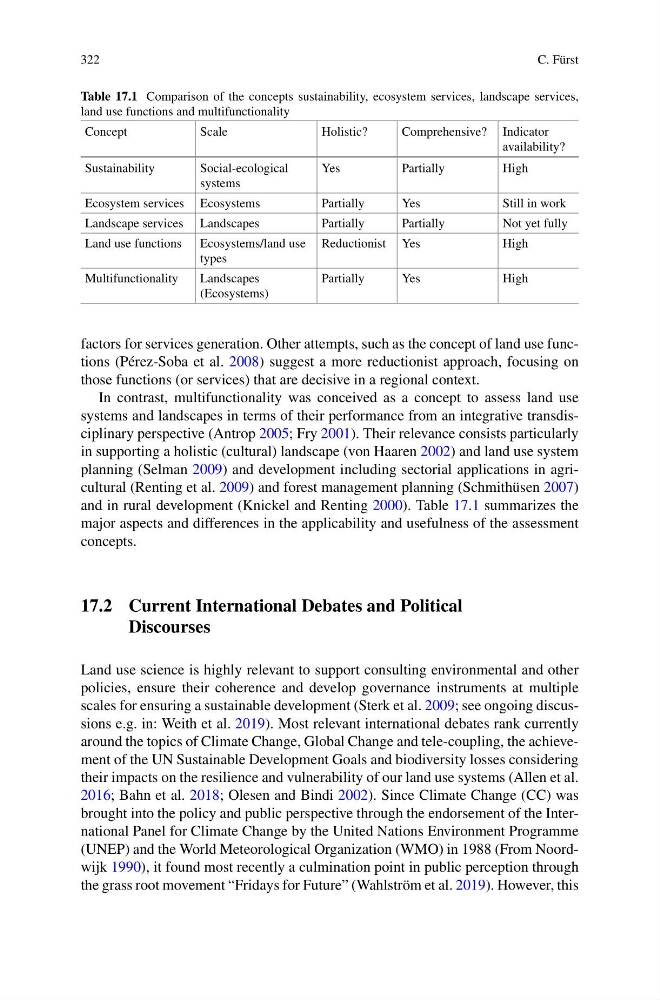
and in rural development (Knickel and Renting 2000). Table 17.1 summarizes the
major aspects and differences in the applicability and usefulness of the assessment
concepts.
17.2 Current International Debates and Political
Discourses
Land use science is highly relevant to support consulting environmental and other
policies, ensure their coherence and develop governance instruments at multiple
scales for ensuring a sustainable development (Sterk et al. 2009; see ongoing discussions e.g. in: Weith et al. 2019). Most relevant international debates rank currently
around the topics of Climate Change, Global Change and tele-coupling, the achievement of the UN Sustainable Development Goals and biodiversity losses considering
their impacts on the resilience and vulnerability of our land use systems (Allen et al.
2016; Bahn et al. 2018; Olesen and Bindi 2002). Since Climate Change (CC) was
brought into the policy and public perspective through the endorsement of the International Panel for Climate Change by the United Nations Environment Programme
(UNEP) and the World Meteorological Organization (WMO) in 1988 (From Noordwijk 1990), it found most recently a culmination point in public perception through
the grass root movement “Fridays for Future” (Wahlström et al. 2019). However, this
C. Fürst
Table 17.1 Comparison of the concepts sustainability, ecosystem services, landscape services,
land use functions and multifunctionality
Concept
Scale
Holistic?
Comprehensive? Indicator
availability?
Sustainability
Social-ecological
systems
Yes
Partially
High
Ecosystem services Ecosystems
Partially
Yes
Still in work
Landscape services Landscapes
Partially
Partially
Not yet fully
Land use functions Ecosystems/land use
types
Reductionist Yes
High
Multifunctionality
Landscapes
(Ecosystems)
Partially
Yes
High
factors for services generation. Other attempts, such as the concept of land use functions (Pérez-Soba et al. 2008) suggest a more reductionist approach, focusing on
those functions (or services) that are decisive in a regional context.
In contrast, multifunctionality was conceived as a concept to assess land use
systems and landscapes in terms of their performance from an integrative transdisciplinary perspective (Antrop 2005; Fry 2001). Their relevance consists particularly
in supporting a holistic (cultural) landscape (von Haaren 2002) and land use system
planning (Selman 2009) and development including sectorial applications in agricultural (Renting et al. 2009) and forest management planning (Schmithüsen 2007)
and in rural development (Knickel and Renting 2000). Table 17.1 summarizes the
major aspects and differences in the applicability and usefulness of the assessment
concepts.
17.2 Current International Debates and Political
Discourses
Land use science is highly relevant to support consulting environmental and other
policies, ensure their coherence and develop governance instruments at multiple
scales for ensuring a sustainable development (Sterk et al. 2009; see ongoing discussions e.g. in: Weith et al. 2019). Most relevant international debates rank currently
around the topics of Climate Change, Global Change and tele-coupling, the achievement of the UN Sustainable Development Goals and biodiversity losses considering
their impacts on the resilience and vulnerability of our land use systems (Allen et al.
2016; Bahn et al. 2018; Olesen and Bindi 2002). Since Climate Change (CC) was
brought into the policy and public perspective through the endorsement of the International Panel for Climate Change by the United Nations Environment Programme
(UNEP) and the World Meteorological Organization (WMO) in 1988 (From Noordwijk 1990), it found most recently a culmination point in public perception through
the grass root movement “Fridays for Future” (Wahlström et al. 2019). However, this