

2 Landscape Change in Europe
23
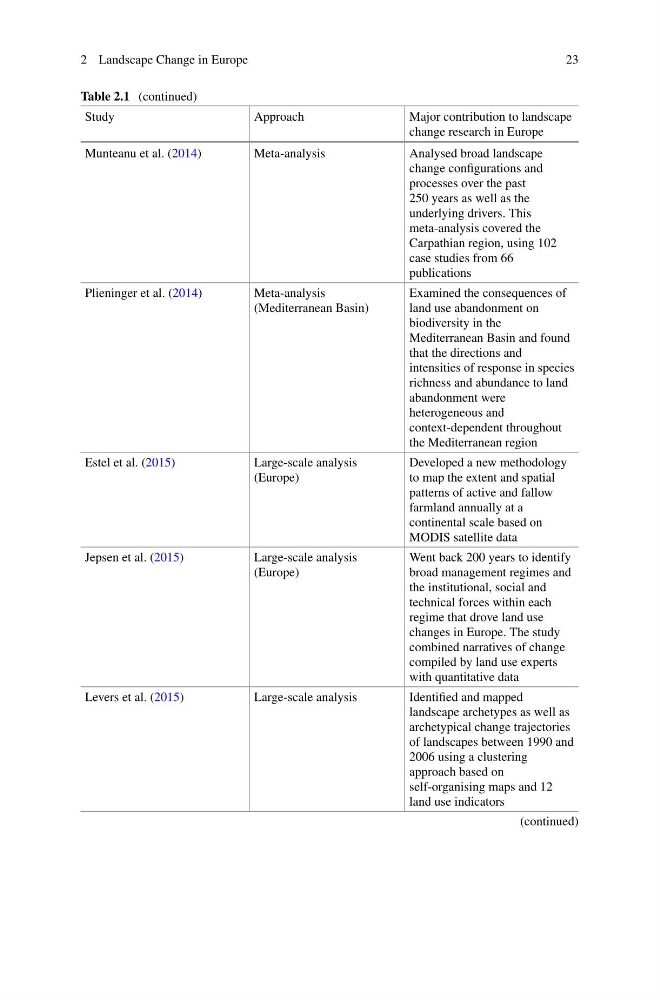
Table 2.1 (continued)
Study
Approach
Major contribution to landscape
change research in Europe
Munteanu et al. (2014)
Meta-analysis
Analysed broad landscape
change configurations and
processes over the past
250 years as well as the
underlying drivers. This
meta-analysis covered the
Carpathian region, using 102
case studies from 66
publications
Plieninger et al. (2014)
Meta-analysis
(Mediterranean Basin)
Examined the consequences of
land use abandonment on
biodiversity in the
Mediterranean Basin and found
that the directions and
intensities of response in species
richness and abundance to land
abandonment were
heterogeneous and
context-dependent throughout
the Mediterranean region
Estel et al. (2015)
Large-scale analysis
(Europe)
Developed a new methodology
to map the extent and spatial
patterns of active and fallow
farmland annually at a
continental scale based on
MODIS satellite data
Jepsen et al. (2015)
Large-scale analysis
(Europe)
Went back 200 years to identify
broad management regimes and
the institutional, social and
technical forces within each
regime that drove land use
changes in Europe. The study
combined narratives of change
compiled by land use experts
with quantitative data
Levers et al. (2015)
Large-scale analysis
Identified and mapped
landscape archetypes as well as
archetypical change trajectories
of landscapes between 1990 and
2006 using a clustering
approach based on
self-organising maps and 12
land use indicators
(continued)
23
Table 2.1 (continued)
Study
Approach
Major contribution to landscape
change research in Europe
Munteanu et al. (2014)
Meta-analysis
Analysed broad landscape
change configurations and
processes over the past
250 years as well as the
underlying drivers. This
meta-analysis covered the
Carpathian region, using 102
case studies from 66
publications
Plieninger et al. (2014)
Meta-analysis
(Mediterranean Basin)
Examined the consequences of
land use abandonment on
biodiversity in the
Mediterranean Basin and found
that the directions and
intensities of response in species
richness and abundance to land
abandonment were
heterogeneous and
context-dependent throughout
the Mediterranean region
Estel et al. (2015)
Large-scale analysis
(Europe)
Developed a new methodology
to map the extent and spatial
patterns of active and fallow
farmland annually at a
continental scale based on
MODIS satellite data
Jepsen et al. (2015)
Large-scale analysis
(Europe)
Went back 200 years to identify
broad management regimes and
the institutional, social and
technical forces within each
regime that drove land use
changes in Europe. The study
combined narratives of change
compiled by land use experts
with quantitative data
Levers et al. (2015)
Large-scale analysis
Identified and mapped
landscape archetypes as well as
archetypical change trajectories
of landscapes between 1990 and
2006 using a clustering
approach based on
self-organising maps and 12
land use indicators
(continued)