

270
P. Heck
The taming of nature and the extraction/consumption of ever-increasing quantities
of resources have been fundamental aspects of all progressive civilisations thus far.
It is also fundamental to the current model of economic growth and development
that we follow to the hilt. As a consequence, severe environmental degradation and
the depletion of resources have occurred in tandem. Adding insult to injury, globalisation and population growth coupled with the fallacious chase for GDP growth
have aggravated this situation even further.
However, since the mid-twentieth century, the manmade environmental calamities
such as the Great Smog of ’52, the threat of DDT in the ’60s, the ozone depletion
of the ’70s, and the largest ever oil spill in human history—the Persian Gulf oil spill
in ’91—drew humanity’s attention to the underlying issues, prompting a sluggish,
nevertheless noticeable shift in this anthropocentric order of business toward an
ecocentric direction.
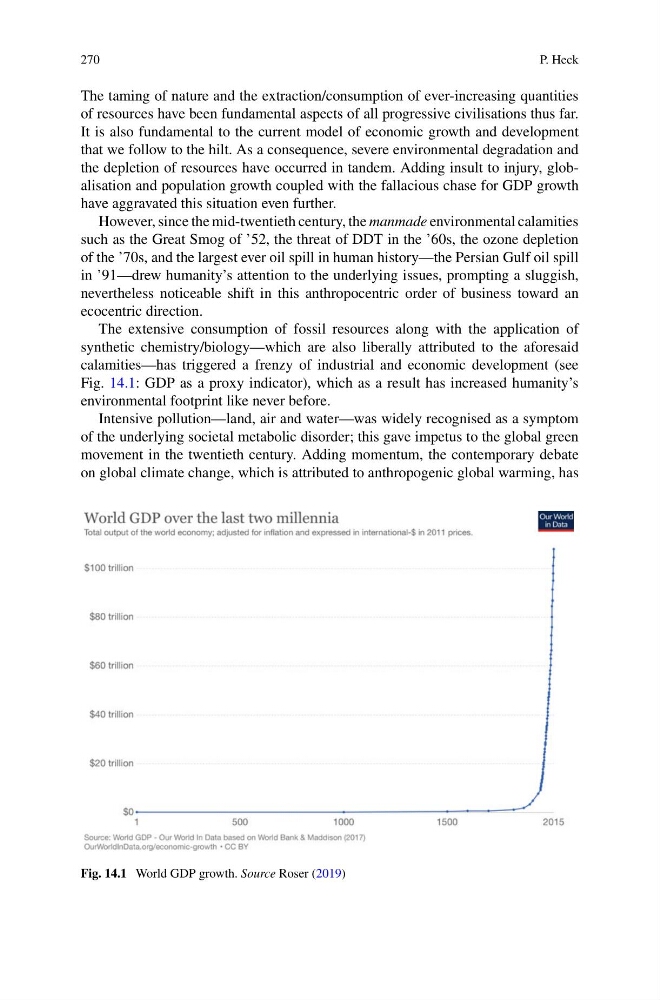
The extensive consumption of fossil resources along with the application of
synthetic chemistry/biology—which are also liberally attributed to the aforesaid
calamities—has triggered a frenzy of industrial and economic development (see
Fig. 14.1: GDP as a proxy indicator), which as a result has increased humanity’s
environmental footprint like never before.
Intensive pollution—land, air and water—was widely recognised as a symptom
of the underlying societal metabolic disorder; this gave impetus to the global green
movement in the twentieth century. Adding momentum, the contemporary debate
on global climate change, which is attributed to anthropogenic global warming, has
Fig. 14.1 World GDP growth. Source Roser (2019)
P. Heck
The taming of nature and the extraction/consumption of ever-increasing quantities
of resources have been fundamental aspects of all progressive civilisations thus far.
It is also fundamental to the current model of economic growth and development
that we follow to the hilt. As a consequence, severe environmental degradation and
the depletion of resources have occurred in tandem. Adding insult to injury, globalisation and population growth coupled with the fallacious chase for GDP growth
have aggravated this situation even further.
However, since the mid-twentieth century, the manmade environmental calamities
such as the Great Smog of ’52, the threat of DDT in the ’60s, the ozone depletion
of the ’70s, and the largest ever oil spill in human history—the Persian Gulf oil spill
in ’91—drew humanity’s attention to the underlying issues, prompting a sluggish,
nevertheless noticeable shift in this anthropocentric order of business toward an
ecocentric direction.
The extensive consumption of fossil resources along with the application of
synthetic chemistry/biology—which are also liberally attributed to the aforesaid
calamities—has triggered a frenzy of industrial and economic development (see
Fig. 14.1: GDP as a proxy indicator), which as a result has increased humanity’s
environmental footprint like never before.
Intensive pollution—land, air and water—was widely recognised as a symptom
of the underlying societal metabolic disorder; this gave impetus to the global green
movement in the twentieth century. Adding momentum, the contemporary debate
on global climate change, which is attributed to anthropogenic global warming, has
Fig. 14.1 World GDP growth. Source Roser (2019)