

258
S. Rogga
13.5 T&I Strategic Policy Pathways in SLM
Up to this point, I have outlined the framework for all kinds of subjects in which
transdisciplinary research can be performed. In the following section, this framework
is applied to land management settings (see Fig. 13.2), seeking to achieve a strategic
mental model of T&I. This mental model is suitable as a starting point for considering
and planning T&I activities in land-related research projects that seek to stimulate
change towards sustainability. To capture the rich nature of land-based issues, the
model picks a rather high level of generalisation. My description of the elements of
the model will include practical examples to facilitate understanding.
The model was inspired by theoretical assumptions from the literature on T&I
using deduction (see Sect. 13.3) as well as by observed transfer strategies applied by
SLM projects (from the funding measure under the same title 2010–2016; see also
Weith et al. 2019), acquired by induction during project activities.
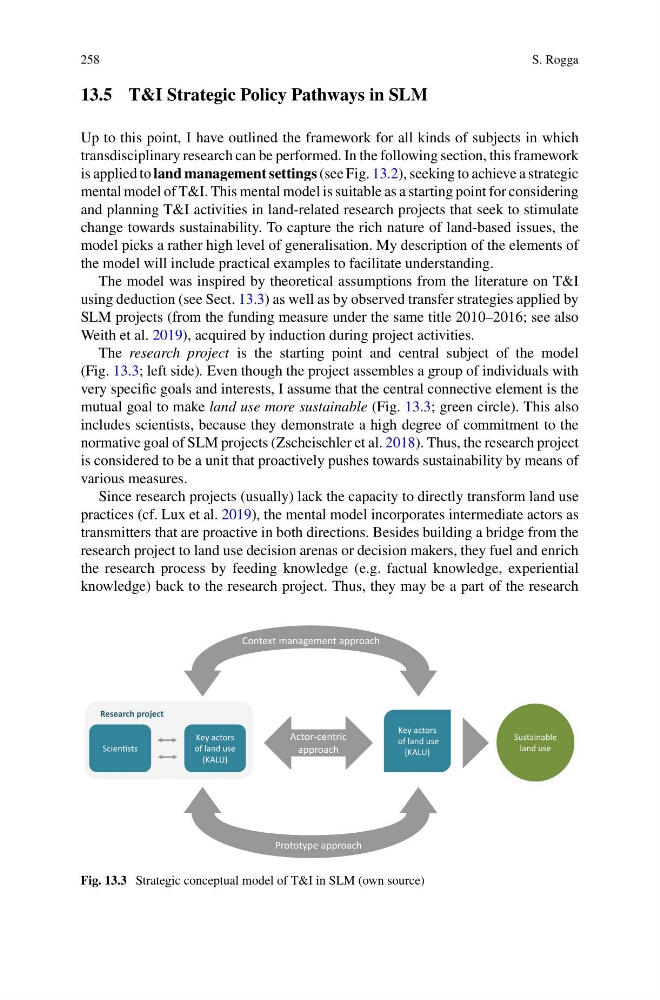
The research project is the starting point and central subject of the model
(Fig. 13.3; left side). Even though the project assembles a group of individuals with
very specific goals and interests, I assume that the central connective element is the
mutual goal to make land use more sustainable (Fig. 13.3; green circle). This also
includes scientists, because they demonstrate a high degree of commitment to the
normative goal of SLM projects (Zscheischler et al. 2018). Thus, the research project
is considered to be a unit that proactively pushes towards sustainability by means of
various measures.
Since research projects (usually) lack the capacity to directly transform land use
practices (cf. Lux et al. 2019), the mental model incorporates intermediate actors as
transmitters that are proactive in both directions. Besides building a bridge from the
research project to land use decision arenas or decision makers, they fuel and enrich
the research process by feeding knowledge (e.g. factual knowledge, experiential
knowledge) back to the research project. Thus, they may be a part of the research
Key actors
of land use
(KALU)
Context management approach
Research project
Actor-centric
approach
Key actors
of land use
(KALU)
Sustainable
land use
Prototype approach
ScienƟsts
Fig. 13.3 Strategic conceptual model of T&I in SLM (own source)
S. Rogga
13.5 T&I Strategic Policy Pathways in SLM
Up to this point, I have outlined the framework for all kinds of subjects in which
transdisciplinary research can be performed. In the following section, this framework
is applied to land management settings (see Fig. 13.2), seeking to achieve a strategic
mental model of T&I. This mental model is suitable as a starting point for considering
and planning T&I activities in land-related research projects that seek to stimulate
change towards sustainability. To capture the rich nature of land-based issues, the
model picks a rather high level of generalisation. My description of the elements of
the model will include practical examples to facilitate understanding.
The model was inspired by theoretical assumptions from the literature on T&I
using deduction (see Sect. 13.3) as well as by observed transfer strategies applied by
SLM projects (from the funding measure under the same title 2010–2016; see also
Weith et al. 2019), acquired by induction during project activities.
The research project is the starting point and central subject of the model
(Fig. 13.3; left side). Even though the project assembles a group of individuals with
very specific goals and interests, I assume that the central connective element is the
mutual goal to make land use more sustainable (Fig. 13.3; green circle). This also
includes scientists, because they demonstrate a high degree of commitment to the
normative goal of SLM projects (Zscheischler et al. 2018). Thus, the research project
is considered to be a unit that proactively pushes towards sustainability by means of
various measures.
Since research projects (usually) lack the capacity to directly transform land use
practices (cf. Lux et al. 2019), the mental model incorporates intermediate actors as
transmitters that are proactive in both directions. Besides building a bridge from the
research project to land use decision arenas or decision makers, they fuel and enrich
the research process by feeding knowledge (e.g. factual knowledge, experiential
knowledge) back to the research project. Thus, they may be a part of the research
Key actors
of land use
(KALU)
Context management approach
Research project
Actor-centric
approach
Key actors
of land use
(KALU)
Sustainable
land use
Prototype approach
ScienƟsts
Fig. 13.3 Strategic conceptual model of T&I in SLM (own source)