

12 Knowledge Management for Sustainability: The Spatial Dimension …
233
12.2 Digitalisation of Higher Education
12.2.1 Classification into Megatrends of the Twenty-First
Century
Two thematic areas are particularly striking when analysing current global megatrends: there are demographic and social scientific considerations as well as economic
interpretations. In many cases, however, the boundaries between these domains are
fluid because there are interactions and links between them. In addition, each of
these megatrends can be accompanied by current developments in the field of education, which require detailed analysis in terms of digitalisation processes. Interesting
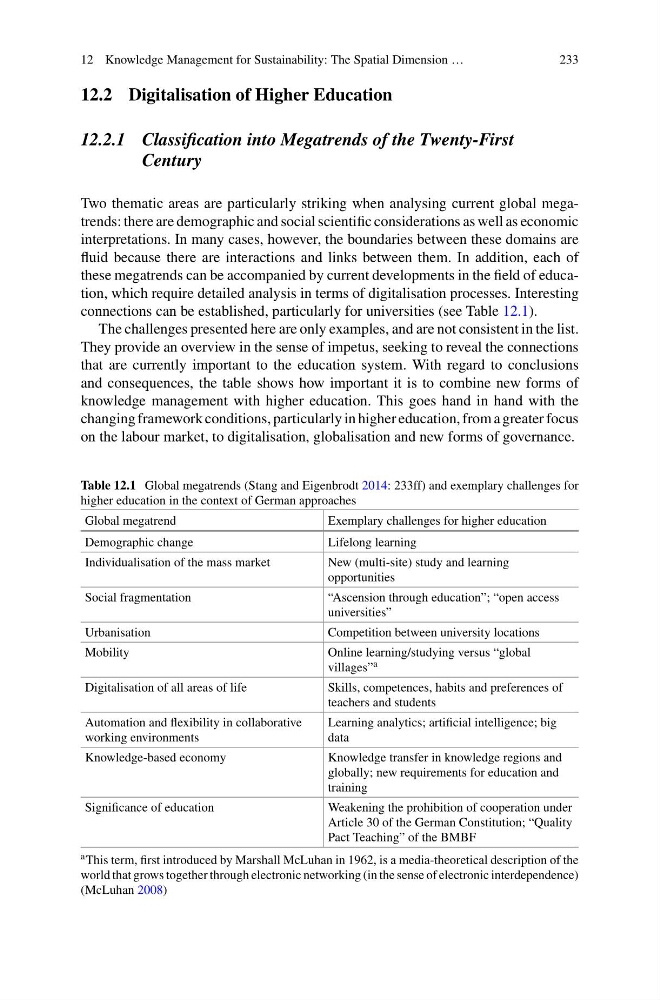
connections can be established, particularly for universities (see Table 12.1).
The challenges presented here are only examples, and are not consistent in the list.
They provide an overview in the sense of impetus, seeking to reveal the connections
that are currently important to the education system. With regard to conclusions
and consequences, the table shows how important it is to combine new forms of
knowledge management with higher education. This goes hand in hand with the
changing framework conditions, particularly in higher education, from a greater focus
on the labour market, to digitalisation, globalisation and new forms of governance.
Table 12.1 Global megatrends (Stang and Eigenbrodt 2014: 233ff) and exemplary challenges for
higher education in the context of German approaches
Global megatrend
Exemplary challenges for higher education
Demographic change
Lifelong learning
Individualisation of the mass market
New (multi-site) study and learning
opportunities
Social fragmentation
“Ascension through education”; “open access
universities”
Urbanisation
Competition between university locations
Mobility
Online learning/studying versus “global
villages” a
Digitalisation of all areas of life
Skills, competences, habits and preferences of
teachers and students
Automation and flexibility in collaborative
working environments
Learning analytics; artificial intelligence; big
data
Knowledge-based economy
Knowledge transfer in knowledge regions and
globally; new requirements for education and
training
Significance of education
Weakening the prohibition of cooperation under
Article 30 of the German Constitution; “Quality
Pact Teaching” of the BMBF
a This term, first introduced by Marshall McLuhan in 1962, is a media-theoretical description of the
world that grows together through electronic networking (in the sense of electronic interdependence)
(McLuhan 2008)
233
12.2 Digitalisation of Higher Education
12.2.1 Classification into Megatrends of the Twenty-First
Century
Two thematic areas are particularly striking when analysing current global megatrends: there are demographic and social scientific considerations as well as economic
interpretations. In many cases, however, the boundaries between these domains are
fluid because there are interactions and links between them. In addition, each of
these megatrends can be accompanied by current developments in the field of education, which require detailed analysis in terms of digitalisation processes. Interesting
connections can be established, particularly for universities (see Table 12.1).
The challenges presented here are only examples, and are not consistent in the list.
They provide an overview in the sense of impetus, seeking to reveal the connections
that are currently important to the education system. With regard to conclusions
and consequences, the table shows how important it is to combine new forms of
knowledge management with higher education. This goes hand in hand with the
changing framework conditions, particularly in higher education, from a greater focus
on the labour market, to digitalisation, globalisation and new forms of governance.
Table 12.1 Global megatrends (Stang and Eigenbrodt 2014: 233ff) and exemplary challenges for
higher education in the context of German approaches
Global megatrend
Exemplary challenges for higher education
Demographic change
Lifelong learning
Individualisation of the mass market
New (multi-site) study and learning
opportunities
Social fragmentation
“Ascension through education”; “open access
universities”
Urbanisation
Competition between university locations
Mobility
Online learning/studying versus “global
villages” a
Digitalisation of all areas of life
Skills, competences, habits and preferences of
teachers and students
Automation and flexibility in collaborative
working environments
Learning analytics; artificial intelligence; big
data
Knowledge-based economy
Knowledge transfer in knowledge regions and
globally; new requirements for education and
training
Significance of education
Weakening the prohibition of cooperation under
Article 30 of the German Constitution; “Quality
Pact Teaching” of the BMBF
a This term, first introduced by Marshall McLuhan in 1962, is a media-theoretical description of the
world that grows together through electronic networking (in the sense of electronic interdependence)
(McLuhan 2008)