

200
J. Maaß
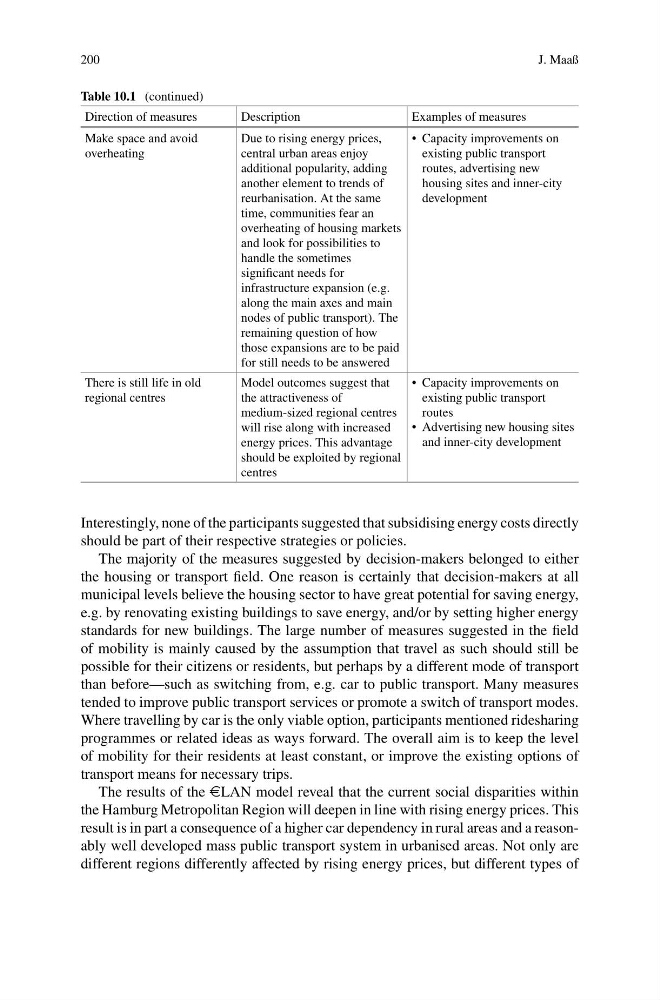
Table 10.1 (continued)
Direction of measures
Description
Examples of measures
Make space and avoid
overheating
Due to rising energy prices,
central urban areas enjoy
additional popularity, adding
another element to trends of
reurbanisation. At the same
time, communities fear an
overheating of housing markets
and look for possibilities to
handle the sometimes
significant needs for
infrastructure expansion (e.g.
along the main axes and main
nodes of public transport). The
remaining question of how
those expansions are to be paid
for still needs to be answered
• Capacity improvements on
existing public transport
routes, advertising new
housing sites and inner-city
development
There is still life in old
regional centres
Model outcomes suggest that
the attractiveness of
medium-sized regional centres
will rise along with increased
energy prices. This advantage
should be exploited by regional
centres
• Capacity improvements on
existing public transport
routes
• Advertising new housing sites
and inner-city development
Interestingly, none of the participants suggested that subsidising energy costs directly
should be part of their respective strategies or policies.
The majority of the measures suggested by decision-makers belonged to either
the housing or transport field. One reason is certainly that decision-makers at all
municipal levels believe the housing sector to have great potential for saving energy,
e.g. by renovating existing buildings to save energy, and/or by setting higher energy
standards for new buildings. The large number of measures suggested in the field
of mobility is mainly caused by the assumption that travel as such should still be
possible for their citizens or residents, but perhaps by a different mode of transport
than before—such as switching from, e.g. car to public transport. Many measures
tended to improve public transport services or promote a switch of transport modes.
Where travelling by car is the only viable option, participants mentioned ridesharing
programmes or related ideas as ways forward. The overall aim is to keep the level
of mobility for their residents at least constant, or improve the existing options of
transport means for necessary trips.
The results of the eLAN model reveal that the current social disparities within
the Hamburg Metropolitan Region will deepen in line with rising energy prices. This
result is in part a consequence of a higher car dependency in rural areas and a reasonably well developed mass public transport system in urbanised areas. Not only are
different regions differently affected by rising energy prices, but different types of
J. Maaß
Table 10.1 (continued)
Direction of measures
Description
Examples of measures
Make space and avoid
overheating
Due to rising energy prices,
central urban areas enjoy
additional popularity, adding
another element to trends of
reurbanisation. At the same
time, communities fear an
overheating of housing markets
and look for possibilities to
handle the sometimes
significant needs for
infrastructure expansion (e.g.
along the main axes and main
nodes of public transport). The
remaining question of how
those expansions are to be paid
for still needs to be answered
• Capacity improvements on
existing public transport
routes, advertising new
housing sites and inner-city
development
There is still life in old
regional centres
Model outcomes suggest that
the attractiveness of
medium-sized regional centres
will rise along with increased
energy prices. This advantage
should be exploited by regional
centres
• Capacity improvements on
existing public transport
routes
• Advertising new housing sites
and inner-city development
Interestingly, none of the participants suggested that subsidising energy costs directly
should be part of their respective strategies or policies.
The majority of the measures suggested by decision-makers belonged to either
the housing or transport field. One reason is certainly that decision-makers at all
municipal levels believe the housing sector to have great potential for saving energy,
e.g. by renovating existing buildings to save energy, and/or by setting higher energy
standards for new buildings. The large number of measures suggested in the field
of mobility is mainly caused by the assumption that travel as such should still be
possible for their citizens or residents, but perhaps by a different mode of transport
than before—such as switching from, e.g. car to public transport. Many measures
tended to improve public transport services or promote a switch of transport modes.
Where travelling by car is the only viable option, participants mentioned ridesharing
programmes or related ideas as ways forward. The overall aim is to keep the level
of mobility for their residents at least constant, or improve the existing options of
transport means for necessary trips.
The results of the eLAN model reveal that the current social disparities within
the Hamburg Metropolitan Region will deepen in line with rising energy prices. This
result is in part a consequence of a higher car dependency in rural areas and a reasonably well developed mass public transport system in urbanised areas. Not only are
different regions differently affected by rising energy prices, but different types of