

192
J. Maaß
generated by an integrated land use and transport model (LuT). This LuT was developed within the project as the second pillar of research, and thus was an excellent fit
for the serious game.
The serious game developed by eLAN focused on setting a scenario for the
participants in which they would be able to react to rising energy prices according
to their actual roles and responsibilities in local government.
10.6 The Serious Game Developed
by eLAN—Methodological Outline
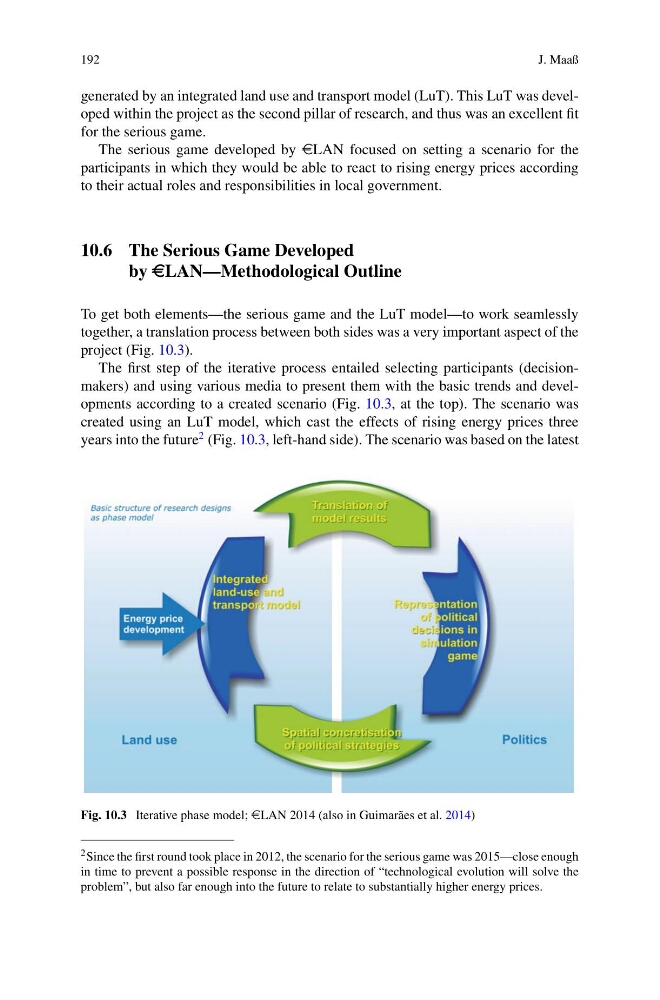
To get both elements—the serious game and the LuT model—to work seamlessly
together, a translation process between both sides was a very important aspect of the
project (Fig. 10.3).
The first step of the iterative process entailed selecting participants (decisionmakers) and using various media to present them with the basic trends and developments according to a created scenario (Fig. 10.3, at the top). The scenario was
created using an LuT model, which cast the effects of rising energy prices three
years into the future
2 (Fig. 10.3, left-hand side). The scenario was based on the latest
Fig. 10.3 Iterative phase model; eLAN 2014 (also in Guimarães et al. 2014)
2 Since the first round took place in 2012, the scenario for the serious game was 2015—close enough
in time to prevent a possible response in the direction of “technological evolution will solve the
problem”, but also far enough into the future to relate to substantially higher energy prices.
J. Maaß
generated by an integrated land use and transport model (LuT). This LuT was developed within the project as the second pillar of research, and thus was an excellent fit
for the serious game.
The serious game developed by eLAN focused on setting a scenario for the
participants in which they would be able to react to rising energy prices according
to their actual roles and responsibilities in local government.
10.6 The Serious Game Developed
by eLAN—Methodological Outline
To get both elements—the serious game and the LuT model—to work seamlessly
together, a translation process between both sides was a very important aspect of the
project (Fig. 10.3).
The first step of the iterative process entailed selecting participants (decisionmakers) and using various media to present them with the basic trends and developments according to a created scenario (Fig. 10.3, at the top). The scenario was
created using an LuT model, which cast the effects of rising energy prices three
years into the future
2 (Fig. 10.3, left-hand side). The scenario was based on the latest
Fig. 10.3 Iterative phase model; eLAN 2014 (also in Guimarães et al. 2014)
2 Since the first round took place in 2012, the scenario for the serious game was 2015—close enough
in time to prevent a possible response in the direction of “technological evolution will solve the
problem”, but also far enough into the future to relate to substantially higher energy prices.