

188
J. Maaß
Such research and its results lead to questions about how much space sealed by
infrastructure or settlement areas is desirable for our society, and how rising energy
prices affect these structures. The answers to these questions should be given by
planners and political decision-makers, but may to a certain degree also depend on
the responses of private households in the sense of supply and demand.
The immediate and direct effects of rising energy prices on public budgets are to a
degree comparable to those of private households. However, the delayed and indirect
effects will affect municipalities the most if high energy prices persist over a longer
period of time. Land management or questions concerning sustainable planning will
therefore become more difficult to anticipate. Forecasting the possibly broad variety
of private households’ responses to rising energy prices seems necessary. Insofar
as planning tries to anticipate and match the future needs of private households
with the services and infrastructure provided, planning becomes more difficult as
soon as outside influences disturb the current system. Linear projections of known
development paths may therefore fail to grasp the effects.
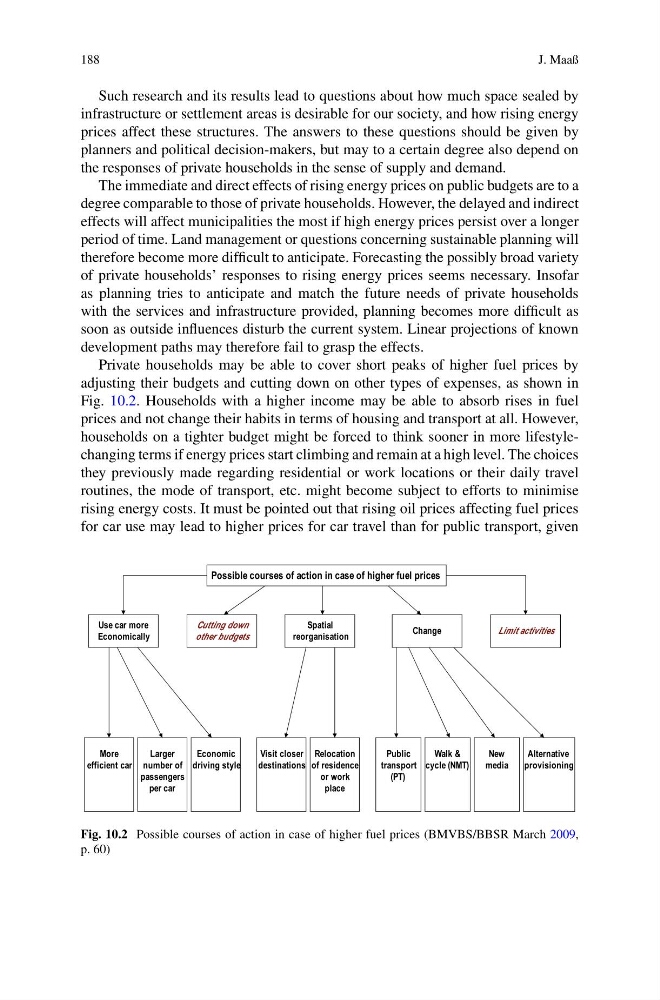
Private households may be able to cover short peaks of higher fuel prices by
adjusting their budgets and cutting down on other types of expenses, as shown in
Fig. 10.2. Households with a higher income may be able to absorb rises in fuel
prices and not change their habits in terms of housing and transport at all. However,
households on a tighter budget might be forced to think sooner in more lifestylechanging terms if energy prices start climbing and remain at a high level. The choices
they previously made regarding residential or work locations or their daily travel
routines, the mode of transport, etc. might become subject to efforts to minimise
rising energy costs. It must be pointed out that rising oil prices affecting fuel prices
for car use may lead to higher prices for car travel than for public transport, given
Use car more
Economically
Economic
driving style
Larger
number of
passengers
per car
More
efficient car
Possible courses of action in case of higher fuel prices
Limit activities
Cutting down
other budgets
Spatial
reorganisation
Visit closer
destinations
Relocation
of residence
or work
place
Change
Public
transport
(PT)
Walk &
cycle (NMT)
New
media
Alternative
provisioning
Fig. 10.2 Possible courses of action in case of higher fuel prices (BMVBS/BBSR March 2009,
p. 60)
J. Maaß
Such research and its results lead to questions about how much space sealed by
infrastructure or settlement areas is desirable for our society, and how rising energy
prices affect these structures. The answers to these questions should be given by
planners and political decision-makers, but may to a certain degree also depend on
the responses of private households in the sense of supply and demand.
The immediate and direct effects of rising energy prices on public budgets are to a
degree comparable to those of private households. However, the delayed and indirect
effects will affect municipalities the most if high energy prices persist over a longer
period of time. Land management or questions concerning sustainable planning will
therefore become more difficult to anticipate. Forecasting the possibly broad variety
of private households’ responses to rising energy prices seems necessary. Insofar
as planning tries to anticipate and match the future needs of private households
with the services and infrastructure provided, planning becomes more difficult as
soon as outside influences disturb the current system. Linear projections of known
development paths may therefore fail to grasp the effects.
Private households may be able to cover short peaks of higher fuel prices by
adjusting their budgets and cutting down on other types of expenses, as shown in
Fig. 10.2. Households with a higher income may be able to absorb rises in fuel
prices and not change their habits in terms of housing and transport at all. However,
households on a tighter budget might be forced to think sooner in more lifestylechanging terms if energy prices start climbing and remain at a high level. The choices
they previously made regarding residential or work locations or their daily travel
routines, the mode of transport, etc. might become subject to efforts to minimise
rising energy costs. It must be pointed out that rising oil prices affecting fuel prices
for car use may lead to higher prices for car travel than for public transport, given
Use car more
Economically
Economic
driving style
Larger
number of
passengers
per car
More
efficient car
Possible courses of action in case of higher fuel prices
Limit activities
Cutting down
other budgets
Spatial
reorganisation
Visit closer
destinations
Relocation
of residence
or work
place
Change
Public
transport
(PT)
Walk &
cycle (NMT)
New
media
Alternative
provisioning
Fig. 10.2 Possible courses of action in case of higher fuel prices (BMVBS/BBSR March 2009,
p. 60)