

8 Innovations for Sustainable Land Management …
155
Such “new” practices were the aim of many of the nine projects under investigation. These practices include new participation concepts, decision support tools,
the initiation and strengthening of new collaborations and networks, and new
organisations.
It emerges that the solution approaches adopted by the nine projects can be grouped
into four clusters that follow different strategies:
1. Multiple land use (Example: agroforestry systems, agrophotovoltaic plants)
These projects primarily focused on the development of technological innovations that follow the strategy of “multiple land use” to mitigate land use competition. In contrast to concept of “multifunctional land use”, which advocates
heterogeneity at the landscape level (see Mander et al. 2007), “multiple land
use” means that one land plot is used simultaneously for two purposes such as
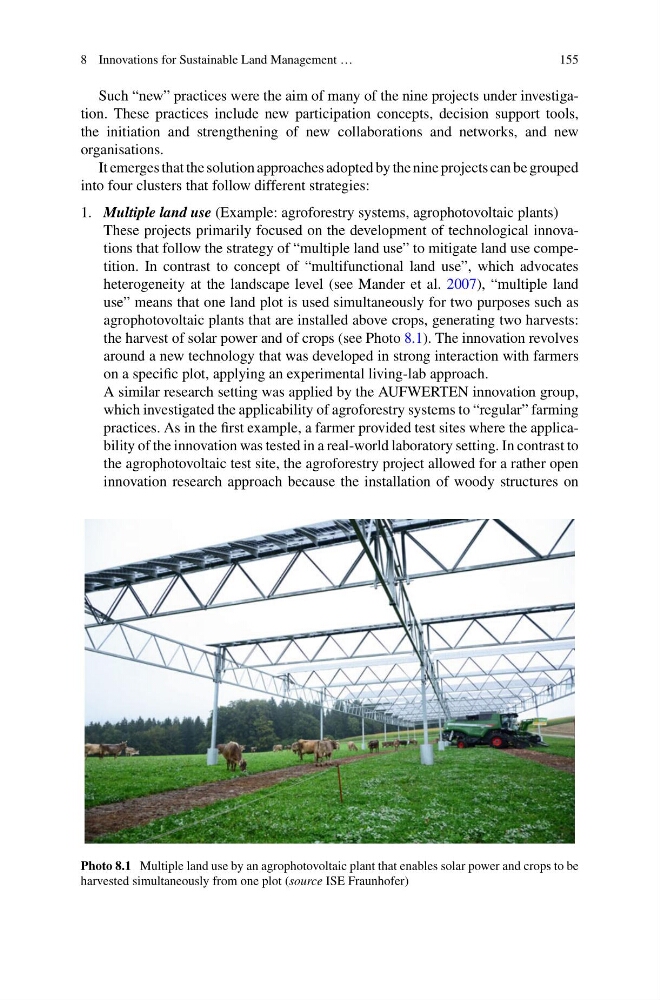
agrophotovoltaic plants that are installed above crops, generating two harvests:
the harvest of solar power and of crops (see Photo 8.1). The innovation revolves
around a new technology that was developed in strong interaction with farmers
on a specific plot, applying an experimental living-lab approach.
A similar research setting was applied by the AUFWERTEN innovation group,
which investigated the applicability of agroforestry systems to “regular” farming
practices. As in the first example, a farmer provided test sites where the applicability of the innovation was tested in a real-world laboratory setting. In contrast to
the agrophotovoltaic test site, the agroforestry project allowed for a rather open
innovation research approach because the installation of woody structures on
Photo 8.1 Multiple land use by an agrophotovoltaic plant that enables solar power and crops to be
harvested simultaneously from one plot (source ISE Fraunhofer)
155
Such “new” practices were the aim of many of the nine projects under investigation. These practices include new participation concepts, decision support tools,
the initiation and strengthening of new collaborations and networks, and new
organisations.
It emerges that the solution approaches adopted by the nine projects can be grouped
into four clusters that follow different strategies:
1. Multiple land use (Example: agroforestry systems, agrophotovoltaic plants)
These projects primarily focused on the development of technological innovations that follow the strategy of “multiple land use” to mitigate land use competition. In contrast to concept of “multifunctional land use”, which advocates
heterogeneity at the landscape level (see Mander et al. 2007), “multiple land
use” means that one land plot is used simultaneously for two purposes such as
agrophotovoltaic plants that are installed above crops, generating two harvests:
the harvest of solar power and of crops (see Photo 8.1). The innovation revolves
around a new technology that was developed in strong interaction with farmers
on a specific plot, applying an experimental living-lab approach.
A similar research setting was applied by the AUFWERTEN innovation group,
which investigated the applicability of agroforestry systems to “regular” farming
practices. As in the first example, a farmer provided test sites where the applicability of the innovation was tested in a real-world laboratory setting. In contrast to
the agrophotovoltaic test site, the agroforestry project allowed for a rather open
innovation research approach because the installation of woody structures on
Photo 8.1 Multiple land use by an agrophotovoltaic plant that enables solar power and crops to be
harvested simultaneously from one plot (source ISE Fraunhofer)