

7 Transdisciplinary Research in Land Use Science …
131
Economy
GeneƟc
Sociology
Physiology
Ecology
Soils
Geology
Chemist
Physics
Mathemat
Commer
Industry
Forestry
Agriculture
Engineer
Architec
Planning
Design
PoliƟcs
Law
Values
Ethics
Philos
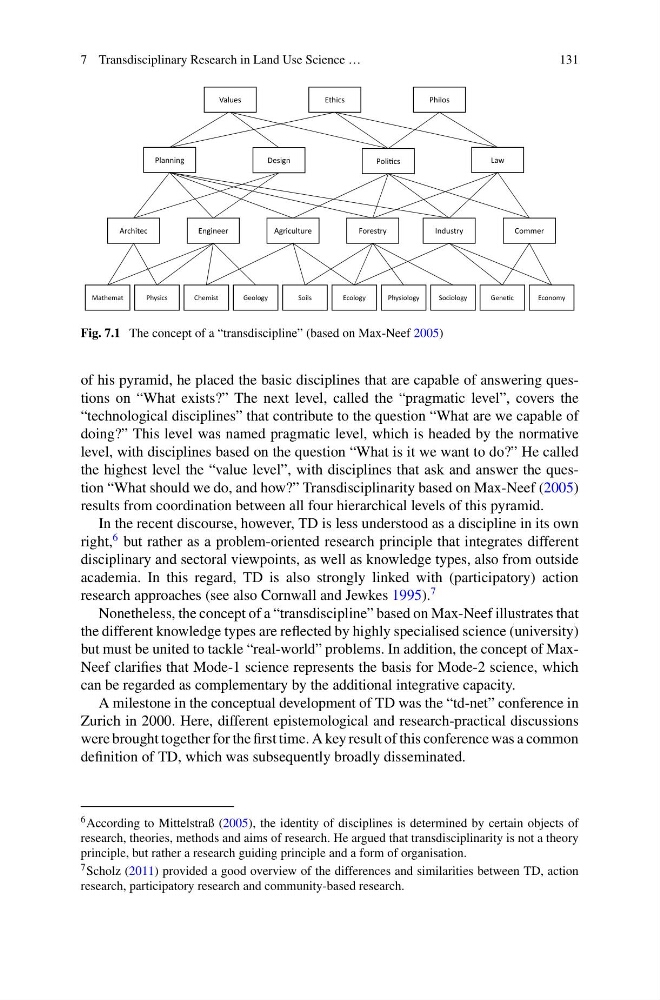
Fig. 7.1 The concept of a “transdiscipline” (based on Max-Neef 2005)
of his pyramid, he placed the basic disciplines that are capable of answering questions on “What exists?” The next level, called the “pragmatic level”, covers the
“technological disciplines” that contribute to the question “What are we capable of
doing?” This level was named pragmatic level, which is headed by the normative
level, with disciplines based on the question “What is it we want to do?” He called
the highest level the “value level”, with disciplines that ask and answer the question “What should we do, and how?” Transdisciplinarity based on Max-Neef (2005)
results from coordination between all four hierarchical levels of this pyramid.
In the recent discourse, however, TD is less understood as a discipline in its own
right,
6 but rather as a problem-oriented research principle that integrates different
disciplinary and sectoral viewpoints, as well as knowledge types, also from outside
academia. In this regard, TD is also strongly linked with (participatory) action
research approaches (see also Cornwall and Jewkes 1995).
7
Nonetheless, the concept of a “transdiscipline” based on Max-Neef illustrates that
the different knowledge types are reflected by highly specialised science (university)
but must be united to tackle “real-world” problems. In addition, the concept of MaxNeef clarifies that Mode-1 science represents the basis for Mode-2 science, which
can be regarded as complementary by the additional integrative capacity.
A milestone in the conceptual development of TD was the “td-net” conference in
Zurich in 2000. Here, different epistemological and research-practical discussions
were brought together for the first time. A key result of this conference was a common
definition of TD, which was subsequently broadly disseminated.
6 According to Mittelstraß (2005), the identity of disciplines is determined by certain objects of
research, theories, methods and aims of research. He argued that transdisciplinarity is not a theory
principle, but rather a research guiding principle and a form of organisation.
7 Scholz (2011) provided a good overview of the differences and similarities between TD, action
research, participatory research and community-based research.
131
Economy
GeneƟc
Sociology
Physiology
Ecology
Soils
Geology
Chemist
Physics
Mathemat
Commer
Industry
Forestry
Agriculture
Engineer
Architec
Planning
Design
PoliƟcs
Law
Values
Ethics
Philos
Fig. 7.1 The concept of a “transdiscipline” (based on Max-Neef 2005)
of his pyramid, he placed the basic disciplines that are capable of answering questions on “What exists?” The next level, called the “pragmatic level”, covers the
“technological disciplines” that contribute to the question “What are we capable of
doing?” This level was named pragmatic level, which is headed by the normative
level, with disciplines based on the question “What is it we want to do?” He called
the highest level the “value level”, with disciplines that ask and answer the question “What should we do, and how?” Transdisciplinarity based on Max-Neef (2005)
results from coordination between all four hierarchical levels of this pyramid.
In the recent discourse, however, TD is less understood as a discipline in its own
right,
6 but rather as a problem-oriented research principle that integrates different
disciplinary and sectoral viewpoints, as well as knowledge types, also from outside
academia. In this regard, TD is also strongly linked with (participatory) action
research approaches (see also Cornwall and Jewkes 1995).
7
Nonetheless, the concept of a “transdiscipline” based on Max-Neef illustrates that
the different knowledge types are reflected by highly specialised science (university)
but must be united to tackle “real-world” problems. In addition, the concept of MaxNeef clarifies that Mode-1 science represents the basis for Mode-2 science, which
can be regarded as complementary by the additional integrative capacity.
A milestone in the conceptual development of TD was the “td-net” conference in
Zurich in 2000. Here, different epistemological and research-practical discussions
were brought together for the first time. A key result of this conference was a common
definition of TD, which was subsequently broadly disseminated.
6 According to Mittelstraß (2005), the identity of disciplines is determined by certain objects of
research, theories, methods and aims of research. He argued that transdisciplinarity is not a theory
principle, but rather a research guiding principle and a form of organisation.
7 Scholz (2011) provided a good overview of the differences and similarities between TD, action
research, participatory research and community-based research.