

5
soil erosion because the biomass layer dissolves the raindrop, and the wind energy
and topsoil are held by the biomass (Pimentel 2006).
Even though the natural resources of the modern world are still not fully mapped,
the level of mapping, growth potential, and demand make the understanding of the
relationships between various natural components and their quantification to predict
possible scenarios, that is, modeling, more and more exciting and vital. Nevertheless,
the human impact on the ecosystem is another unpredictable component that makes
modeling so accessible and thus should be taken into account.
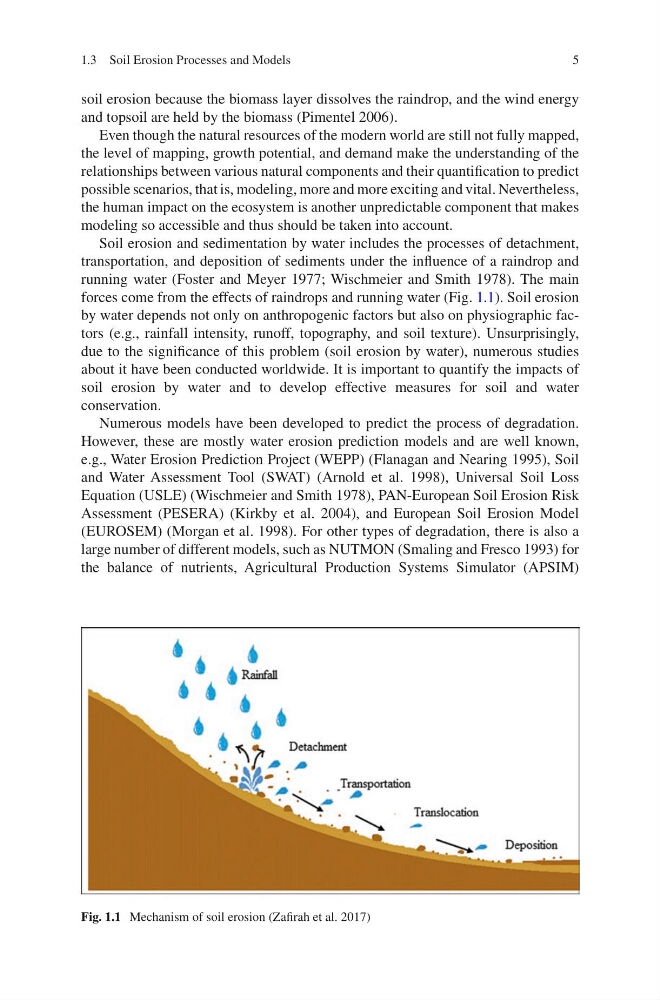
Soil erosion and sedimentation by water includes the processes of detachment,
transportation, and deposition of sediments under the influence of a raindrop and
running water (Foster and Meyer 1977; Wischmeier and Smith 1978). The main
forces come from the effects of raindrops and running water (Fig. 1.1). Soil erosion
by water depends not only on anthropogenic factors but also on physiographic factors (e.g., rainfall intensity, runoff, topography, and soil texture). Unsurprisingly,
due to the significance of this problem (soil erosion by water), numerous studies
about it have been conducted worldwide. It is important to quantify the impacts of
soil erosion by water and to develop effective measures for soil and water
conservation.
Numerous models have been developed to predict the process of degradation.
However, these are mostly water erosion prediction models and are well known,
e.g., Water Erosion Prediction Project (WEPP) (Flanagan and Nearing 1995), Soil
and Water Assessment Tool (SWAT) (Arnold et al. 1998), Universal Soil Loss
Equation (USLE) (Wischmeier and Smith 1978), PAN-European Soil Erosion Risk
Assessment (PESERA) (Kirkby et al. 2004), and European Soil Erosion Model
(EUROSEM) (Morgan et al. 1998). For other types of degradation, there is also a
large number of different models, such as NUTMON (Smaling and Fresco 1993) for
the balance of nutrients, Agricultural Production Systems Simulator (APSIM)
Fig. 1.1 Mechanism of soil erosion (Zafirah et al. 2017)
1.3 Soil Erosion Processes and Models
soil erosion because the biomass layer dissolves the raindrop, and the wind energy
and topsoil are held by the biomass (Pimentel 2006).
Even though the natural resources of the modern world are still not fully mapped,
the level of mapping, growth potential, and demand make the understanding of the
relationships between various natural components and their quantification to predict
possible scenarios, that is, modeling, more and more exciting and vital. Nevertheless,
the human impact on the ecosystem is another unpredictable component that makes
modeling so accessible and thus should be taken into account.
Soil erosion and sedimentation by water includes the processes of detachment,
transportation, and deposition of sediments under the influence of a raindrop and
running water (Foster and Meyer 1977; Wischmeier and Smith 1978). The main
forces come from the effects of raindrops and running water (Fig. 1.1). Soil erosion
by water depends not only on anthropogenic factors but also on physiographic factors (e.g., rainfall intensity, runoff, topography, and soil texture). Unsurprisingly,
due to the significance of this problem (soil erosion by water), numerous studies
about it have been conducted worldwide. It is important to quantify the impacts of
soil erosion by water and to develop effective measures for soil and water
conservation.
Numerous models have been developed to predict the process of degradation.
However, these are mostly water erosion prediction models and are well known,
e.g., Water Erosion Prediction Project (WEPP) (Flanagan and Nearing 1995), Soil
and Water Assessment Tool (SWAT) (Arnold et al. 1998), Universal Soil Loss
Equation (USLE) (Wischmeier and Smith 1978), PAN-European Soil Erosion Risk
Assessment (PESERA) (Kirkby et al. 2004), and European Soil Erosion Model
(EUROSEM) (Morgan et al. 1998). For other types of degradation, there is also a
large number of different models, such as NUTMON (Smaling and Fresco 1993) for
the balance of nutrients, Agricultural Production Systems Simulator (APSIM)
Fig. 1.1 Mechanism of soil erosion (Zafirah et al. 2017)
1.3 Soil Erosion Processes and Models