

2.6 Summary
In summary, the physico chemical process involved in the photocatalytic
antibacterial activity of transition metal oxide based semiconductors is discussed
in the present chapter. TiO 2 , ZnO and CuO were chosen as the model semiconductors for discussion which are coming under the class of cost effective, abundant and
stable semiconductors and can be upscaled for commercial utilization. Different
strategies adopted for the enhancement of the antibacterial activity of these metal
oxides are classified and discussed. The main strategies include nanostructuring,
doping, composites, metal loading and modification with advanced materials. Thus
morphological, electronic and optical tuning can influence the bacterial inactivation
by photocatalytic means. The present chapter is indent to provide a brief idea of
photo assisted antibacterial activity of transition metal oxides for graduates and entry
level researchers working in this area.
References
Abadikhah H, Naderi Kalali E, Khodi S, Xu X, Agathopoulos S (2019) Multifunctional thin-film
Nanofiltration membrane incorporated with reduced graphene oxide@TiO 2 @Ag
Nanocomposites for high desalination performance, dye retention, and antibacterial properties.
ACS Appl Mater Interfaces 11:23535–23545. https://doi.org/10.1021/acsami.9b03557
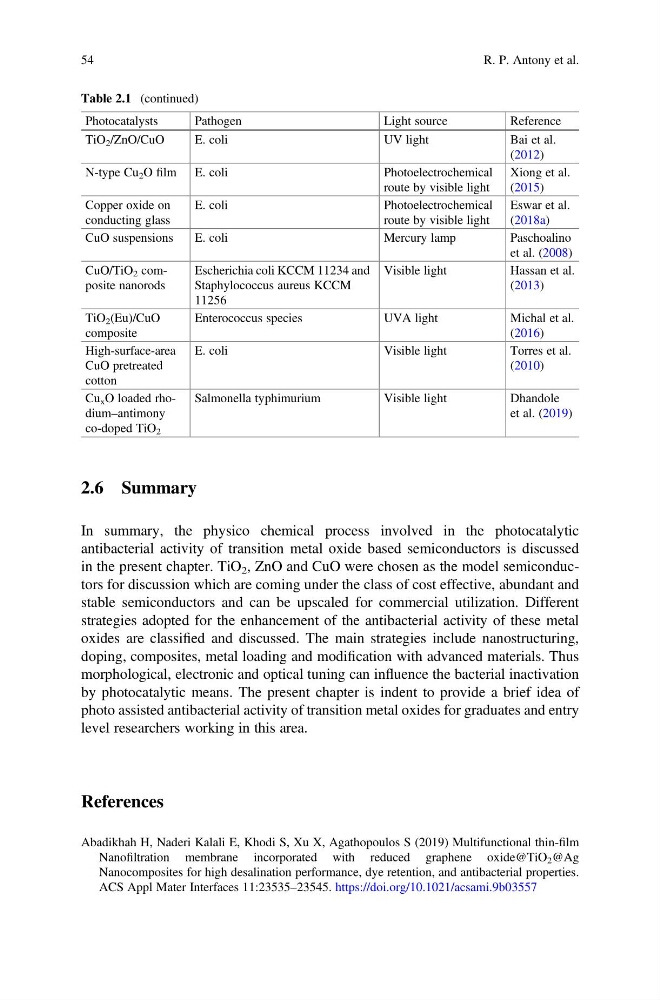
Table 2.1 (continued)
Photocatalysts
Pathogen
Light source
Reference
TiO 2 /ZnO/CuO
E. coli
UV light
Bai et al.
(2012)
N-type Cu 2 O film E. coli
Photoelectrochemical
route by visible light
Xiong et al.
(2015)
Copper oxide on
conducting glass
E. coli
Photoelectrochemical
route by visible light
Eswar et al.
(2018a)
CuO suspensions
E. coli
Mercury lamp
Paschoalino
et al. (2008)
CuO/TiO 2 composite nanorods
Escherichia coli KCCM 11234 and
Staphylococcus aureus KCCM
11256
Visible light
Hassan et al.
(2013)
TiO 2 (Eu)/CuO
composite
Enterococcus species
UVA light
Michal et al.
(2016)
High-surface-area
CuO pretreated
cotton
E. coli
Visible light
Torres et al.
(2010)
Cu x O loaded rhodium–antimony
co-doped TiO 2
Salmonella typhimurium
Visible light
Dhandole
et al. (2019)
54
R. P. Antony et al.
In summary, the physico chemical process involved in the photocatalytic
antibacterial activity of transition metal oxide based semiconductors is discussed
in the present chapter. TiO 2 , ZnO and CuO were chosen as the model semiconductors for discussion which are coming under the class of cost effective, abundant and
stable semiconductors and can be upscaled for commercial utilization. Different
strategies adopted for the enhancement of the antibacterial activity of these metal
oxides are classified and discussed. The main strategies include nanostructuring,
doping, composites, metal loading and modification with advanced materials. Thus
morphological, electronic and optical tuning can influence the bacterial inactivation
by photocatalytic means. The present chapter is indent to provide a brief idea of
photo assisted antibacterial activity of transition metal oxides for graduates and entry
level researchers working in this area.
References
Abadikhah H, Naderi Kalali E, Khodi S, Xu X, Agathopoulos S (2019) Multifunctional thin-film
Nanofiltration membrane incorporated with reduced graphene oxide@TiO 2 @Ag
Nanocomposites for high desalination performance, dye retention, and antibacterial properties.
ACS Appl Mater Interfaces 11:23535–23545. https://doi.org/10.1021/acsami.9b03557
Table 2.1 (continued)
Photocatalysts
Pathogen
Light source
Reference
TiO 2 /ZnO/CuO
E. coli
UV light
Bai et al.
(2012)
N-type Cu 2 O film E. coli
Photoelectrochemical
route by visible light
Xiong et al.
(2015)
Copper oxide on
conducting glass
E. coli
Photoelectrochemical
route by visible light
Eswar et al.
(2018a)
CuO suspensions
E. coli
Mercury lamp
Paschoalino
et al. (2008)
CuO/TiO 2 composite nanorods
Escherichia coli KCCM 11234 and
Staphylococcus aureus KCCM
11256
Visible light
Hassan et al.
(2013)
TiO 2 (Eu)/CuO
composite
Enterococcus species
UVA light
Michal et al.
(2016)
High-surface-area
CuO pretreated
cotton
E. coli
Visible light
Torres et al.
(2010)
Cu x O loaded rhodium–antimony
co-doped TiO 2
Salmonella typhimurium
Visible light
Dhandole
et al. (2019)
54
R. P. Antony et al.