

were negative and presence of Cu
2+ enhanced the electrostatic force leading to
complete destruction of bacterial cells. Akhavan and Kaderi developed CuO and
reduced CuO (Cu) nanoparticle immobilized silica thin films for photocatalytic
antibacterial applications especially E. Coli disinfection (Akhavan and Ghaderi
2010). It was observed that Cu nanoparticle with slight under layer of CuO layer
showed ~63% improvement in the photocatalytic inactivation process and the
improved activity is assigned the improved charge transfer process. Later Akhavan
developed CuO/Cu(OH) 2 hierarchical nanostructures and studied the bacterial disinfection efficacy under sunlight illuminated conditions (Akhavan et al. 2011). It was
observed that the chemical composition and surface density were the dominating
factors which affected the bacterial disinfection under illumination. Presence of
small amount of Cu(OH) 2 played an important role in OH
À adsorption and this
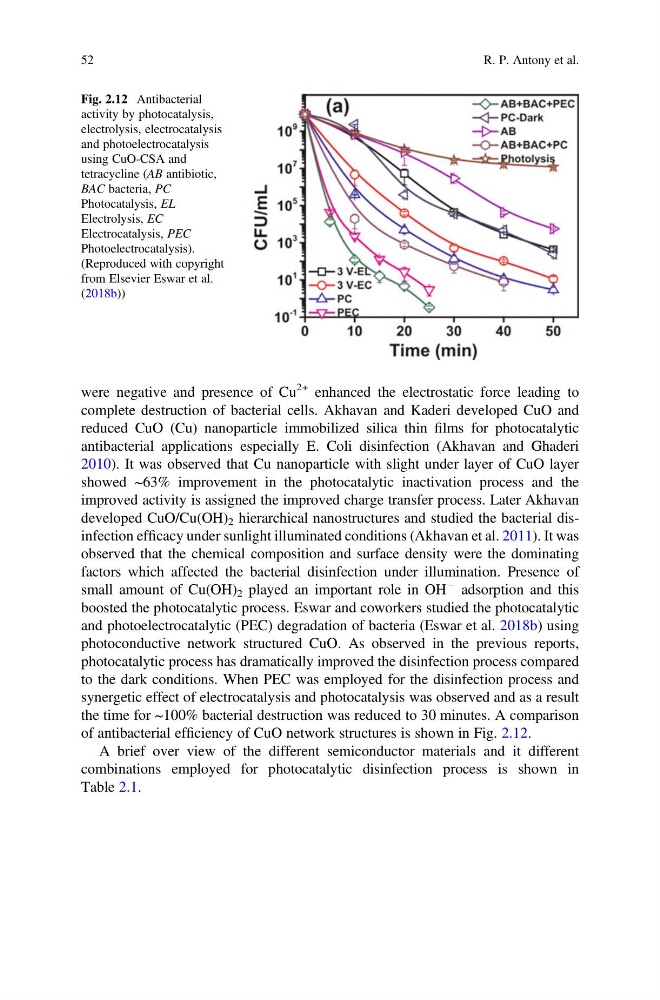
boosted the photocatalytic process. Eswar and coworkers studied the photocatalytic
and photoelectrocatalytic (PEC) degradation of bacteria (Eswar et al. 2018b) using
photoconductive network structured CuO. As observed in the previous reports,
photocatalytic process has dramatically improved the disinfection process compared
to the dark conditions. When PEC was employed for the disinfection process and
synergetic effect of electrocatalysis and photocatalysis was observed and as a result
the time for ~100% bacterial destruction was reduced to 30 minutes. A comparison
of antibacterial efficiency of CuO network structures is shown in Fig. 2.12.
A brief over view of the different semiconductor materials and it different
combinations employed for photocatalytic disinfection process is shown in
Table 2.1.
Fig. 2.12 Antibacterial
activity by photocatalysis,
electrolysis, electrocatalysis
and photoelectrocatalysis
using CuO-CSA and
tetracycline (AB antibiotic,
BAC bacteria, PC
Photocatalysis, EL
Electrolysis, EC
Electrocatalysis, PEC
Photoelectrocatalysis).
(Reproduced with copyright
from Elsevier Eswar et al.
(2018b))
52
R. P. Antony et al.
2+ enhanced the electrostatic force leading to
complete destruction of bacterial cells. Akhavan and Kaderi developed CuO and
reduced CuO (Cu) nanoparticle immobilized silica thin films for photocatalytic
antibacterial applications especially E. Coli disinfection (Akhavan and Ghaderi
2010). It was observed that Cu nanoparticle with slight under layer of CuO layer
showed ~63% improvement in the photocatalytic inactivation process and the
improved activity is assigned the improved charge transfer process. Later Akhavan
developed CuO/Cu(OH) 2 hierarchical nanostructures and studied the bacterial disinfection efficacy under sunlight illuminated conditions (Akhavan et al. 2011). It was
observed that the chemical composition and surface density were the dominating
factors which affected the bacterial disinfection under illumination. Presence of
small amount of Cu(OH) 2 played an important role in OH
À adsorption and this
boosted the photocatalytic process. Eswar and coworkers studied the photocatalytic
and photoelectrocatalytic (PEC) degradation of bacteria (Eswar et al. 2018b) using
photoconductive network structured CuO. As observed in the previous reports,
photocatalytic process has dramatically improved the disinfection process compared
to the dark conditions. When PEC was employed for the disinfection process and
synergetic effect of electrocatalysis and photocatalysis was observed and as a result
the time for ~100% bacterial destruction was reduced to 30 minutes. A comparison
of antibacterial efficiency of CuO network structures is shown in Fig. 2.12.
A brief over view of the different semiconductor materials and it different
combinations employed for photocatalytic disinfection process is shown in
Table 2.1.
Fig. 2.12 Antibacterial
activity by photocatalysis,
electrolysis, electrocatalysis
and photoelectrocatalysis
using CuO-CSA and
tetracycline (AB antibiotic,
BAC bacteria, PC
Photocatalysis, EL
Electrolysis, EC
Electrocatalysis, PEC
Photoelectrocatalysis).
(Reproduced with copyright
from Elsevier Eswar et al.
(2018b))
52
R. P. Antony et al.