

compared to ZnO and MoS 2 . The improvement in the bactericidal effect of these
composites were attributed to the improved surface area and increased product of
reactive oxygen species as observed from surface area and photoluminescence
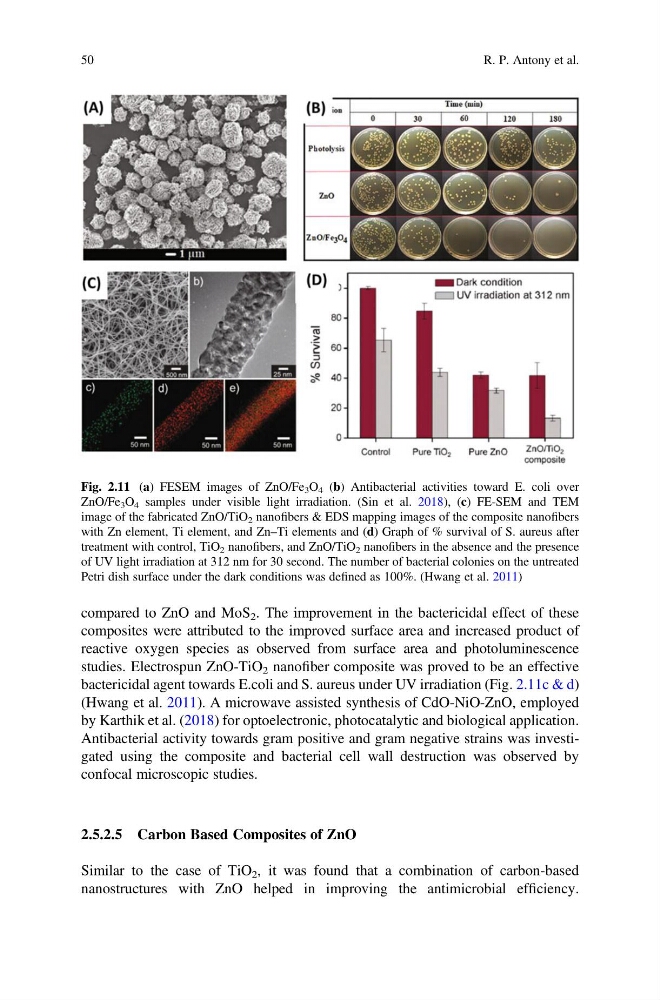
studies. Electrospun ZnO-TiO 2 nanofiber composite was proved to be an effective
bactericidal agent towards E.coli and S. aureus under UV irradiation (Fig. 2.11c & d)
(Hwang et al. 2011). A microwave assisted synthesis of CdO-NiO-ZnO, employed
by Karthik et al. (2018) for optoelectronic, photocatalytic and biological application.
Antibacterial activity towards gram positive and gram negative strains was investigated using the composite and bacterial cell wall destruction was observed by
confocal microscopic studies.
2.5.2.5 Carbon Based Composites of ZnO
Similar to the case of TiO 2 , it was found that a combination of carbon-based
nanostructures with ZnO helped in improving the antimicrobial efficiency.
Fig. 2.11 (a) FESEM images of ZnO/Fe 3 O 4 (b) Antibacterial activities toward E. coli over
ZnO/Fe 3 O 4 samples under visible light irradiation. (Sin et al. 2018), (c) FE-SEM and TEM
image of the fabricated ZnO/TiO 2 nanofibers & EDS mapping images of the composite nanofibers
with Zn element, Ti element, and Zn–Ti elements and (d) Graph of % survival of S. aureus after
treatment with control, TiO 2 nanofibers, and ZnO/TiO 2 nanofibers in the absence and the presence
of UV light irradiation at 312 nm for 30 second. The number of bacterial colonies on the untreated
Petri dish surface under the dark conditions was defined as 100%. (Hwang et al. 2011)
50
R. P. Antony et al.
composites were attributed to the improved surface area and increased product of
reactive oxygen species as observed from surface area and photoluminescence
studies. Electrospun ZnO-TiO 2 nanofiber composite was proved to be an effective
bactericidal agent towards E.coli and S. aureus under UV irradiation (Fig. 2.11c & d)
(Hwang et al. 2011). A microwave assisted synthesis of CdO-NiO-ZnO, employed
by Karthik et al. (2018) for optoelectronic, photocatalytic and biological application.
Antibacterial activity towards gram positive and gram negative strains was investigated using the composite and bacterial cell wall destruction was observed by
confocal microscopic studies.
2.5.2.5 Carbon Based Composites of ZnO
Similar to the case of TiO 2 , it was found that a combination of carbon-based
nanostructures with ZnO helped in improving the antimicrobial efficiency.
Fig. 2.11 (a) FESEM images of ZnO/Fe 3 O 4 (b) Antibacterial activities toward E. coli over
ZnO/Fe 3 O 4 samples under visible light irradiation. (Sin et al. 2018), (c) FE-SEM and TEM
image of the fabricated ZnO/TiO 2 nanofibers & EDS mapping images of the composite nanofibers
with Zn element, Ti element, and Zn–Ti elements and (d) Graph of % survival of S. aureus after
treatment with control, TiO 2 nanofibers, and ZnO/TiO 2 nanofibers in the absence and the presence
of UV light irradiation at 312 nm for 30 second. The number of bacterial colonies on the untreated
Petri dish surface under the dark conditions was defined as 100%. (Hwang et al. 2011)
50
R. P. Antony et al.