

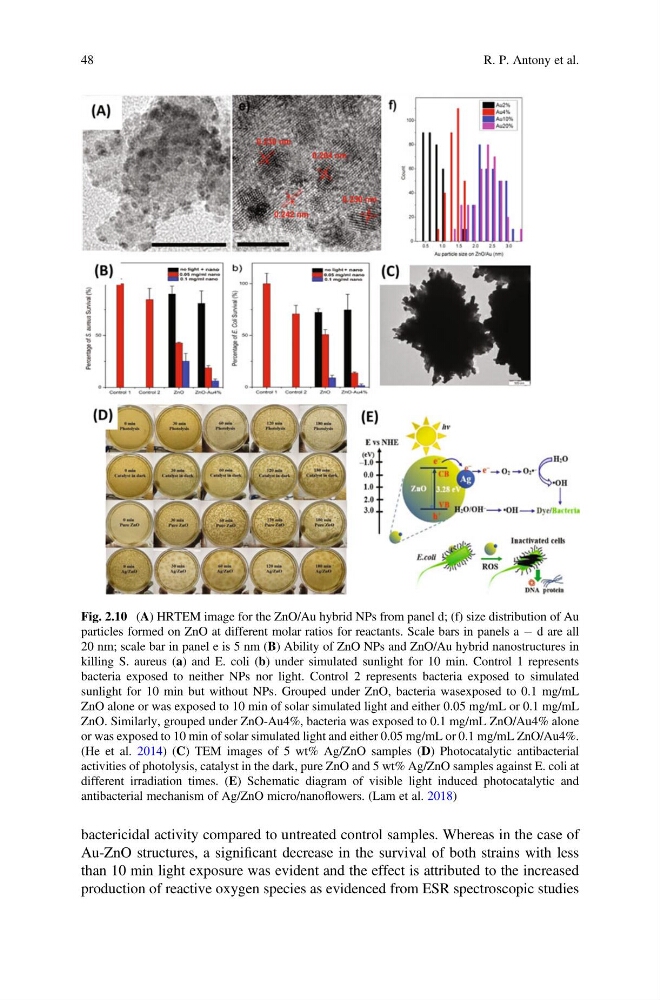
bactericidal activity compared to untreated control samples. Whereas in the case of
Au-ZnO structures, a significant decrease in the survival of both strains with less
than 10 min light exposure was evident and the effect is attributed to the increased
production of reactive oxygen species as evidenced from ESR spectroscopic studies
Fig. 2.10 (A) HRTEM image for the ZnO/Au hybrid NPs from panel d; (f) size distribution of Au
particles formed on ZnO at different molar ratios for reactants. Scale bars in panels a À d are all
20 nm; scale bar in panel e is 5 nm (B) Ability of ZnO NPs and ZnO/Au hybrid nanostructures in
killing S. aureus (a) and E. coli (b) under simulated sunlight for 10 min. Control 1 represents
bacteria exposed to neither NPs nor light. Control 2 represents bacteria exposed to simulated
sunlight for 10 min but without NPs. Grouped under ZnO, bacteria wasexposed to 0.1 mg/mL
ZnO alone or was exposed to 10 min of solar simulated light and either 0.05 mg/mL or 0.1 mg/mL
ZnO. Similarly, grouped under ZnO-Au4%, bacteria was exposed to 0.1 mg/mL ZnO/Au4% alone
or was exposed to 10 min of solar simulated light and either 0.05 mg/mL or 0.1 mg/mL ZnO/Au4%.
(He et al. 2014) (C) TEM images of 5 wt% Ag/ZnO samples (D) Photocatalytic antibacterial
activities of photolysis, catalyst in the dark, pure ZnO and 5 wt% Ag/ZnO samples against E. coli at
different irradiation times. (E) Schematic diagram of visible light induced photocatalytic and
antibacterial mechanism of Ag/ZnO micro/nanoflowers. (Lam et al. 2018)
48
R. P. Antony et al.
Au-ZnO structures, a significant decrease in the survival of both strains with less
than 10 min light exposure was evident and the effect is attributed to the increased
production of reactive oxygen species as evidenced from ESR spectroscopic studies
Fig. 2.10 (A) HRTEM image for the ZnO/Au hybrid NPs from panel d; (f) size distribution of Au
particles formed on ZnO at different molar ratios for reactants. Scale bars in panels a À d are all
20 nm; scale bar in panel e is 5 nm (B) Ability of ZnO NPs and ZnO/Au hybrid nanostructures in
killing S. aureus (a) and E. coli (b) under simulated sunlight for 10 min. Control 1 represents
bacteria exposed to neither NPs nor light. Control 2 represents bacteria exposed to simulated
sunlight for 10 min but without NPs. Grouped under ZnO, bacteria wasexposed to 0.1 mg/mL
ZnO alone or was exposed to 10 min of solar simulated light and either 0.05 mg/mL or 0.1 mg/mL
ZnO. Similarly, grouped under ZnO-Au4%, bacteria was exposed to 0.1 mg/mL ZnO/Au4% alone
or was exposed to 10 min of solar simulated light and either 0.05 mg/mL or 0.1 mg/mL ZnO/Au4%.
(He et al. 2014) (C) TEM images of 5 wt% Ag/ZnO samples (D) Photocatalytic antibacterial
activities of photolysis, catalyst in the dark, pure ZnO and 5 wt% Ag/ZnO samples against E. coli at
different irradiation times. (E) Schematic diagram of visible light induced photocatalytic and
antibacterial mechanism of Ag/ZnO micro/nanoflowers. (Lam et al. 2018)
48
R. P. Antony et al.