

of Ag-ZnO was attributed to the enhanced generation of reactive oxygen species
such as •O 2
À , OH• and H 2 O 2 . Raju and coworkers demonstrated a similar system
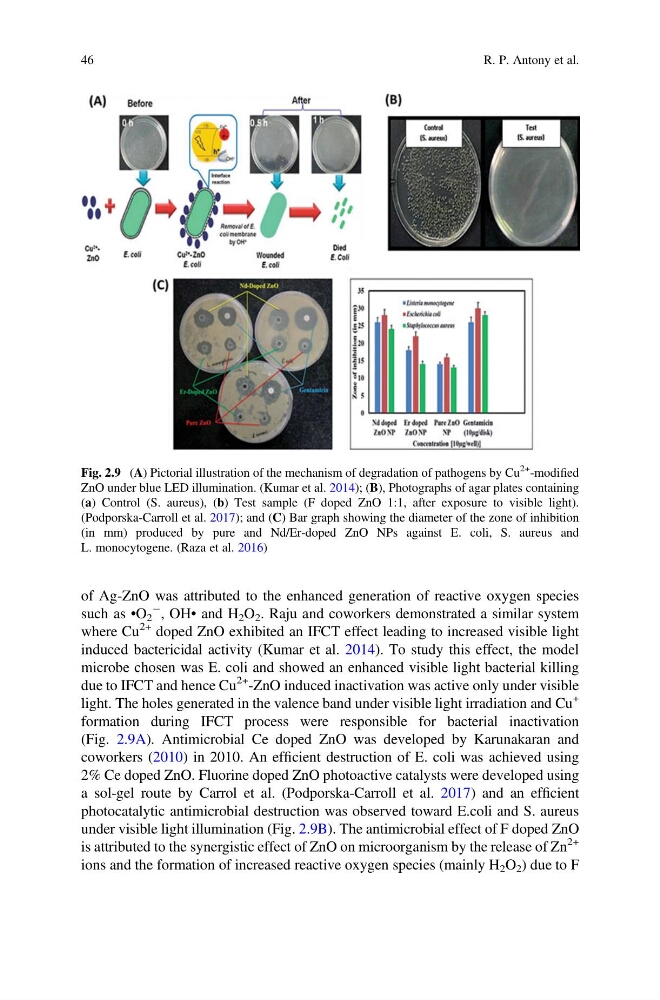
where Cu
2+ doped ZnO exhibited an IFCT effect leading to increased visible light
induced bactericidal activity (Kumar et al. 2014). To study this effect, the model
microbe chosen was E. coli and showed an enhanced visible light bacterial killing
due to IFCT and hence Cu
2+ -ZnO induced inactivation was active only under visible
light. The holes generated in the valence band under visible light irradiation and Cu
+
formation during IFCT process were responsible for bacterial inactivation
(Fig. 2.9A). Antimicrobial Ce doped ZnO was developed by Karunakaran and
coworkers (2010) in 2010. An efficient destruction of E. coli was achieved using
2% Ce doped ZnO. Fluorine doped ZnO photoactive catalysts were developed using
a sol-gel route by Carrol et al. (Podporska-Carroll et al. 2017) and an efficient
photocatalytic antimicrobial destruction was observed toward E.coli and S. aureus
under visible light illumination (Fig. 2.9B). The antimicrobial effect of F doped ZnO
is attributed to the synergistic effect of ZnO on microorganism by the release of Zn
2+
ions and the formation of increased reactive oxygen species (mainly H 2 O 2 ) due to F
Fig. 2.9 (A) Pictorial illustration of the mechanism of degradation of pathogens by Cu
2+ -modified
ZnO under blue LED illumination. (Kumar et al. 2014); (B), Photographs of agar plates containing
(a) Control (S. aureus), (b) Test sample (F doped ZnO 1:1, after exposure to visible light).
(Podporska-Carroll et al. 2017); and (C) Bar graph showing the diameter of the zone of inhibition
(in mm) produced by pure and Nd/Er-doped ZnO NPs against E. coli, S. aureus and
L. monocytogene. (Raza et al. 2016)
46
R. P. Antony et al.
such as •O 2
À , OH• and H 2 O 2 . Raju and coworkers demonstrated a similar system
where Cu
2+ doped ZnO exhibited an IFCT effect leading to increased visible light
induced bactericidal activity (Kumar et al. 2014). To study this effect, the model
microbe chosen was E. coli and showed an enhanced visible light bacterial killing
due to IFCT and hence Cu
2+ -ZnO induced inactivation was active only under visible
light. The holes generated in the valence band under visible light irradiation and Cu
+
formation during IFCT process were responsible for bacterial inactivation
(Fig. 2.9A). Antimicrobial Ce doped ZnO was developed by Karunakaran and
coworkers (2010) in 2010. An efficient destruction of E. coli was achieved using
2% Ce doped ZnO. Fluorine doped ZnO photoactive catalysts were developed using
a sol-gel route by Carrol et al. (Podporska-Carroll et al. 2017) and an efficient
photocatalytic antimicrobial destruction was observed toward E.coli and S. aureus
under visible light illumination (Fig. 2.9B). The antimicrobial effect of F doped ZnO
is attributed to the synergistic effect of ZnO on microorganism by the release of Zn
2+
ions and the formation of increased reactive oxygen species (mainly H 2 O 2 ) due to F
Fig. 2.9 (A) Pictorial illustration of the mechanism of degradation of pathogens by Cu
2+ -modified
ZnO under blue LED illumination. (Kumar et al. 2014); (B), Photographs of agar plates containing
(a) Control (S. aureus), (b) Test sample (F doped ZnO 1:1, after exposure to visible light).
(Podporska-Carroll et al. 2017); and (C) Bar graph showing the diameter of the zone of inhibition
(in mm) produced by pure and Nd/Er-doped ZnO NPs against E. coli, S. aureus and
L. monocytogene. (Raza et al. 2016)
46
R. P. Antony et al.