

photocatalytic disinfection process, but cannot be modeled together. When the value
of ‘m’ ¼ 1, the model reduces to Chick-Watson model, when m > 1, it shows a
shoulder (lag) and when m < 1, it shows a tailing off behaviour as shown in Fig. 2.2c
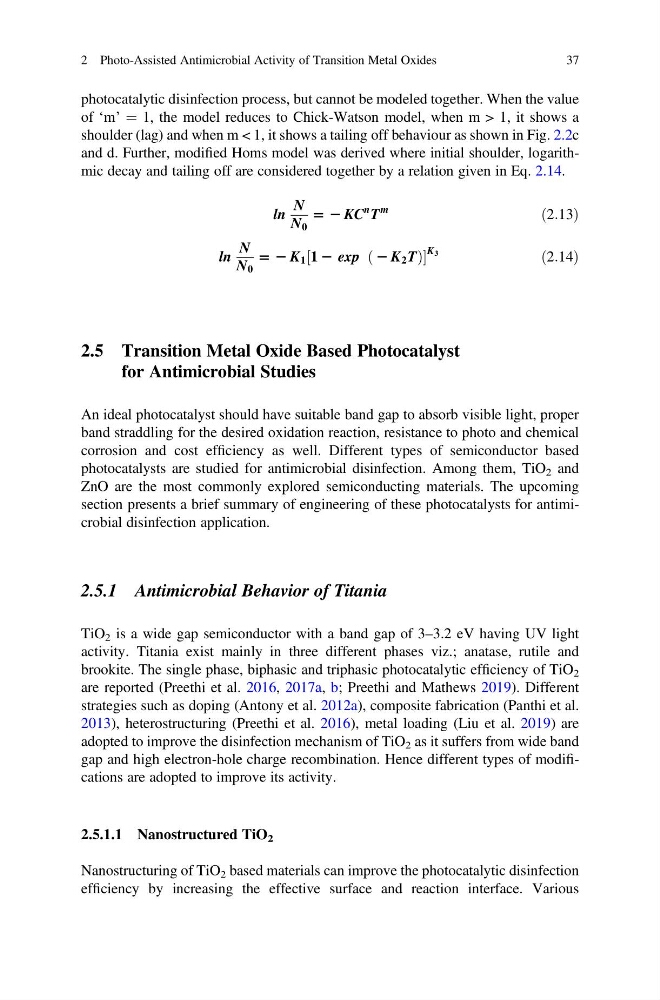
and d. Further, modified Homs model was derived where initial shoulder, logarithmic decay and tailing off are considered together by a relation given in Eq. 2.14.
ln
N
N 0
= 2 KC
n T
m
ð2:13Þ
ln
N
N 0
= 2 K 1 1 2 exp 2 K 2 T
ð
Þ
½
K 3
ð2:14Þ
2.5 Transition Metal Oxide Based Photocatalyst
for Antimicrobial Studies
An ideal photocatalyst should have suitable band gap to absorb visible light, proper
band straddling for the desired oxidation reaction, resistance to photo and chemical
corrosion and cost efficiency as well. Different types of semiconductor based
photocatalysts are studied for antimicrobial disinfection. Among them, TiO 2 and
ZnO are the most commonly explored semiconducting materials. The upcoming
section presents a brief summary of engineering of these photocatalysts for antimicrobial disinfection application.
2.5.1 Antimicrobial Behavior of Titania
TiO 2 is a wide gap semiconductor with a band gap of 3–3.2 eV having UV light
activity. Titania exist mainly in three different phases viz.; anatase, rutile and
brookite. The single phase, biphasic and triphasic photocatalytic efficiency of TiO 2
are reported (Preethi et al. 2016, 2017a, b; Preethi and Mathews 2019). Different
strategies such as doping (Antony et al. 2012a), composite fabrication (Panthi et al.
2013), heterostructuring (Preethi et al. 2016), metal loading (Liu et al. 2019) are
adopted to improve the disinfection mechanism of TiO 2 as it suffers from wide band
gap and high electron-hole charge recombination. Hence different types of modifications are adopted to improve its activity.
2.5.1.1 Nanostructured TiO 2
Nanostructuring of TiO 2 based materials can improve the photocatalytic disinfection
efficiency by increasing the effective surface and reaction interface. Various
2 Photo-Assisted Antimicrobial Activity of Transition Metal Oxides
37
of ‘m’ ¼ 1, the model reduces to Chick-Watson model, when m > 1, it shows a
shoulder (lag) and when m < 1, it shows a tailing off behaviour as shown in Fig. 2.2c
and d. Further, modified Homs model was derived where initial shoulder, logarithmic decay and tailing off are considered together by a relation given in Eq. 2.14.
ln
N
N 0
= 2 KC
n T
m
ð2:13Þ
ln
N
N 0
= 2 K 1 1 2 exp 2 K 2 T
ð
Þ
½
K 3
ð2:14Þ
2.5 Transition Metal Oxide Based Photocatalyst
for Antimicrobial Studies
An ideal photocatalyst should have suitable band gap to absorb visible light, proper
band straddling for the desired oxidation reaction, resistance to photo and chemical
corrosion and cost efficiency as well. Different types of semiconductor based
photocatalysts are studied for antimicrobial disinfection. Among them, TiO 2 and
ZnO are the most commonly explored semiconducting materials. The upcoming
section presents a brief summary of engineering of these photocatalysts for antimicrobial disinfection application.
2.5.1 Antimicrobial Behavior of Titania
TiO 2 is a wide gap semiconductor with a band gap of 3–3.2 eV having UV light
activity. Titania exist mainly in three different phases viz.; anatase, rutile and
brookite. The single phase, biphasic and triphasic photocatalytic efficiency of TiO 2
are reported (Preethi et al. 2016, 2017a, b; Preethi and Mathews 2019). Different
strategies such as doping (Antony et al. 2012a), composite fabrication (Panthi et al.
2013), heterostructuring (Preethi et al. 2016), metal loading (Liu et al. 2019) are
adopted to improve the disinfection mechanism of TiO 2 as it suffers from wide band
gap and high electron-hole charge recombination. Hence different types of modifications are adopted to improve its activity.
2.5.1.1 Nanostructured TiO 2
Nanostructuring of TiO 2 based materials can improve the photocatalytic disinfection
efficiency by increasing the effective surface and reaction interface. Various
2 Photo-Assisted Antimicrobial Activity of Transition Metal Oxides
37