

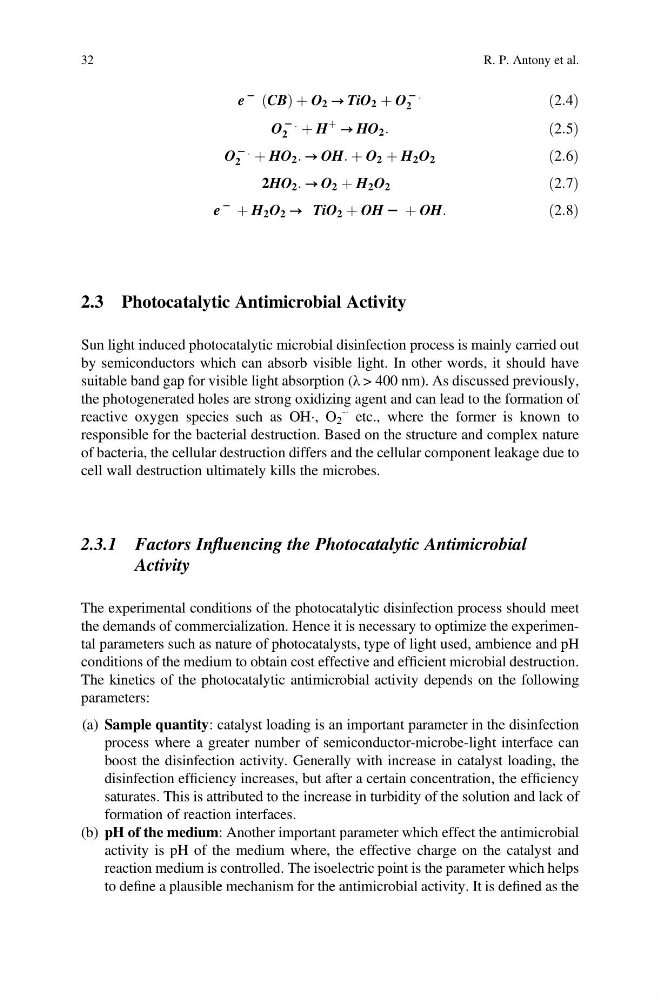
e
2 CB
ð ÞþO 2 → TiO 2 þ O
2 :
2
ð2:4Þ
O
2 :
2 þ H
þ
→ HO 2 :
ð2:5Þ
O
2 :
2 þ HO 2 : → OH: þ O 2 þ H 2 O 2
ð2:6Þ
2HO 2 : → O 2 þ H 2 O 2
ð2:7Þ
e
2
þ H 2 O 2 → TiO 2 þ OH 2 þ OH:
ð2:8Þ
2.3 Photocatalytic Antimicrobial Activity
Sun light induced photocatalytic microbial disinfection process is mainly carried out
by semiconductors which can absorb visible light. In other words, it should have
suitable band gap for visible light absorption (λ > 400 nm). As discussed previously,
the photogenerated holes are strong oxidizing agent and can lead to the formation of
reactive oxygen species such as OHÁ, O 2
-Á etc., where the former is known to
responsible for the bacterial destruction. Based on the structure and complex nature
of bacteria, the cellular destruction differs and the cellular component leakage due to
cell wall destruction ultimately kills the microbes.
2.3.1 Factors Influencing the Photocatalytic Antimicrobial
Activity
The experimental conditions of the photocatalytic disinfection process should meet
the demands of commercialization. Hence it is necessary to optimize the experimental parameters such as nature of photocatalysts, type of light used, ambience and pH
conditions of the medium to obtain cost effective and efficient microbial destruction.
The kinetics of the photocatalytic antimicrobial activity depends on the following
parameters:
(a) Sample quantity: catalyst loading is an important parameter in the disinfection
process where a greater number of semiconductor-microbe-light interface can
boost the disinfection activity. Generally with increase in catalyst loading, the
disinfection efficiency increases, but after a certain concentration, the efficiency
saturates. This is attributed to the increase in turbidity of the solution and lack of
formation of reaction interfaces.
(b) pH of the medium: Another important parameter which effect the antimicrobial
activity is pH of the medium where, the effective charge on the catalyst and
reaction medium is controlled. The isoelectric point is the parameter which helps
to define a plausible mechanism for the antimicrobial activity. It is defined as the
32
R. P. Antony et al.
2 CB
ð ÞþO 2 → TiO 2 þ O
2 :
2
ð2:4Þ
O
2 :
2 þ H
þ
→ HO 2 :
ð2:5Þ
O
2 :
2 þ HO 2 : → OH: þ O 2 þ H 2 O 2
ð2:6Þ
2HO 2 : → O 2 þ H 2 O 2
ð2:7Þ
e
2
þ H 2 O 2 → TiO 2 þ OH 2 þ OH:
ð2:8Þ
2.3 Photocatalytic Antimicrobial Activity
Sun light induced photocatalytic microbial disinfection process is mainly carried out
by semiconductors which can absorb visible light. In other words, it should have
suitable band gap for visible light absorption (λ > 400 nm). As discussed previously,
the photogenerated holes are strong oxidizing agent and can lead to the formation of
reactive oxygen species such as OHÁ, O 2
-Á etc., where the former is known to
responsible for the bacterial destruction. Based on the structure and complex nature
of bacteria, the cellular destruction differs and the cellular component leakage due to
cell wall destruction ultimately kills the microbes.
2.3.1 Factors Influencing the Photocatalytic Antimicrobial
Activity
The experimental conditions of the photocatalytic disinfection process should meet
the demands of commercialization. Hence it is necessary to optimize the experimental parameters such as nature of photocatalysts, type of light used, ambience and pH
conditions of the medium to obtain cost effective and efficient microbial destruction.
The kinetics of the photocatalytic antimicrobial activity depends on the following
parameters:
(a) Sample quantity: catalyst loading is an important parameter in the disinfection
process where a greater number of semiconductor-microbe-light interface can
boost the disinfection activity. Generally with increase in catalyst loading, the
disinfection efficiency increases, but after a certain concentration, the efficiency
saturates. This is attributed to the increase in turbidity of the solution and lack of
formation of reaction interfaces.
(b) pH of the medium: Another important parameter which effect the antimicrobial
activity is pH of the medium where, the effective charge on the catalyst and
reaction medium is controlled. The isoelectric point is the parameter which helps
to define a plausible mechanism for the antimicrobial activity. It is defined as the
32
R. P. Antony et al.