

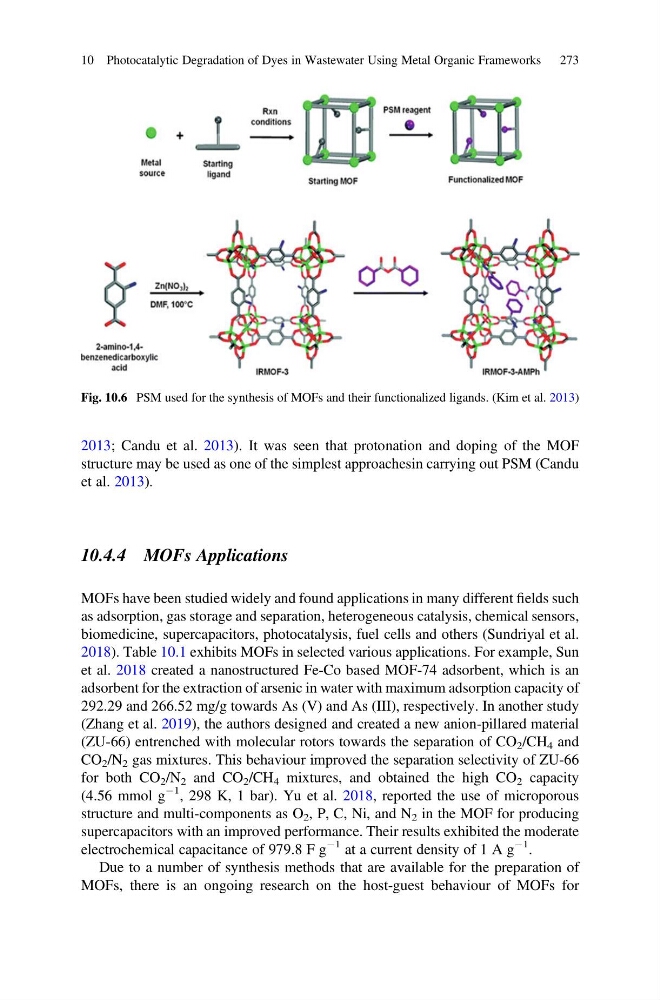
2013; Candu et al. 2013). It was seen that protonation and doping of the MOF
structure may be used as one of the simplest approachesin carrying out PSM (Candu
et al. 2013).
10.4.4 MOFs Applications
MOFs have been studied widely and found applications in many different fields such
as adsorption, gas storage and separation, heterogeneous catalysis, chemical sensors,
biomedicine, supercapacitors, photocatalysis, fuel cells and others (Sundriyal et al.
2018). Table 10.1 exhibits MOFs in selected various applications. For example, Sun
et al. 2018 created a nanostructured Fe-Co based MOF-74 adsorbent, which is an
adsorbent for the extraction of arsenic in water with maximum adsorption capacity of
292.29 and 266.52 mg/g towards As (V) and As (III), respectively. In another study
(Zhang et al. 2019), the authors designed and created a new anion-pillared material
(ZU-66) entrenched with molecular rotors towards the separation of CO 2 /CH 4 and
CO 2 /N 2 gas mixtures. This behaviour improved the separation selectivity of ZU-66
for both CO 2 /N 2 and CO 2 /CH 4 mixtures, and obtained the high CO 2 capacity
(4.56 mmol g
À1 , 298 K, 1 bar). Yu et al. 2018, reported the use of microporous
structure and multi-components as O 2 , P, C, Ni, and N 2 in the MOF for producing
supercapacitors with an improved performance. Their results exhibited the moderate
electrochemical capacitance of 979.8 F g
À1 at a current density of 1 A g
À1 .
Due to a number of synthesis methods that are available for the preparation of
MOFs, there is an ongoing research on the host-guest behaviour of MOFs for
Fig. 10.6 PSM used for the synthesis of MOFs and their functionalized ligands. (Kim et al. 2013)
10 Photocatalytic Degradation of Dyes in Wastewater Using Metal Organic Frameworks 273
structure may be used as one of the simplest approachesin carrying out PSM (Candu
et al. 2013).
10.4.4 MOFs Applications
MOFs have been studied widely and found applications in many different fields such
as adsorption, gas storage and separation, heterogeneous catalysis, chemical sensors,
biomedicine, supercapacitors, photocatalysis, fuel cells and others (Sundriyal et al.
2018). Table 10.1 exhibits MOFs in selected various applications. For example, Sun
et al. 2018 created a nanostructured Fe-Co based MOF-74 adsorbent, which is an
adsorbent for the extraction of arsenic in water with maximum adsorption capacity of
292.29 and 266.52 mg/g towards As (V) and As (III), respectively. In another study
(Zhang et al. 2019), the authors designed and created a new anion-pillared material
(ZU-66) entrenched with molecular rotors towards the separation of CO 2 /CH 4 and
CO 2 /N 2 gas mixtures. This behaviour improved the separation selectivity of ZU-66
for both CO 2 /N 2 and CO 2 /CH 4 mixtures, and obtained the high CO 2 capacity
(4.56 mmol g
À1 , 298 K, 1 bar). Yu et al. 2018, reported the use of microporous
structure and multi-components as O 2 , P, C, Ni, and N 2 in the MOF for producing
supercapacitors with an improved performance. Their results exhibited the moderate
electrochemical capacitance of 979.8 F g
À1 at a current density of 1 A g
À1 .
Due to a number of synthesis methods that are available for the preparation of
MOFs, there is an ongoing research on the host-guest behaviour of MOFs for
Fig. 10.6 PSM used for the synthesis of MOFs and their functionalized ligands. (Kim et al. 2013)
10 Photocatalytic Degradation of Dyes in Wastewater Using Metal Organic Frameworks 273