

about MOF is that its structure is highly tuneable by changing the metal nodes or
organic ligands. This characteristic makes it probable to acquire a suitable MOF
material suitable for a specified application (Suna et al. 2017; Vlasova et al. 2016).
MOFs pore permeability can range from 20 and be as high as 95 percent (Meng et al.
2017). The excellent pore permeability is associated with the high internal surface
areas and due to this property, MOFs have gained much attention from the scientific
community (Zhao et al. 2016; Cheetham et al. 2006).
10.4.1 Discovery of Metal Organic Frameworks
MOFs discovery occurred at the time when several scientists where studying the
Zeolites (Li and Yang 2007; Tranchemontagne et al. 2008). This led to Yaghi
coining the term “metal-organic frameworks, MOFs in 1995 when copper-4,40 -bipryridal complex which displayed extended metal-organic interactions was successfully synthesised (Zhao et al. 2016; Li and Yang 2007). MOFs have its place to
the general family of coordination polymers and specifically, to the 2D or 3D
crystallized networks possessing porous property in comparison to the traditional
coordination polymers (Qiu et al. 2018; Ramohlola et al. 2017a, b, c, 2018; Monama
et al. 2018, 2019; Mashao et al. 2019; Yuan et al. 2015; Kreno et al. 2011).
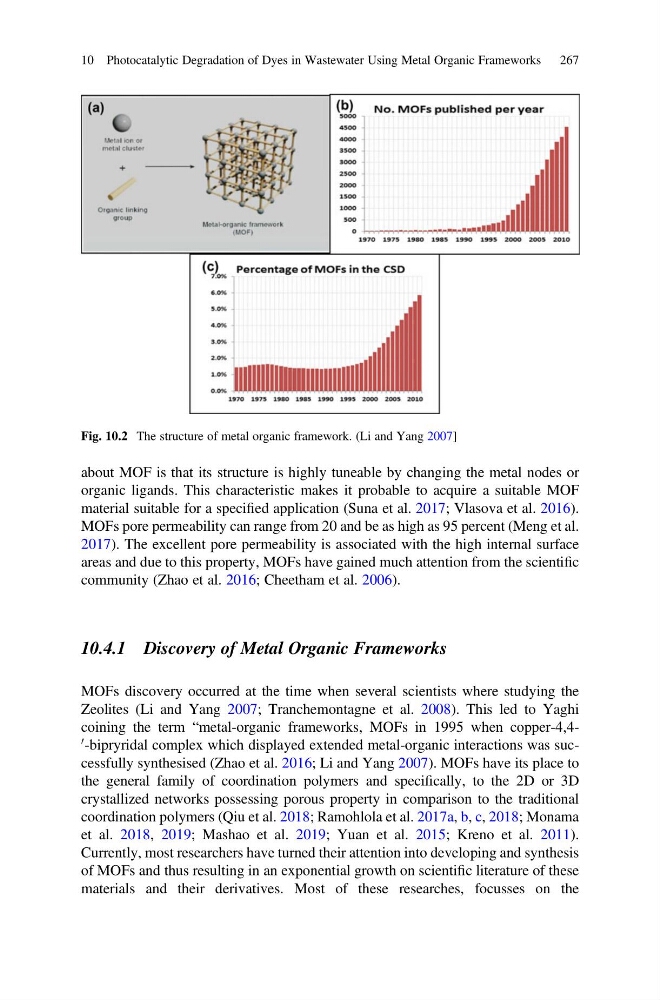
Currently, most researchers have turned their attention into developing and synthesis
of MOFs and thus resulting in an exponential growth on scientific literature of these
materials and their derivatives. Most of these researches, focusses on the
Fig. 10.2 The structure of metal organic framework. (Li and Yang 2007]
10 Photocatalytic Degradation of Dyes in Wastewater Using Metal Organic Frameworks 267
organic ligands. This characteristic makes it probable to acquire a suitable MOF
material suitable for a specified application (Suna et al. 2017; Vlasova et al. 2016).
MOFs pore permeability can range from 20 and be as high as 95 percent (Meng et al.
2017). The excellent pore permeability is associated with the high internal surface
areas and due to this property, MOFs have gained much attention from the scientific
community (Zhao et al. 2016; Cheetham et al. 2006).
10.4.1 Discovery of Metal Organic Frameworks
MOFs discovery occurred at the time when several scientists where studying the
Zeolites (Li and Yang 2007; Tranchemontagne et al. 2008). This led to Yaghi
coining the term “metal-organic frameworks, MOFs in 1995 when copper-4,40 -bipryridal complex which displayed extended metal-organic interactions was successfully synthesised (Zhao et al. 2016; Li and Yang 2007). MOFs have its place to
the general family of coordination polymers and specifically, to the 2D or 3D
crystallized networks possessing porous property in comparison to the traditional
coordination polymers (Qiu et al. 2018; Ramohlola et al. 2017a, b, c, 2018; Monama
et al. 2018, 2019; Mashao et al. 2019; Yuan et al. 2015; Kreno et al. 2011).
Currently, most researchers have turned their attention into developing and synthesis
of MOFs and thus resulting in an exponential growth on scientific literature of these
materials and their derivatives. Most of these researches, focusses on the
Fig. 10.2 The structure of metal organic framework. (Li and Yang 2007]
10 Photocatalytic Degradation of Dyes in Wastewater Using Metal Organic Frameworks 267