

from aqueous solution. At a pH value of 5.6 after 12 h treatment, the observed
adsorption capacities were ~ 65.6 mgg
À1 for Pb(II), ~72.8 mgg
À1 for Cd
(II) and ~ 88.9 mgg
À1 for Zn(II). These values were much higher than that observed
for colloidal graphene oxide. In another study, synthesized TiO 2 hierarchical spheres
demonstrated higher As(V) removal capacity compared to commercial TiO 2 , commercial CeO 2 , synthesized CeO 2 hierarchical nanostructures and commercial αFe 2 O 3 (Hu et al. 2008). On the other hand, the synthesized CeO 2 produced the
best result in terms of Cr(VI) adsorption capacity among the oxides studied. Apart
from the ones discussed above, other metal oxides used with some success for the
purpose of heavy metal decontamination from water are CeO 2 (Zhong et al. 2007),
Al 2 O 3 (Yamani et al. 2012; Kuan et al. 1998), SiO 2 (Sheet et al. 2014; Karnib et al.
2014), MgO (Cao et al. 2012), ZrO 2 (Hristovski et al. 2007), and NiO (Hristovski
et al. 2007).
1.4 Salt
We have vast resources of water in the forms of seas and oceans. However, we
cannot use water from these resources for our consumption and daily household
needs because they contain large concentration of dissolved salts. Nevertheless,
owing to the severe scarcity of water underground and fresh water bodies, we
have in recent times turned our attention to device methods and techniques for
utilizing sea and ocean waters for our daily activities. There are a number of different
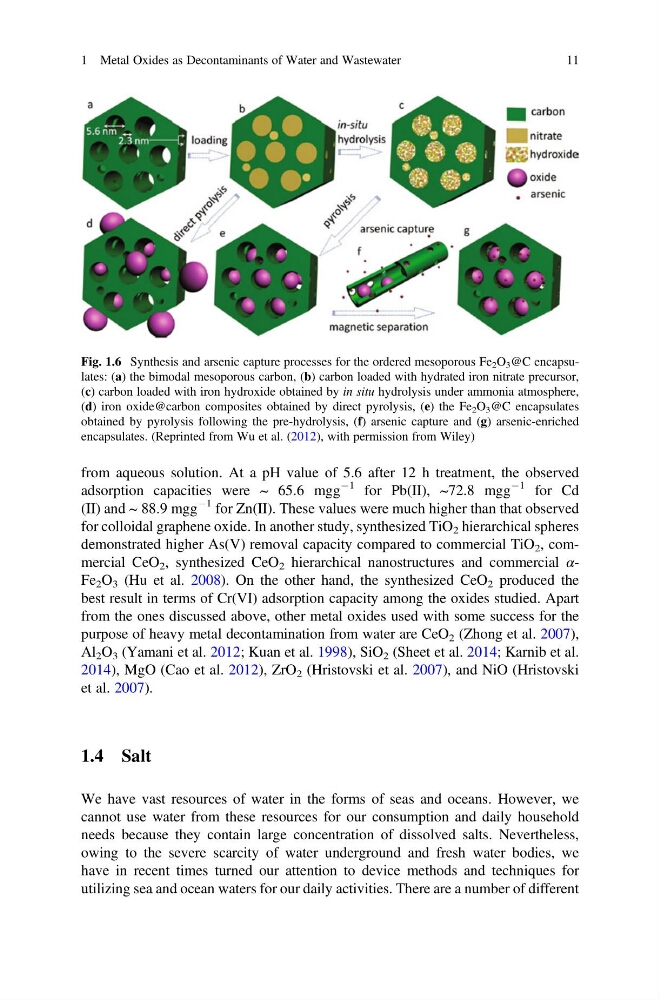
Fig. 1.6 Synthesis and arsenic capture processes for the ordered mesoporous Fe 2 O 3 @C encapsulates: (a) the bimodal mesoporous carbon, (b) carbon loaded with hydrated iron nitrate precursor,
(c) carbon loaded with iron hydroxide obtained by in situ hydrolysis under ammonia atmosphere,
(d) iron oxide@carbon composites obtained by direct pyrolysis, (e) the Fe 2 O 3 @C encapsulates
obtained by pyrolysis following the pre-hydrolysis, (f) arsenic capture and (g) arsenic-enriched
encapsulates. (Reprinted from Wu et al. (2012), with permission from Wiley)
1 Metal Oxides as Decontaminants of Water and Wastewater
11
adsorption capacities were ~ 65.6 mgg
À1 for Pb(II), ~72.8 mgg
À1 for Cd
(II) and ~ 88.9 mgg
À1 for Zn(II). These values were much higher than that observed
for colloidal graphene oxide. In another study, synthesized TiO 2 hierarchical spheres
demonstrated higher As(V) removal capacity compared to commercial TiO 2 , commercial CeO 2 , synthesized CeO 2 hierarchical nanostructures and commercial αFe 2 O 3 (Hu et al. 2008). On the other hand, the synthesized CeO 2 produced the
best result in terms of Cr(VI) adsorption capacity among the oxides studied. Apart
from the ones discussed above, other metal oxides used with some success for the
purpose of heavy metal decontamination from water are CeO 2 (Zhong et al. 2007),
Al 2 O 3 (Yamani et al. 2012; Kuan et al. 1998), SiO 2 (Sheet et al. 2014; Karnib et al.
2014), MgO (Cao et al. 2012), ZrO 2 (Hristovski et al. 2007), and NiO (Hristovski
et al. 2007).
1.4 Salt
We have vast resources of water in the forms of seas and oceans. However, we
cannot use water from these resources for our consumption and daily household
needs because they contain large concentration of dissolved salts. Nevertheless,
owing to the severe scarcity of water underground and fresh water bodies, we
have in recent times turned our attention to device methods and techniques for
utilizing sea and ocean waters for our daily activities. There are a number of different
Fig. 1.6 Synthesis and arsenic capture processes for the ordered mesoporous Fe 2 O 3 @C encapsulates: (a) the bimodal mesoporous carbon, (b) carbon loaded with hydrated iron nitrate precursor,
(c) carbon loaded with iron hydroxide obtained by in situ hydrolysis under ammonia atmosphere,
(d) iron oxide@carbon composites obtained by direct pyrolysis, (e) the Fe 2 O 3 @C encapsulates
obtained by pyrolysis following the pre-hydrolysis, (f) arsenic capture and (g) arsenic-enriched
encapsulates. (Reprinted from Wu et al. (2012), with permission from Wiley)
1 Metal Oxides as Decontaminants of Water and Wastewater
11