

7.3 The Solving the Problem of Abundancy
Any world problem must have various parallel solution with immediate, middle and
long-term solution. The solutions for water remediation problem aspired to be
permanent and sustainable Herein, we described the four-possible solution for
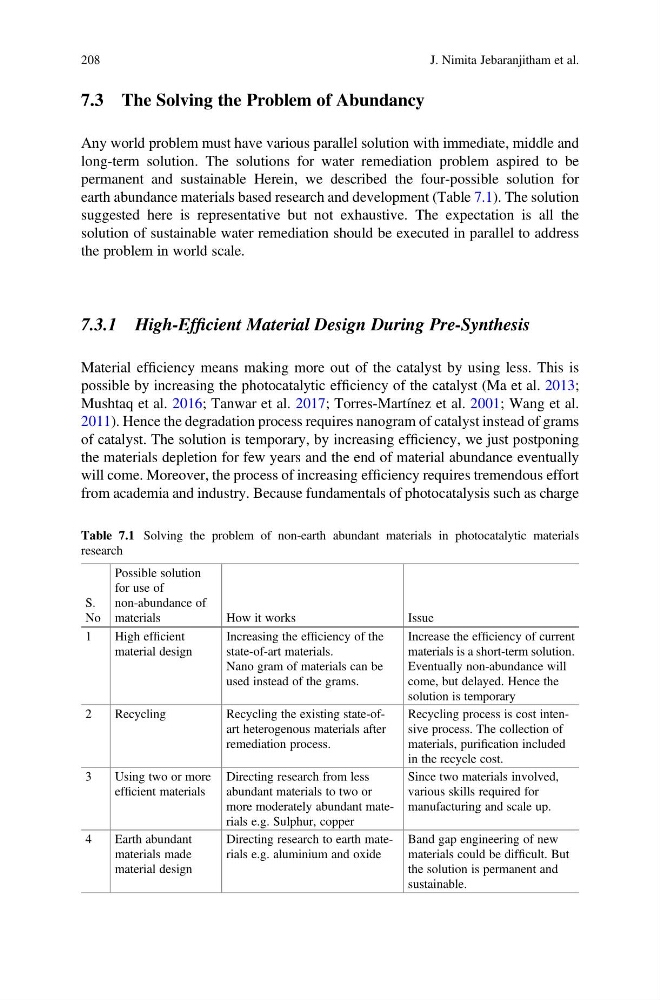
earth abundance materials based research and development (Table 7.1). The solution
suggested here is representative but not exhaustive. The expectation is all the
solution of sustainable water remediation should be executed in parallel to address
the problem in world scale.
7.3.1 High-Efficient Material Design During Pre-Synthesis
Material efficiency means making more out of the catalyst by using less. This is
possible by increasing the photocatalytic efficiency of the catalyst (Ma et al. 2013;
Mushtaq et al. 2016; Tanwar et al. 2017; Torres-Martínez et al. 2001; Wang et al.
2011). Hence the degradation process requires nanogram of catalyst instead of grams
of catalyst. The solution is temporary, by increasing efficiency, we just postponing
the materials depletion for few years and the end of material abundance eventually
will come. Moreover, the process of increasing efficiency requires tremendous effort
from academia and industry. Because fundamentals of photocatalysis such as charge
Table 7.1 Solving the problem of non-earth abundant materials in photocatalytic materials
research
S.
No
Possible solution
for use of
non-abundance of
materials
How it works
Issue
1
High efficient
material design
Increasing the efficiency of the
state-of-art materials.
Nano gram of materials can be
used instead of the grams.
Increase the efficiency of current
materials is a short-term solution.
Eventually non-abundance will
come, but delayed. Hence the
solution is temporary
2
Recycling
Recycling the existing state-ofart heterogenous materials after
remediation process.
Recycling process is cost intensive process. The collection of
materials, purification included
in the recycle cost.
3
Using two or more
efficient materials
Directing research from less
abundant materials to two or
more moderately abundant materials e.g. Sulphur, copper
Since two materials involved,
various skills required for
manufacturing and scale up.
4
Earth abundant
materials made
material design
Directing research to earth materials e.g. aluminium and oxide
Band gap engineering of new
materials could be difficult. But
the solution is permanent and
sustainable.
208
J. Nimita Jebaranjitham et al.
Any world problem must have various parallel solution with immediate, middle and
long-term solution. The solutions for water remediation problem aspired to be
permanent and sustainable Herein, we described the four-possible solution for
earth abundance materials based research and development (Table 7.1). The solution
suggested here is representative but not exhaustive. The expectation is all the
solution of sustainable water remediation should be executed in parallel to address
the problem in world scale.
7.3.1 High-Efficient Material Design During Pre-Synthesis
Material efficiency means making more out of the catalyst by using less. This is
possible by increasing the photocatalytic efficiency of the catalyst (Ma et al. 2013;
Mushtaq et al. 2016; Tanwar et al. 2017; Torres-Martínez et al. 2001; Wang et al.
2011). Hence the degradation process requires nanogram of catalyst instead of grams
of catalyst. The solution is temporary, by increasing efficiency, we just postponing
the materials depletion for few years and the end of material abundance eventually
will come. Moreover, the process of increasing efficiency requires tremendous effort
from academia and industry. Because fundamentals of photocatalysis such as charge
Table 7.1 Solving the problem of non-earth abundant materials in photocatalytic materials
research
S.
No
Possible solution
for use of
non-abundance of
materials
How it works
Issue
1
High efficient
material design
Increasing the efficiency of the
state-of-art materials.
Nano gram of materials can be
used instead of the grams.
Increase the efficiency of current
materials is a short-term solution.
Eventually non-abundance will
come, but delayed. Hence the
solution is temporary
2
Recycling
Recycling the existing state-ofart heterogenous materials after
remediation process.
Recycling process is cost intensive process. The collection of
materials, purification included
in the recycle cost.
3
Using two or more
efficient materials
Directing research from less
abundant materials to two or
more moderately abundant materials e.g. Sulphur, copper
Since two materials involved,
various skills required for
manufacturing and scale up.
4
Earth abundant
materials made
material design
Directing research to earth materials e.g. aluminium and oxide
Band gap engineering of new
materials could be difficult. But
the solution is permanent and
sustainable.
208
J. Nimita Jebaranjitham et al.