

selenide and telluride. Chalcogenides have dominant covalent bond forming ability
and made photocatalyst covalent in nature. It is to be mentioned that anions bond
with cation is covalent form whereas contaminants bond with cation though
co-ordination induced adsorption process. Novel photocatalyst includes
multicomponent oxides, metals, nanocomposites, core-shell nanoparticles and
photocatalyst with active supports. Among the heterogenous catalyst, type-I catalyst
has heterojunctions with straddle band gap. Some notable type-I catalysts are CdSe/
CdS, Bi 2 S 3 /CdS, Fe 2 O 3 /SrTiO 3 and many more (Fang et al. 2011; Schultz et al.
2012; Thibert et al. 2011). Among the heterogenous catalyst, type-II catalyst have
heterojunctions with staggered band gap. Some notable type-II catalysts are
CdS/TiO 2 , Bi 2 S 3 /TiO 2 , In 2 O 3 /TiO 2 and many more(Bessekhouad et al. 2004;
Chen et al. 2012; Liu et al. 2012).
7.2 Earth Abundance: Matter of Importance
Heterogenous catalysis for water remediation has a huge potential to become
commercially viable technology. The water remediation occurs all over the earth,
the real situation requires tonnes of materials. Hence choice of earth abundant
material for the photocatalytic water remediation have the paramount importance.
Because even if we achieve the highly effective catalyst with precious/non-abundant
materials, the materials will deplete over commercialisation before it solves the realworld remediation problem. Therefore, the analysing the material abundance for the
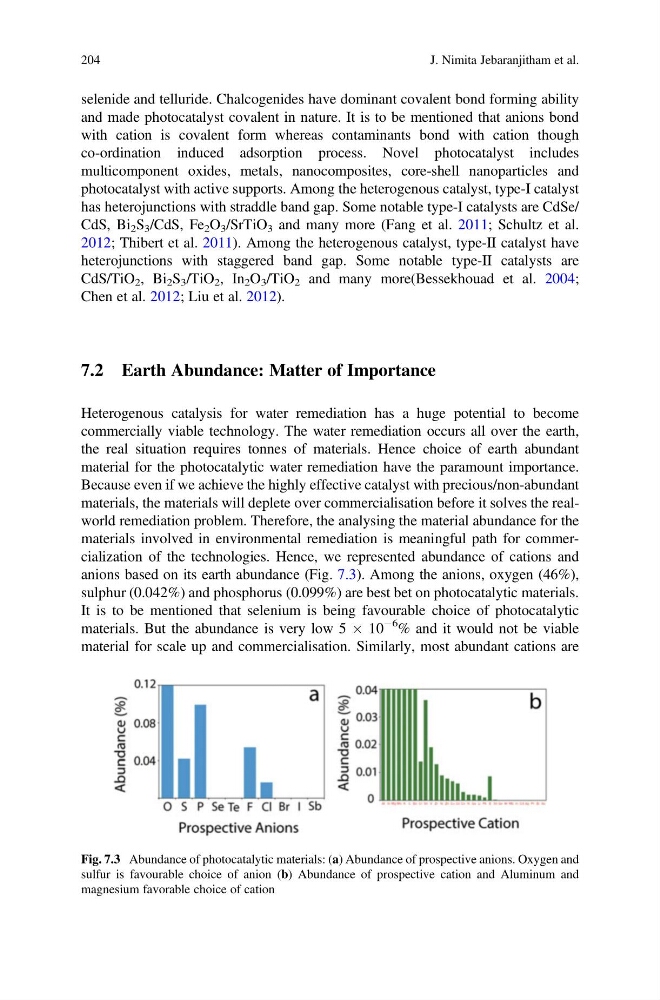
materials involved in environmental remediation is meaningful path for commercialization of the technologies. Hence, we represented abundance of cations and
anions based on its earth abundance (Fig. 7.3). Among the anions, oxygen (46%),
sulphur (0.042%) and phosphorus (0.099%) are best bet on photocatalytic materials.
It is to be mentioned that selenium is being favourable choice of photocatalytic
materials. But the abundance is very low 5 Â 10
À6 % and it would not be viable
material for scale up and commercialisation. Similarly, most abundant cations are
Fig. 7.3 Abundance of photocatalytic materials: (a) Abundance of prospective anions. Oxygen and
sulfur is favourable choice of anion (b) Abundance of prospective cation and Aluminum and
magnesium favorable choice of cation
204
J. Nimita Jebaranjitham et al.
and made photocatalyst covalent in nature. It is to be mentioned that anions bond
with cation is covalent form whereas contaminants bond with cation though
co-ordination induced adsorption process. Novel photocatalyst includes
multicomponent oxides, metals, nanocomposites, core-shell nanoparticles and
photocatalyst with active supports. Among the heterogenous catalyst, type-I catalyst
has heterojunctions with straddle band gap. Some notable type-I catalysts are CdSe/
CdS, Bi 2 S 3 /CdS, Fe 2 O 3 /SrTiO 3 and many more (Fang et al. 2011; Schultz et al.
2012; Thibert et al. 2011). Among the heterogenous catalyst, type-II catalyst have
heterojunctions with staggered band gap. Some notable type-II catalysts are
CdS/TiO 2 , Bi 2 S 3 /TiO 2 , In 2 O 3 /TiO 2 and many more(Bessekhouad et al. 2004;
Chen et al. 2012; Liu et al. 2012).
7.2 Earth Abundance: Matter of Importance
Heterogenous catalysis for water remediation has a huge potential to become
commercially viable technology. The water remediation occurs all over the earth,
the real situation requires tonnes of materials. Hence choice of earth abundant
material for the photocatalytic water remediation have the paramount importance.
Because even if we achieve the highly effective catalyst with precious/non-abundant
materials, the materials will deplete over commercialisation before it solves the realworld remediation problem. Therefore, the analysing the material abundance for the
materials involved in environmental remediation is meaningful path for commercialization of the technologies. Hence, we represented abundance of cations and
anions based on its earth abundance (Fig. 7.3). Among the anions, oxygen (46%),
sulphur (0.042%) and phosphorus (0.099%) are best bet on photocatalytic materials.
It is to be mentioned that selenium is being favourable choice of photocatalytic
materials. But the abundance is very low 5 Â 10
À6 % and it would not be viable
material for scale up and commercialisation. Similarly, most abundant cations are
Fig. 7.3 Abundance of photocatalytic materials: (a) Abundance of prospective anions. Oxygen and
sulfur is favourable choice of anion (b) Abundance of prospective cation and Aluminum and
magnesium favorable choice of cation
204
J. Nimita Jebaranjitham et al.