

2018) Zhang et al. have come up with serially connected four MFCs for powering
the cathode reaction. This prototype is found to show better activity, yet the removal
of excess H 2 O 2 becomes difficult. (Zhang et al. 2015) The usage of noble metal
platinum as a cathode material has the drawback of tearing nafion membrane easily.
One of the reasons is that platinum gets break off from the electrode surface and gets
deposited over the nafion membrane where it acts as a Fenton like reagent to produce
•OH radicals. Since •OH is highly reactive it will affect the side groups in nafion
membrane and cause defective sites. (Yu et al. 2011) Another interesting work was
carried out by Wang et al. in which the graphene-poly(vinyl alcohol) on indium tin
oxide coated glass substrate in BEF-MFC system was used as cathode and
decolourised reactive black 5 dye by 60.25%. Moreover, at open circuit potential
(0.42 V), the optimal power density obtained using this method is 74.1 mW/m
2 .
(Wang and Wang 2017).
5.7 Conclusions and Perspectives
In conclusions, integrated oxidation and adsorption based systems are proven to be
highly effective in the removal of priority organic and inorganic pollutants and for
the production of sustainable energy. Combination of adsorption or oxidation
process with sonochemical, electrochemical and photochemical methods demonstrates the improvement in the production of •OH radical production in oxidation
processes and adsorption efficiency. Further, the combination of microbial fuel cell
with oxidation processes especially electro-Fenton reaction is an economically
feasible system since the reactants of Fenton process like Fe
2+ and H 2 O 2 can be
produced within the reaction system with the simultaneous generation of electric
power as output.
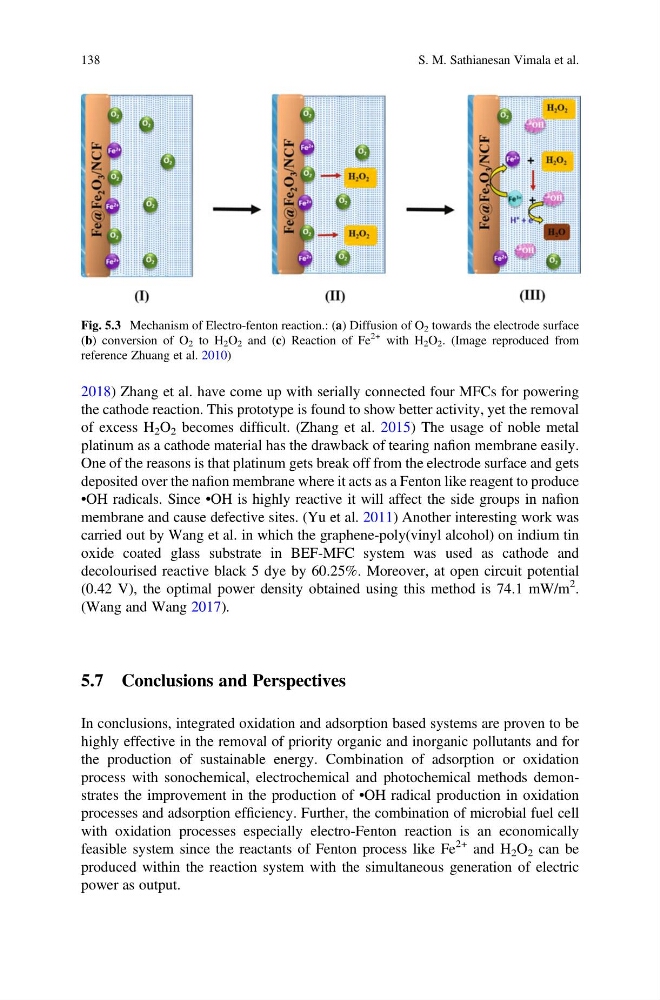
Fig. 5.3 Mechanism of Electro-fenton reaction.: (a) Diffusion of O 2 towards the electrode surface
(b) conversion of O 2 to H 2 O 2 and (c) Reaction of Fe
2+ with H 2 O 2 . (Image reproduced from
reference Zhuang et al. 2010)
138
S. M. Sathianesan Vimala et al.
the cathode reaction. This prototype is found to show better activity, yet the removal
of excess H 2 O 2 becomes difficult. (Zhang et al. 2015) The usage of noble metal
platinum as a cathode material has the drawback of tearing nafion membrane easily.
One of the reasons is that platinum gets break off from the electrode surface and gets
deposited over the nafion membrane where it acts as a Fenton like reagent to produce
•OH radicals. Since •OH is highly reactive it will affect the side groups in nafion
membrane and cause defective sites. (Yu et al. 2011) Another interesting work was
carried out by Wang et al. in which the graphene-poly(vinyl alcohol) on indium tin
oxide coated glass substrate in BEF-MFC system was used as cathode and
decolourised reactive black 5 dye by 60.25%. Moreover, at open circuit potential
(0.42 V), the optimal power density obtained using this method is 74.1 mW/m
2 .
(Wang and Wang 2017).
5.7 Conclusions and Perspectives
In conclusions, integrated oxidation and adsorption based systems are proven to be
highly effective in the removal of priority organic and inorganic pollutants and for
the production of sustainable energy. Combination of adsorption or oxidation
process with sonochemical, electrochemical and photochemical methods demonstrates the improvement in the production of •OH radical production in oxidation
processes and adsorption efficiency. Further, the combination of microbial fuel cell
with oxidation processes especially electro-Fenton reaction is an economically
feasible system since the reactants of Fenton process like Fe
2+ and H 2 O 2 can be
produced within the reaction system with the simultaneous generation of electric
power as output.
Fig. 5.3 Mechanism of Electro-fenton reaction.: (a) Diffusion of O 2 towards the electrode surface
(b) conversion of O 2 to H 2 O 2 and (c) Reaction of Fe
2+ with H 2 O 2 . (Image reproduced from
reference Zhuang et al. 2010)
138
S. M. Sathianesan Vimala et al.