

et al. 2009). The components of anodic and cathodic compartments in MFC-electroFenton cell are described below:
5.6.1.1 Anode Compartment
The anode compartment consists of an anode which is usually made up of graphite as
base material on which either enzymes or biofilms are formed for the conversion of
organic residues to CO 2 and water (Santiago et al. 2016). Degradable organic
effluents like wastewater or added molecules like glucose, lactate and acetate form
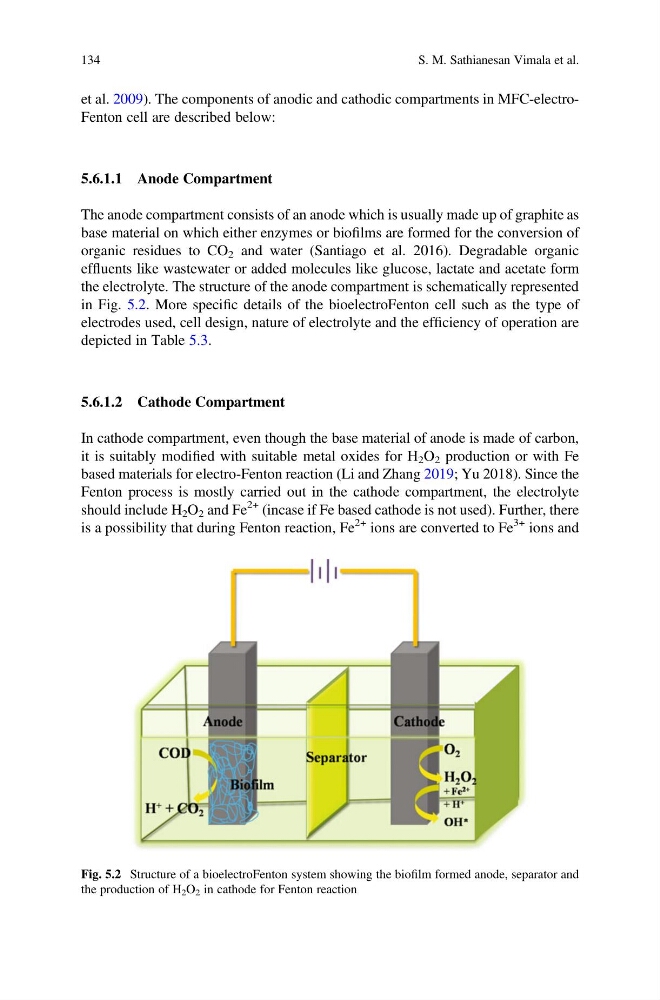
the electrolyte. The structure of the anode compartment is schematically represented
in Fig. 5.2. More specific details of the bioelectroFenton cell such as the type of
electrodes used, cell design, nature of electrolyte and the efficiency of operation are
depicted in Table 5.3.
5.6.1.2 Cathode Compartment
In cathode compartment, even though the base material of anode is made of carbon,
it is suitably modified with suitable metal oxides for H 2 O 2 production or with Fe
based materials for electro-Fenton reaction (Li and Zhang 2019; Yu 2018). Since the
Fenton process is mostly carried out in the cathode compartment, the electrolyte
should include H 2 O 2 and Fe
2+ (incase if Fe based cathode is not used). Further, there
is a possibility that during Fenton reaction, Fe
2+ ions are converted to Fe
3+ ions and
Fig. 5.2 Structure of a bioelectroFenton system showing the biofilm formed anode, separator and
the production of H 2 O 2 in cathode for Fenton reaction
134
S. M. Sathianesan Vimala et al.
5.6.1.1 Anode Compartment
The anode compartment consists of an anode which is usually made up of graphite as
base material on which either enzymes or biofilms are formed for the conversion of
organic residues to CO 2 and water (Santiago et al. 2016). Degradable organic
effluents like wastewater or added molecules like glucose, lactate and acetate form
the electrolyte. The structure of the anode compartment is schematically represented
in Fig. 5.2. More specific details of the bioelectroFenton cell such as the type of
electrodes used, cell design, nature of electrolyte and the efficiency of operation are
depicted in Table 5.3.
5.6.1.2 Cathode Compartment
In cathode compartment, even though the base material of anode is made of carbon,
it is suitably modified with suitable metal oxides for H 2 O 2 production or with Fe
based materials for electro-Fenton reaction (Li and Zhang 2019; Yu 2018). Since the
Fenton process is mostly carried out in the cathode compartment, the electrolyte
should include H 2 O 2 and Fe
2+ (incase if Fe based cathode is not used). Further, there
is a possibility that during Fenton reaction, Fe
2+ ions are converted to Fe
3+ ions and
Fig. 5.2 Structure of a bioelectroFenton system showing the biofilm formed anode, separator and
the production of H 2 O 2 in cathode for Fenton reaction
134
S. M. Sathianesan Vimala et al.