

5.4.1.4 Electrochemical Oxidation
Electrochemical oxidation is a technique based on the transfer of electrons, which
makes it particularly interesting from the environmental point of view since it is a
clean and effective way to produce hydroxyl radicals in situ (•OH) that can destroy a
large variety of organic pollutants. These OH radicals can be produced electrochemically on the cathode side either directly or indirectly through the Fenton reagent
(Electro-Fenton process) in acidic medium. In the cathode compartment, apart from
the Fenton process, there is another possible reaction that is the production of H 2 O 2
through oxygen reduction reaction which is also strongly influenced by pH change.
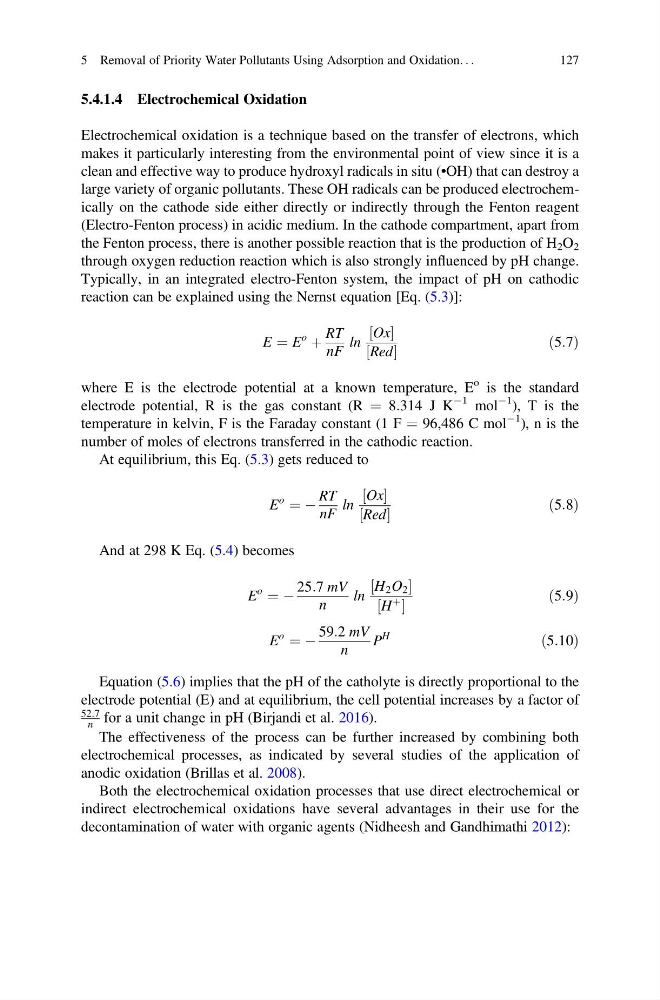
Typically, in an integrated electro-Fenton system, the impact of pH on cathodic
reaction can be explained using the Nernst equation [Eq. (5.3)]:
E ¼ E
o
þ
RT
nF
ln
Ox
½
Red
½
ð5:7Þ
where E is the electrode potential at a known temperature, E
o is the standard
electrode potential, R is the gas constant (R ¼ 8.314 J K
À1 mol
À1 ), T is the
temperature in kelvin, F is the Faraday constant (1 F ¼ 96,486 C mol
À1 ), n is the
number of moles of electrons transferred in the cathodic reaction.
At equilibrium, this Eq. (5.3) gets reduced to
E
o
¼ À
RT
nF
ln
Ox
½
Red
½
ð5:8Þ
And at 298 K Eq. (5.4) becomes
E
o
¼ À
25:7 mV
n
ln
H 2 O 2
½
H
þ
½
ð5:9Þ
E
o
¼ À
59:2 mV
n
P
H
ð5:10Þ
Equation (5.6) implies that the pH of the catholyte is directly proportional to the
electrode potential (E) and at equilibrium, the cell potential increases by a factor of
52:7
n for a unit change in pH (Birjandi et al. 2016).
The effectiveness of the process can be further increased by combining both
electrochemical processes, as indicated by several studies of the application of
anodic oxidation (Brillas et al. 2008).
Both the electrochemical oxidation processes that use direct electrochemical or
indirect electrochemical oxidations have several advantages in their use for the
decontamination of water with organic agents (Nidheesh and Gandhimathi 2012):
5 Removal of Priority Water Pollutants Using Adsorption and Oxidation. . .
127
Electrochemical oxidation is a technique based on the transfer of electrons, which
makes it particularly interesting from the environmental point of view since it is a
clean and effective way to produce hydroxyl radicals in situ (•OH) that can destroy a
large variety of organic pollutants. These OH radicals can be produced electrochemically on the cathode side either directly or indirectly through the Fenton reagent
(Electro-Fenton process) in acidic medium. In the cathode compartment, apart from
the Fenton process, there is another possible reaction that is the production of H 2 O 2
through oxygen reduction reaction which is also strongly influenced by pH change.
Typically, in an integrated electro-Fenton system, the impact of pH on cathodic
reaction can be explained using the Nernst equation [Eq. (5.3)]:
E ¼ E
o
þ
RT
nF
ln
Ox
½
Red
½
ð5:7Þ
where E is the electrode potential at a known temperature, E
o is the standard
electrode potential, R is the gas constant (R ¼ 8.314 J K
À1 mol
À1 ), T is the
temperature in kelvin, F is the Faraday constant (1 F ¼ 96,486 C mol
À1 ), n is the
number of moles of electrons transferred in the cathodic reaction.
At equilibrium, this Eq. (5.3) gets reduced to
E
o
¼ À
RT
nF
ln
Ox
½
Red
½
ð5:8Þ
And at 298 K Eq. (5.4) becomes
E
o
¼ À
25:7 mV
n
ln
H 2 O 2
½
H
þ
½
ð5:9Þ
E
o
¼ À
59:2 mV
n
P
H
ð5:10Þ
Equation (5.6) implies that the pH of the catholyte is directly proportional to the
electrode potential (E) and at equilibrium, the cell potential increases by a factor of
52:7
n for a unit change in pH (Birjandi et al. 2016).
The effectiveness of the process can be further increased by combining both
electrochemical processes, as indicated by several studies of the application of
anodic oxidation (Brillas et al. 2008).
Both the electrochemical oxidation processes that use direct electrochemical or
indirect electrochemical oxidations have several advantages in their use for the
decontamination of water with organic agents (Nidheesh and Gandhimathi 2012):
5 Removal of Priority Water Pollutants Using Adsorption and Oxidation. . .
127