

concentration of Fe
2+ ions the degradation process is known to be depleted. The
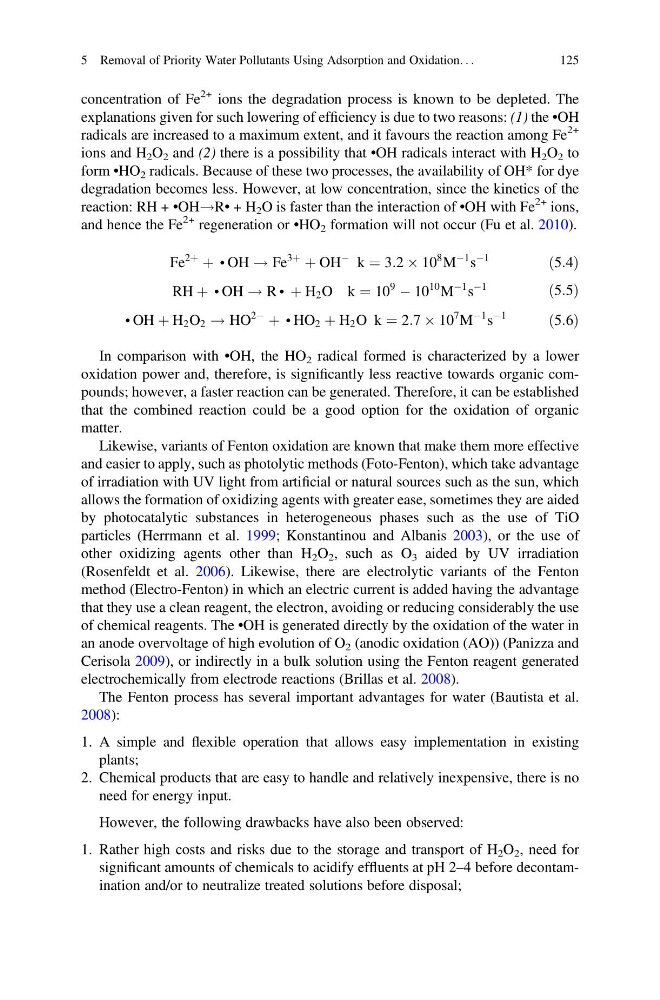
explanations given for such lowering of efficiency is due to two reasons: (1) the •OH
radicals are increased to a maximum extent, and it favours the reaction among Fe
2+
ions and H 2 O 2 and (2) there is a possibility that •OH radicals interact with H 2 O 2 to
form •HO 2 radicals. Because of these two processes, the availability of OH* for dye
degradation becomes less. However, at low concentration, since the kinetics of the
reaction: RH + •OH!R• + H 2 O is faster than the interaction of •OH with Fe
2+ ions,
and hence the Fe
2+ regeneration or •HO 2 formation will not occur (Fu et al. 2010).
Fe
2þ
þ • OH ! Fe
3þ
þ OH
À k ¼ 3:2 Â 10
8 M
À1 s
À1
ð5:4Þ
RH þ • OH ! R • þ H 2 O k ¼ 10
9
À 10
10 M
À1 s
À1
ð5:5Þ
• OH þ H 2 O 2 ! HO
2À
þ • HO 2 þ H 2 O k ¼ 2:7 Â 10
7 M
À1 s
À1
ð5:6Þ
In comparison with •OH, the HO 2 radical formed is characterized by a lower
oxidation power and, therefore, is significantly less reactive towards organic compounds; however, a faster reaction can be generated. Therefore, it can be established
that the combined reaction could be a good option for the oxidation of organic
matter.
Likewise, variants of Fenton oxidation are known that make them more effective
and easier to apply, such as photolytic methods (Foto-Fenton), which take advantage
of irradiation with UV light from artificial or natural sources such as the sun, which
allows the formation of oxidizing agents with greater ease, sometimes they are aided
by photocatalytic substances in heterogeneous phases such as the use of TiO
particles (Herrmann et al. 1999; Konstantinou and Albanis 2003), or the use of
other oxidizing agents other than H 2 O 2 , such as O 3 aided by UV irradiation
(Rosenfeldt et al. 2006). Likewise, there are electrolytic variants of the Fenton
method (Electro-Fenton) in which an electric current is added having the advantage
that they use a clean reagent, the electron, avoiding or reducing considerably the use
of chemical reagents. The •OH is generated directly by the oxidation of the water in
an anode overvoltage of high evolution of O 2 (anodic oxidation (AO)) (Panizza and
Cerisola 2009), or indirectly in a bulk solution using the Fenton reagent generated
electrochemically from electrode reactions (Brillas et al. 2008).
The Fenton process has several important advantages for water (Bautista et al.
2008):
1. A simple and flexible operation that allows easy implementation in existing
plants;
2. Chemical products that are easy to handle and relatively inexpensive, there is no
need for energy input.
However, the following drawbacks have also been observed:
1. Rather high costs and risks due to the storage and transport of H 2 O 2 , need for
significant amounts of chemicals to acidify effluents at pH 2–4 before decontamination and/or to neutralize treated solutions before disposal;
5 Removal of Priority Water Pollutants Using Adsorption and Oxidation. . .
125
2+ ions the degradation process is known to be depleted. The
explanations given for such lowering of efficiency is due to two reasons: (1) the •OH
radicals are increased to a maximum extent, and it favours the reaction among Fe
2+
ions and H 2 O 2 and (2) there is a possibility that •OH radicals interact with H 2 O 2 to
form •HO 2 radicals. Because of these two processes, the availability of OH* for dye
degradation becomes less. However, at low concentration, since the kinetics of the
reaction: RH + •OH!R• + H 2 O is faster than the interaction of •OH with Fe
2+ ions,
and hence the Fe
2+ regeneration or •HO 2 formation will not occur (Fu et al. 2010).
Fe
2þ
þ • OH ! Fe
3þ
þ OH
À k ¼ 3:2 Â 10
8 M
À1 s
À1
ð5:4Þ
RH þ • OH ! R • þ H 2 O k ¼ 10
9
À 10
10 M
À1 s
À1
ð5:5Þ
• OH þ H 2 O 2 ! HO
2À
þ • HO 2 þ H 2 O k ¼ 2:7 Â 10
7 M
À1 s
À1
ð5:6Þ
In comparison with •OH, the HO 2 radical formed is characterized by a lower
oxidation power and, therefore, is significantly less reactive towards organic compounds; however, a faster reaction can be generated. Therefore, it can be established
that the combined reaction could be a good option for the oxidation of organic
matter.
Likewise, variants of Fenton oxidation are known that make them more effective
and easier to apply, such as photolytic methods (Foto-Fenton), which take advantage
of irradiation with UV light from artificial or natural sources such as the sun, which
allows the formation of oxidizing agents with greater ease, sometimes they are aided
by photocatalytic substances in heterogeneous phases such as the use of TiO
particles (Herrmann et al. 1999; Konstantinou and Albanis 2003), or the use of
other oxidizing agents other than H 2 O 2 , such as O 3 aided by UV irradiation
(Rosenfeldt et al. 2006). Likewise, there are electrolytic variants of the Fenton
method (Electro-Fenton) in which an electric current is added having the advantage
that they use a clean reagent, the electron, avoiding or reducing considerably the use
of chemical reagents. The •OH is generated directly by the oxidation of the water in
an anode overvoltage of high evolution of O 2 (anodic oxidation (AO)) (Panizza and
Cerisola 2009), or indirectly in a bulk solution using the Fenton reagent generated
electrochemically from electrode reactions (Brillas et al. 2008).
The Fenton process has several important advantages for water (Bautista et al.
2008):
1. A simple and flexible operation that allows easy implementation in existing
plants;
2. Chemical products that are easy to handle and relatively inexpensive, there is no
need for energy input.
However, the following drawbacks have also been observed:
1. Rather high costs and risks due to the storage and transport of H 2 O 2 , need for
significant amounts of chemicals to acidify effluents at pH 2–4 before decontamination and/or to neutralize treated solutions before disposal;
5 Removal of Priority Water Pollutants Using Adsorption and Oxidation. . .
125