

rGO hybrid. Heavy metals like Pb(II) and Cd(II) are successfully degraded by MoS 2 /
thiol-functionalized multiwalled carbon nanotube (SH-MWCNT) nanocomposite.
Isotherm studies showed that the degradation followed Freundlich adsorption isotherm models and kinetic studies represented that adsorption process followed
pseudo-second-order. The degradation attained was 90 mg/g and 66.6 mg/g for Pb
(II) and Cd(II) respectively (Gusain et al. 2019). This high efficiency is due to
ion-exchange and electrostatic interactions. Additionally, it was noted that Metalsulfur complex formation was identified as the key contributor for adsorption of
heavy-metal ions followed by electrostatic interactions for multilayer adsorption.
4.8 Constraints of Photocatalysis
Photocatalysis has to overcome many drawbacks before commercialisation.
Photocatalyst recycling from reaction media is one prominent factor. Retention of
costly photocatalyst and its repeatability consists of two steps. First step involves
separation and collection of photocatalysis and other step is to maintain degradation
efficiency during repeated usage. The later part is dependent on catalyst and usage of
methodology for avoiding the aggregation of catalytic element so as to maintain
photocatalytic efficiency. Magnetic separation method is proven to possess numerous advantages in comparison to conventional process of filtration and centrifugal
separation (Shokouhimehr 2015; Polshettiwar et al. 2011). Due to nanosize of
photocatalyst, the conventional methods are not advantageous. Additionally, dissolution of homogenous photocatalyst in the reaction media makes a major hindrance
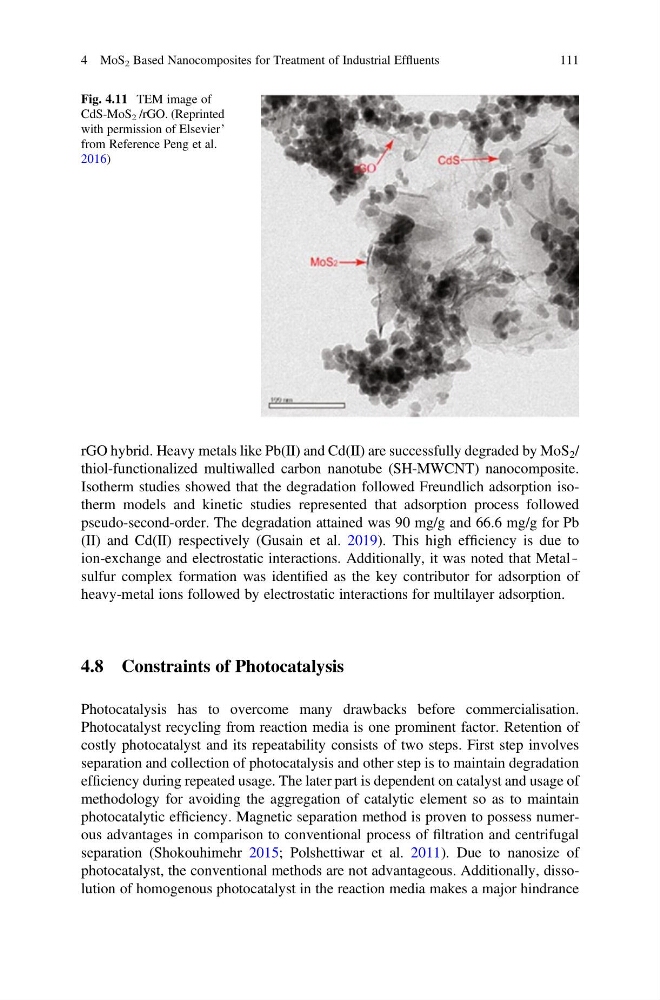
Fig. 4.11 TEM image of
CdS-MoS 2 /rGO. (Reprinted
with permission of Elsevier’
from Reference Peng et al.
2016)
4 MoS 2 Based Nanocomposites for Treatment of Industrial Effluents
111
thiol-functionalized multiwalled carbon nanotube (SH-MWCNT) nanocomposite.
Isotherm studies showed that the degradation followed Freundlich adsorption isotherm models and kinetic studies represented that adsorption process followed
pseudo-second-order. The degradation attained was 90 mg/g and 66.6 mg/g for Pb
(II) and Cd(II) respectively (Gusain et al. 2019). This high efficiency is due to
ion-exchange and electrostatic interactions. Additionally, it was noted that Metalsulfur complex formation was identified as the key contributor for adsorption of
heavy-metal ions followed by electrostatic interactions for multilayer adsorption.
4.8 Constraints of Photocatalysis
Photocatalysis has to overcome many drawbacks before commercialisation.
Photocatalyst recycling from reaction media is one prominent factor. Retention of
costly photocatalyst and its repeatability consists of two steps. First step involves
separation and collection of photocatalysis and other step is to maintain degradation
efficiency during repeated usage. The later part is dependent on catalyst and usage of
methodology for avoiding the aggregation of catalytic element so as to maintain
photocatalytic efficiency. Magnetic separation method is proven to possess numerous advantages in comparison to conventional process of filtration and centrifugal
separation (Shokouhimehr 2015; Polshettiwar et al. 2011). Due to nanosize of
photocatalyst, the conventional methods are not advantageous. Additionally, dissolution of homogenous photocatalyst in the reaction media makes a major hindrance
Fig. 4.11 TEM image of
CdS-MoS 2 /rGO. (Reprinted
with permission of Elsevier’
from Reference Peng et al.
2016)
4 MoS 2 Based Nanocomposites for Treatment of Industrial Effluents
111