

Keywords MoS 2 · Nanocomposites · Industrial dyes · Photocatalysis ·
Degradation · Wastewater treatment
4.1 Introduction
Increase of consumption capacity and population of world has escalated energy
demands and amount of toxics and pollutants released into the environment. Textile
industry expels out more than 10,000 different types of dyes and chemicals accounting to 700,000 tonnes globally. Water is used in every segment of its utilisation and
cleaning which is later disposed as wastewater. Various methodologies are adhered
to treat the outlet from various industries into general water and air medium. Dyes
and chemicals in wastewater from textile industry, tanning industry and paint
industry should be treated before expelling it into open source. This wastewater is
treated by methods like adsorption (ONG et al. 2008), biodegradation (Casas et al.
2007) and photocatalytic oxidation (Hu et al. 2014). Various method used for
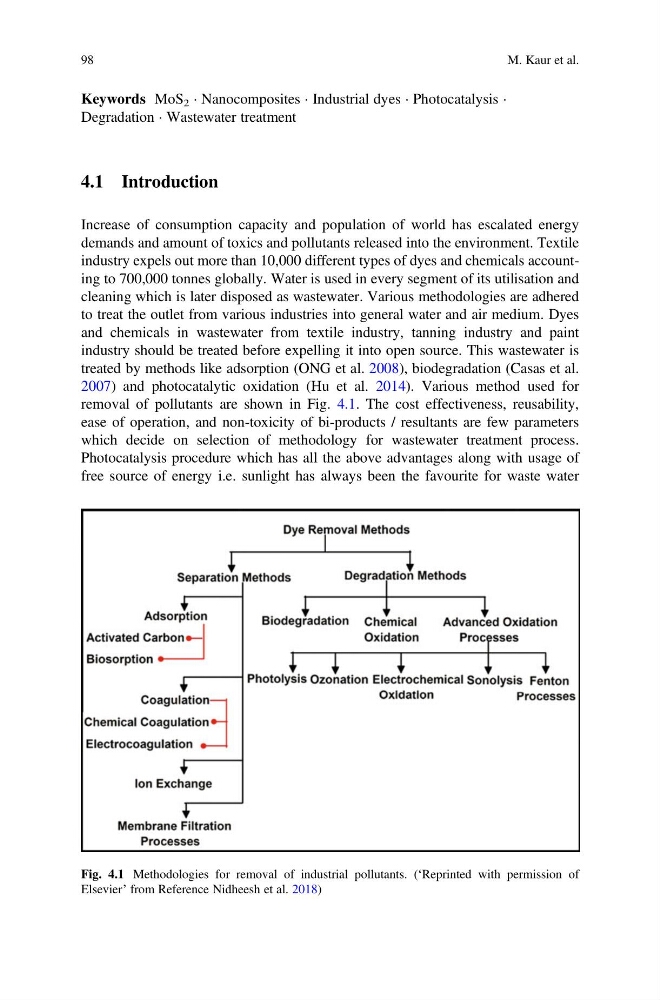
removal of pollutants are shown in Fig. 4.1. The cost effectiveness, reusability,
ease of operation, and non-toxicity of bi-products / resultants are few parameters
which decide on selection of methodology for wastewater treatment process.
Photocatalysis procedure which has all the above advantages along with usage of
free source of energy i.e. sunlight has always been the favourite for waste water
Fig. 4.1 Methodologies for removal of industrial pollutants. (‘Reprinted with permission of
Elsevier’ from Reference Nidheesh et al. 2018)
98
M. Kaur et al.
Degradation · Wastewater treatment
4.1 Introduction
Increase of consumption capacity and population of world has escalated energy
demands and amount of toxics and pollutants released into the environment. Textile
industry expels out more than 10,000 different types of dyes and chemicals accounting to 700,000 tonnes globally. Water is used in every segment of its utilisation and
cleaning which is later disposed as wastewater. Various methodologies are adhered
to treat the outlet from various industries into general water and air medium. Dyes
and chemicals in wastewater from textile industry, tanning industry and paint
industry should be treated before expelling it into open source. This wastewater is
treated by methods like adsorption (ONG et al. 2008), biodegradation (Casas et al.
2007) and photocatalytic oxidation (Hu et al. 2014). Various method used for
removal of pollutants are shown in Fig. 4.1. The cost effectiveness, reusability,
ease of operation, and non-toxicity of bi-products / resultants are few parameters
which decide on selection of methodology for wastewater treatment process.
Photocatalysis procedure which has all the above advantages along with usage of
free source of energy i.e. sunlight has always been the favourite for waste water
Fig. 4.1 Methodologies for removal of industrial pollutants. (‘Reprinted with permission of
Elsevier’ from Reference Nidheesh et al. 2018)
98
M. Kaur et al.