

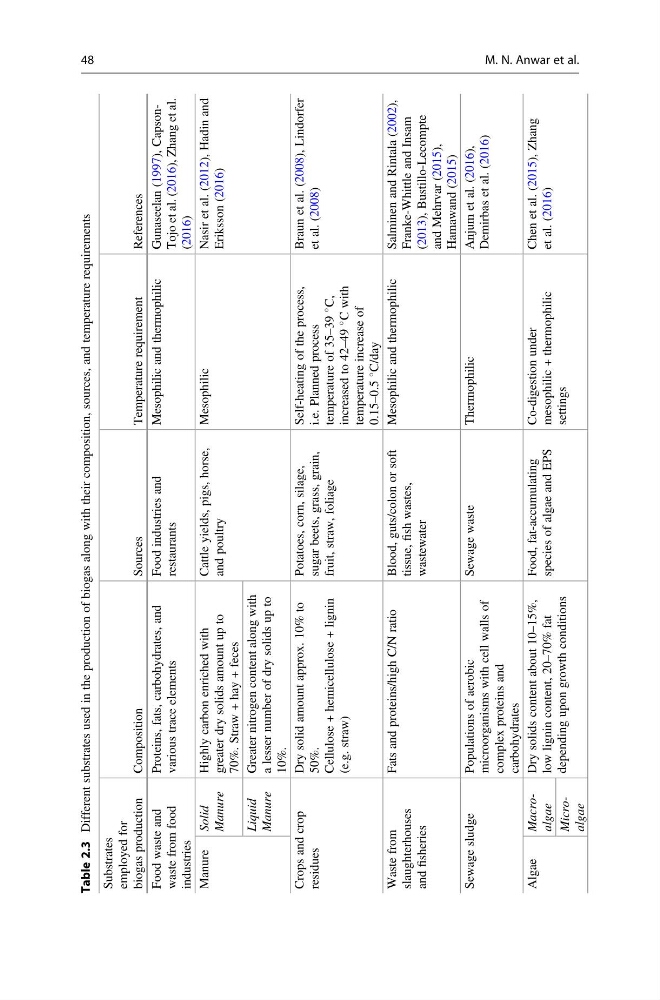
Table 2.3
Different substrates used in the production of biogas along with their composition, sources, and temperature requirements
Substrates
employed for
biogas production
Composition
Sources
Temperature requirement
References
Food waste and
waste from food
industries
Proteins, fats, carbohydrates, and
various trace elements
Food industries and
restaurants
Mesophilic and thermophilic
Gunaseelan (1997), CapsonTojo et al. (2016), Zhang et al.
(2016)
Manure Solid
Manure
Highly carbon enriched with
greater dry solids amount up to
70%. Straw + hay + feces
Cattle yields, pigs, horse,
and poultry
Mesophilic
Nasir et al. (2012), Hadin and
Eriksson (2016)
Liquid
Manure
Greater nitrogen content along with
a lesser number of dry solids up to
10%.
Crops and crop
residues
Dry solid amount approx. 10% to
50%.
Cellulose + hemicellulose + lignin
(e.g. straw)
Potatoes, corn, silage,
sugar beets, grass, grain,
fruit, straw, foliage
Self-heating of the process,
i.e. Planned process
temperature of 35–39
C,
increased to 42–49
C with
temperature increase of
0.15–0.5
C/day
Braun et al. (2008), Lindorfer
et al. (2008)
Waste from
slaughterhouses
and
fisheries
Fats and proteins/high C/N ratio
Blood, guts/colon or soft
tissue,
fish wastes,
wastewater
Mesophilic and thermophilic
Salminen and Rintala (2002),
Franke-Whittle and Insam
(2013), Bustillo-Lecompte
and Mehrvar (2015),
Hamawand (2015)
Sewage sludge
Populations of aerobic
microorganisms with cell walls of
complex proteins and
carbohydrates
Sewage waste
Thermophilic
Anjum et al. (2016),
Demirbas et al. (2016)
Algae
Macroalgae
Dry solids content about 10–15%,
low lignin content, 20–70% fat
depending upon growth conditions
Food, fat-accumulating
species of algae and EPS
Co-digestion under
mesophilic + thermophilic
settings
Chen et al. (2015), Zhang
et al. (2016)
Microalgae
48
M. N. Anwar et al.
Different substrates used in the production of biogas along with their composition, sources, and temperature requirements
Substrates
employed for
biogas production
Composition
Sources
Temperature requirement
References
Food waste and
waste from food
industries
Proteins, fats, carbohydrates, and
various trace elements
Food industries and
restaurants
Mesophilic and thermophilic
Gunaseelan (1997), CapsonTojo et al. (2016), Zhang et al.
(2016)
Manure Solid
Manure
Highly carbon enriched with
greater dry solids amount up to
70%. Straw + hay + feces
Cattle yields, pigs, horse,
and poultry
Mesophilic
Nasir et al. (2012), Hadin and
Eriksson (2016)
Liquid
Manure
Greater nitrogen content along with
a lesser number of dry solids up to
10%.
Crops and crop
residues
Dry solid amount approx. 10% to
50%.
Cellulose + hemicellulose + lignin
(e.g. straw)
Potatoes, corn, silage,
sugar beets, grass, grain,
fruit, straw, foliage
Self-heating of the process,
i.e. Planned process
temperature of 35–39
C,
increased to 42–49
C with
temperature increase of
0.15–0.5
C/day
Braun et al. (2008), Lindorfer
et al. (2008)
Waste from
slaughterhouses
and
fisheries
Fats and proteins/high C/N ratio
Blood, guts/colon or soft
tissue,
fish wastes,
wastewater
Mesophilic and thermophilic
Salminen and Rintala (2002),
Franke-Whittle and Insam
(2013), Bustillo-Lecompte
and Mehrvar (2015),
Hamawand (2015)
Sewage sludge
Populations of aerobic
microorganisms with cell walls of
complex proteins and
carbohydrates
Sewage waste
Thermophilic
Anjum et al. (2016),
Demirbas et al. (2016)
Algae
Macroalgae
Dry solids content about 10–15%,
low lignin content, 20–70% fat
depending upon growth conditions
Food, fat-accumulating
species of algae and EPS
Co-digestion under
mesophilic + thermophilic
settings
Chen et al. (2015), Zhang
et al. (2016)
Microalgae
48
M. N. Anwar et al.