

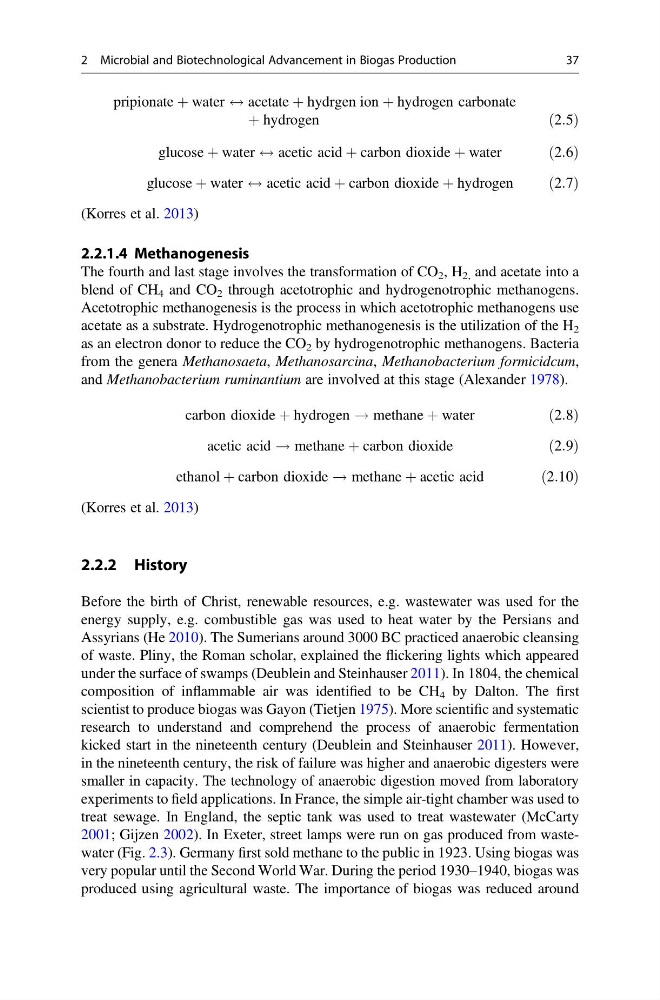
pripionate þ water $ acetate þ hydrgen ion þ hydrogen carbonate
þ hydrogen
ð2:5Þ
glucose þ water $ acetic acid þ carbon dioxide þ water
ð2:6Þ
glucose þ water $ acetic acid þ carbon dioxide þ hydrogen
ð2:7Þ
(Korres et al. 2013)
2.2.1.4 Methanogenesis
The fourth and last stage involves the transformation of CO 2 , H 2, and acetate into a
blend of CH 4 and CO 2 through acetotrophic and hydrogenotrophic methanogens.
Acetotrophic methanogenesis is the process in which acetotrophic methanogens use
acetate as a substrate. Hydrogenotrophic methanogenesis is the utilization of the H 2
as an electron donor to reduce the CO 2 by hydrogenotrophic methanogens. Bacteria
from the genera Methanosaeta, Methanosarcina, Methanobacterium formicidcum,
and Methanobacterium ruminantium are involved at this stage (Alexander 1978).
carbon dioxide þ hydrogen ! methane þ water
ð2:8Þ
acetic acid ! methane þ carbon dioxide
ð2:9Þ
ethanol þ carbon dioxide ! methane þ acetic acid
ð2:10Þ
(Korres et al. 2013)
2.2.2 History
Before the birth of Christ, renewable resources, e.g. wastewater was used for the
energy supply, e.g. combustible gas was used to heat water by the Persians and
Assyrians (He 2010). The Sumerians around 3000 BC practiced anaerobic cleansing
of waste. Pliny, the Roman scholar, explained the flickering lights which appeared
under the surface of swamps (Deublein and Steinhauser 2011). In 1804, the chemical
composition of inflammable air was identified to be CH 4 by Dalton. The first
scientist to produce biogas was Gayon (Tietjen 1975). More scientific and systematic
research to understand and comprehend the process of anaerobic fermentation
kicked start in the nineteenth century (Deublein and Steinhauser 2011). However,
in the nineteenth century, the risk of failure was higher and anaerobic digesters were
smaller in capacity. The technology of anaerobic digestion moved from laboratory
experiments to field applications. In France, the simple air-tight chamber was used to
treat sewage. In England, the septic tank was used to treat wastewater (McCarty
2001; Gijzen 2002). In Exeter, street lamps were run on gas produced from wastewater (Fig. 2.3). Germany first sold methane to the public in 1923. Using biogas was
very popular until the Second World War. During the period 1930–1940, biogas was
produced using agricultural waste. The importance of biogas was reduced around
2 Microbial and Biotechnological Advancement in Biogas Production
37
þ hydrogen
ð2:5Þ
glucose þ water $ acetic acid þ carbon dioxide þ water
ð2:6Þ
glucose þ water $ acetic acid þ carbon dioxide þ hydrogen
ð2:7Þ
(Korres et al. 2013)
2.2.1.4 Methanogenesis
The fourth and last stage involves the transformation of CO 2 , H 2, and acetate into a
blend of CH 4 and CO 2 through acetotrophic and hydrogenotrophic methanogens.
Acetotrophic methanogenesis is the process in which acetotrophic methanogens use
acetate as a substrate. Hydrogenotrophic methanogenesis is the utilization of the H 2
as an electron donor to reduce the CO 2 by hydrogenotrophic methanogens. Bacteria
from the genera Methanosaeta, Methanosarcina, Methanobacterium formicidcum,
and Methanobacterium ruminantium are involved at this stage (Alexander 1978).
carbon dioxide þ hydrogen ! methane þ water
ð2:8Þ
acetic acid ! methane þ carbon dioxide
ð2:9Þ
ethanol þ carbon dioxide ! methane þ acetic acid
ð2:10Þ
(Korres et al. 2013)
2.2.2 History
Before the birth of Christ, renewable resources, e.g. wastewater was used for the
energy supply, e.g. combustible gas was used to heat water by the Persians and
Assyrians (He 2010). The Sumerians around 3000 BC practiced anaerobic cleansing
of waste. Pliny, the Roman scholar, explained the flickering lights which appeared
under the surface of swamps (Deublein and Steinhauser 2011). In 1804, the chemical
composition of inflammable air was identified to be CH 4 by Dalton. The first
scientist to produce biogas was Gayon (Tietjen 1975). More scientific and systematic
research to understand and comprehend the process of anaerobic fermentation
kicked start in the nineteenth century (Deublein and Steinhauser 2011). However,
in the nineteenth century, the risk of failure was higher and anaerobic digesters were
smaller in capacity. The technology of anaerobic digestion moved from laboratory
experiments to field applications. In France, the simple air-tight chamber was used to
treat sewage. In England, the septic tank was used to treat wastewater (McCarty
2001; Gijzen 2002). In Exeter, street lamps were run on gas produced from wastewater (Fig. 2.3). Germany first sold methane to the public in 1923. Using biogas was
very popular until the Second World War. During the period 1930–1940, biogas was
produced using agricultural waste. The importance of biogas was reduced around
2 Microbial and Biotechnological Advancement in Biogas Production
37