

16.3 The Sites and Phases of Biotransformation Reaction
16.3.1 Sites for Biotransformation Reactions
Liver Predominantly, liver is the major and largest site in the body which
contributes to both the pre-systemic and the systemic elimination of several xenobiotic compounds and the metabolism involved is called the hepatic metabolism. It has
the largest concentration of enzymes required for transformation of compounds.
Intestinal Mucosa Cells The cells in the mucosal lining contain specific enzymes
and microflora which convert the orally administered compounds and prepare them
for complete conversion in the liver. The intestinal tract helps in the hepatic
metabolism of the compounds as the blood from intestine flows directly into the
liver via hepatic portal vein instead of going into general circulation (Pang and Kwan
1983; Liska 1998).
The other organs for extra-hepatic metabolism are kidneys and lungs which have
only 10–30% liver’s capacity. Skin, testes, and placenta have very low capacity for
biotransformation (Vīna et al. 2013).
16.3.2 Different Phases of Biotransformation Process
Major contributions to the knowledge of metabolism and toxicology of drugs and
xenobiotics were made by professor Richard Tecwyn William who is also known as
founding father of drug metabolism. He not only studied the processes of transformation of several drugs but also classified these reactions and introduced the concept
of phase I and phase II metabolic pathways in the second edition of his book
“Detoxication mechanism: The metabolism of drugs and allied organic compounds”
(Williams 1959). He suggested that in the first phase or phase I, oxidations,
reductions, or hydrolysis or a combination of any of these three occurs, whereas in
the second phase or phase II, it uses the metabolites of phase I and conjugates them
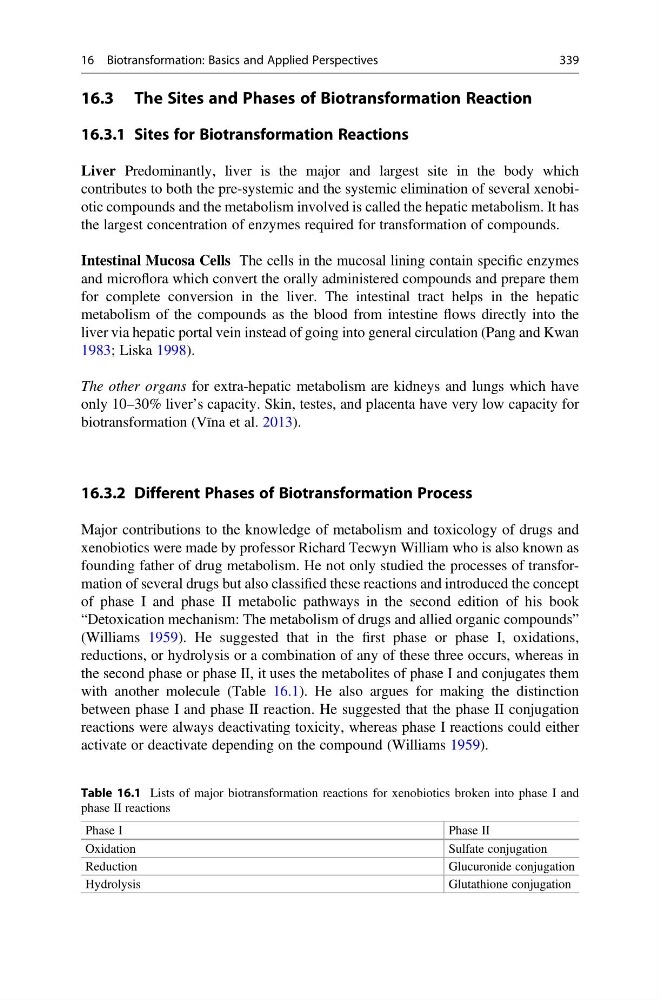
with another molecule (Table 16.1). He also argues for making the distinction
between phase I and phase II reaction. He suggested that the phase II conjugation
reactions were always deactivating toxicity, whereas phase I reactions could either
activate or deactivate depending on the compound (Williams 1959).
Table 16.1 Lists of major biotransformation reactions for xenobiotics broken into phase I and
phase II reactions
Phase I
Phase II
Oxidation
Sulfate conjugation
Reduction
Glucuronide conjugation
Hydrolysis
Glutathione conjugation
16 Biotransformation: Basics and Applied Perspectives
339
16.3.1 Sites for Biotransformation Reactions
Liver Predominantly, liver is the major and largest site in the body which
contributes to both the pre-systemic and the systemic elimination of several xenobiotic compounds and the metabolism involved is called the hepatic metabolism. It has
the largest concentration of enzymes required for transformation of compounds.
Intestinal Mucosa Cells The cells in the mucosal lining contain specific enzymes
and microflora which convert the orally administered compounds and prepare them
for complete conversion in the liver. The intestinal tract helps in the hepatic
metabolism of the compounds as the blood from intestine flows directly into the
liver via hepatic portal vein instead of going into general circulation (Pang and Kwan
1983; Liska 1998).
The other organs for extra-hepatic metabolism are kidneys and lungs which have
only 10–30% liver’s capacity. Skin, testes, and placenta have very low capacity for
biotransformation (Vīna et al. 2013).
16.3.2 Different Phases of Biotransformation Process
Major contributions to the knowledge of metabolism and toxicology of drugs and
xenobiotics were made by professor Richard Tecwyn William who is also known as
founding father of drug metabolism. He not only studied the processes of transformation of several drugs but also classified these reactions and introduced the concept
of phase I and phase II metabolic pathways in the second edition of his book
“Detoxication mechanism: The metabolism of drugs and allied organic compounds”
(Williams 1959). He suggested that in the first phase or phase I, oxidations,
reductions, or hydrolysis or a combination of any of these three occurs, whereas in
the second phase or phase II, it uses the metabolites of phase I and conjugates them
with another molecule (Table 16.1). He also argues for making the distinction
between phase I and phase II reaction. He suggested that the phase II conjugation
reactions were always deactivating toxicity, whereas phase I reactions could either
activate or deactivate depending on the compound (Williams 1959).
Table 16.1 Lists of major biotransformation reactions for xenobiotics broken into phase I and
phase II reactions
Phase I
Phase II
Oxidation
Sulfate conjugation
Reduction
Glucuronide conjugation
Hydrolysis
Glutathione conjugation
16 Biotransformation: Basics and Applied Perspectives
339